



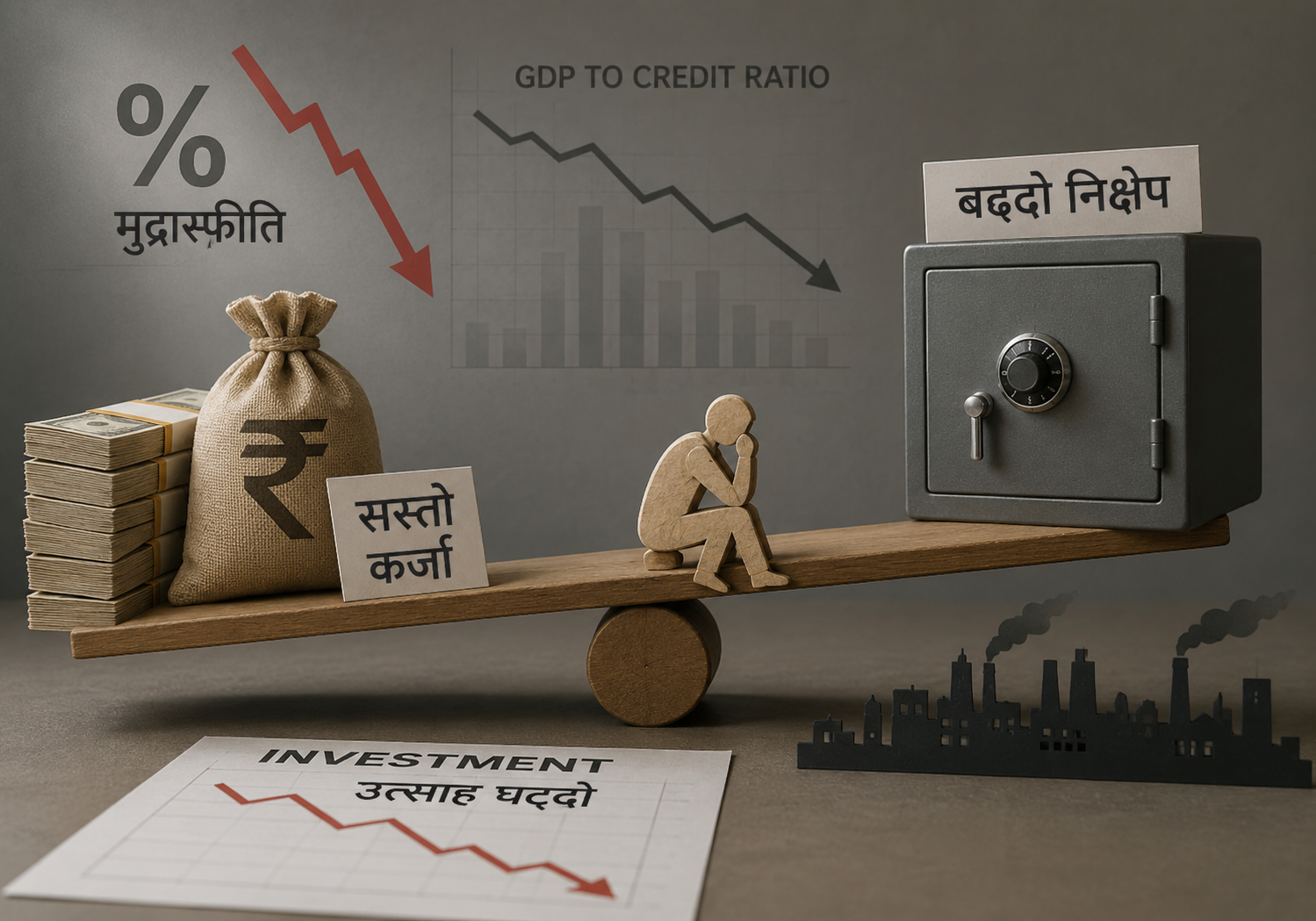
Kathmandu. In the last few years, the deposit-to-GDP ratio has been on the rise, while the GDP to credit ratio has been declining. In the last few years, the liquidity gap in the banking sector has led to high GDP to deposit ratio and low loan ratio.
Generally, the GDP-to-credit ratio shows how much credit flows to the private sector relative to the country’s GDP. Economists say that the decline in this ratio could indicate that economic activity is slowing down or the private sector is not expanding investment as expected.
According to former banker Parshuram Kunwar, the increase in this ratio is seen as an indication of expansion of economic activities, increase in private sector investment and revival of production-oriented sector. However, he said that the decrease in this ratio means that economic activities are slowing down or the private sector is not expanding investment as expected.
The total credit-to-GDP ratio, which had reached 103.17 percent in 2018, has come down to 96.46 percent in mid-April 2083. According to Banker Kunwar, the low interest rate of the loan is a positive aspect for the investors. However, the lack of demand for credit is not a good sign for the economy.

According to economists, the main reason for this is the events that have occurred in different periods. According to an economist, the problem in credit flow is due to the economic slowdown after the Corona epidemic, the unstable policies of the unstable government and some of the decisions taken by the current government after the Genji movement.
Due to the corona epidemic that started in the end of 2076 BS, prohibitory orders and other restrictions were imposed from time to time for about two years. Production, trade, tourism, industry and service sectors were affected. When economic activity was limited, a large part of the credit flow from banks and financial institutions went to the stock market and other sectors rather than to the productive sector. After the corona epidemic, the demand for loans increased significantly.
At that time, banks expanded credit rapidly. However, the production and income did not increase as expected. Now banks are providing loans at cheap interest rates. Generally, the reduction in loan interest rates is expected to increase investment. However, that is not the case now.
According to banking expert Bhuwan Dahal, the current situation in Nepal is not encouraging. According to him, the piling up of money in the banks and the lack of credit expansion is a sad situation for the developing economy.
“It is unfortunate that in a country like ours, there is no expansion of credit and accumulation of deposits. Investment is necessary in all sectors including health, education and infrastructure. However, the money has not been invested. The loan-to-GDP ratio is decreasing rather than increasing. This shows that the economic activities in the country are not taking place. “This shows that the country’s economic situation is in a worrisome state,” he said.
According to Dahal, from the outside, Nepal’s loan-to-GDP ratio is higher than that of some countries. “Our proportion is higher than that of our neighbour India. However, economic activities in Nepal have not expanded as compared to India. ” he says. According to him, the current economic indicators of the Nepal Rastra Bank clearly show that the demand for loans is weak.
Similarly, Dahal says that the high deposit-to-GDP ratio is positive for some things, but if this situation persists for a long time, it will affect the economy. According to the data of Nepal Rastra Bank, the deposit-to-GDP ratio has increased from 113.45 percent to 130.79 percent by mid-April 2083.
“High deposits mean that there is enough money for investment in the country, but the current liquidity is not enough for big projects and it has not been invested,” he says, “This indicates that the condition of the country’s industries and factories is dysfunctional.” ’

Interest rate on loans and deposits at low point
Interest rates on both loans and deposits have fallen to their lowest level in the last few years due to sufficient liquidity in the banking system. According to Nepal Rastra Bank, the average loan interest rate in the post-pandemic years 2079 and 2080 was 11.42 percent and 12.65 percent respectively. It has now come down to 6.73 per cent.
Generally, a reduction in lending interest rates is expected to increase private sector investment and expand economic activity. But now, even when interest rates are historically low, the demand for credit has not increased significantly. According to former banker Parshuram Kunwar, the private sector is not convinced to invest in new investment due to lack of investment despite the availability of cheap loans.

Similarly, the average deposit interest rate of banks has also come down to 3.35 percent. The interest rate on deposits, which was above the average of 8.08 percent in April 2020, has come down to 3.35 percent by mid-April of the current fiscal year.
Deposit interest rates, on average, have fallen below inflation. Currently, the country’s annual inflation rate is above 5 percent. However, the average interest rate of deposits is only 3.35 percent. Kunwar says that due to the low interest rate of deposits, the profit of the fund and the company that collects deposits has declined.

As of mid-April of the current fiscal year, the country’s annual inflation has reached above 5 percent. However, the average deposit rate of banks has come down to 3.35 percent. According to Dahal, a banking expert, this means that the real value of savings is decreasing as the returns received by the depositors are less than inflation.
For example, the price of an item that a consumer buys for Rs 100 will reach Rs 105 after a year due to a 5 percent increase in prices. However, if you deposit the same Rs 100 in the bank, the amount will be around Rs 103 at an interest rate of 3.35 percent. According to Dahal, a banking expert, the purchasing power of savers is decreasing as the income from deposits is not able to withstand the impact of price rise.

According to Dahal, in normal circumstances, the interest rate of deposits should be above inflation. But now the situation in Nepal is the opposite. He said that this situation has also arisen due to the lack of effective policies to attract domestic deposits along with the international war and geopolitical tensions.
According to Kunwar, the private sector had taken a huge amount of loan during the coronavirus pandemic. However, due to the lack of expected income, many borrowers had difficulty in paying the principal and interest. Therefore, after the loan expansion accelerated at that time, the Nepal Rastra Bank had made a provision to implement a counter-cyclical buffer and maintain the CD ratio within 80 percent.
According to the statistics of Nepal Rastra Bank, the average CD ratio of banks and financial institutions stood at 73.06 percent as of mid-April. According to the Nepal Rastra Bank, banks and financial institutions can invest loans up to 90 percent in CD ratio. In 2079, the CD ratio of the banks reached around 90.5 percent.

According to Kunwar, the official statistics have not been able to include all economic activities as a large part of Nepal’s Gross Domestic Product (GDP) still comes from the informal economy. He claims that only about 42 per cent of the current GDP of about Rs 67 trillion is in the formal system. He says that this aspect should also be taken into account while analyzing the credit-to-GDP ratio as there is a complete record of the loan issued by the bank.
Currently, most of the banks are operating with a CD ratio of around 50 percent. Due to the lack of loan expansion, the money in the bank is lying idle. This has also affected the profitability and return on equity (ROE) of banks. According to Kunwar, the ROE of the banks is also declining.

















प्रतिक्रिया दिनुहोस्