Amlekhgunj-Lothar Petroleum Pipeline: Land filling works in full swing
हवाई इन्धन पनि पाइपलाइनबाटै
लगानी न्यूज
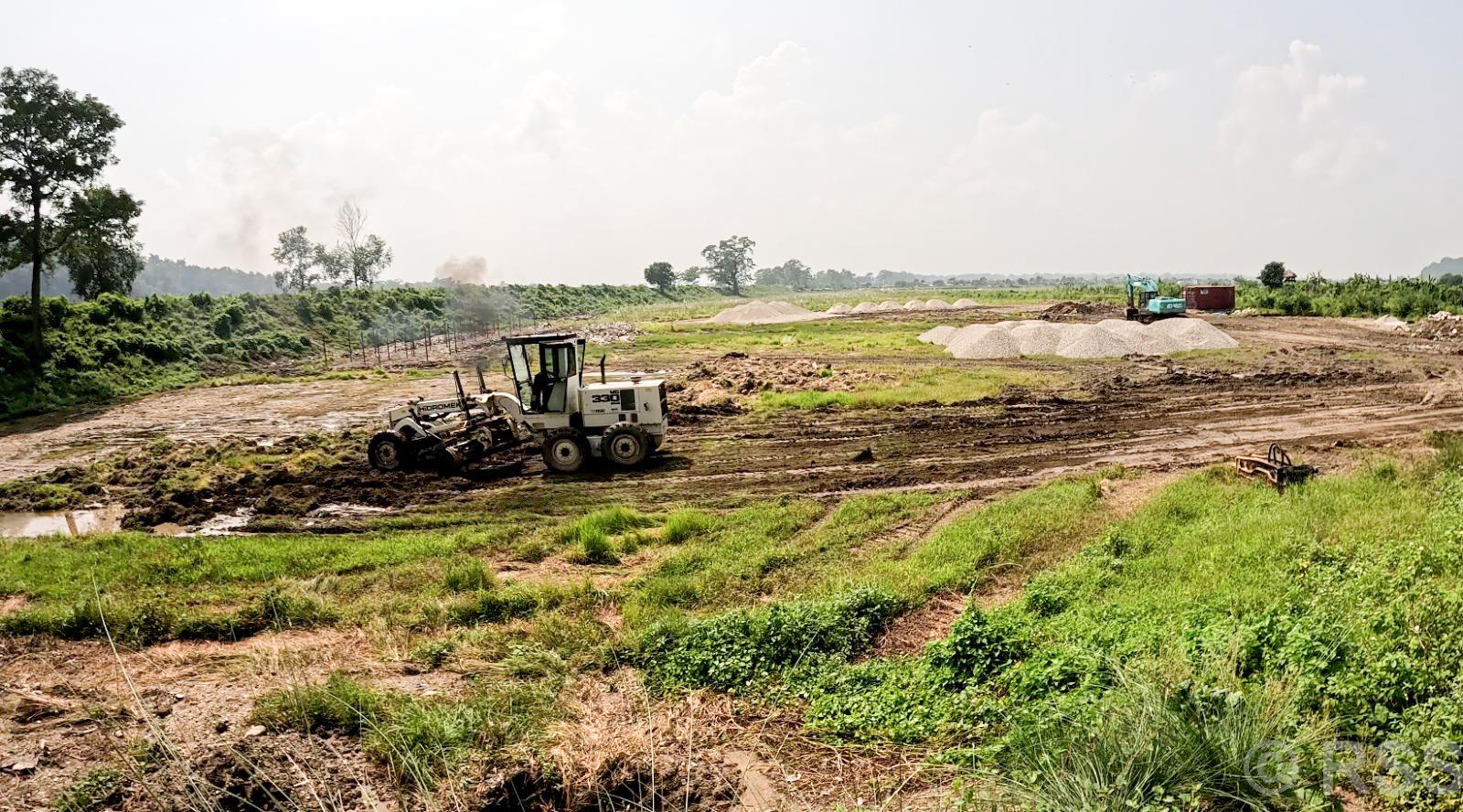
Chitwan. Under the Amlekhgunj-Lothar petroleum pipeline project, the work of ‘landfilling’ and the construction of outer wall is going on at Lothar of Rapti Municipality-1 in Chitwan.
Pradeep Kumar Yadav, director of Nepal Oil Corporation and chief of the project, said that the environmental impact assessment (EIA) of the project has also reached the final stage. Under the project, a greenfield terminal with modern facilities will be constructed on about 23 bigha and 12 kattha of land at Lothar of Rapti Municipality-1.TAG_OPEN_div_92
Arrangements will be made to pump petroleum products for the pipeline from the pump house located at the Motihari depot of the Indian Oil Corporation (IOC). A 10.75-inch pipeline will be laid from Amlekhgunj to Lothar over a distance of about 62 kilometers.
The corporation is bringing petroleum products from Motihari of India to Amlekhgunj of Bara through a pipeline. The same pipeline is going to be extended from Amlekhgunj to Lothar.
Yadav informed that the mapping of the pipeline has already been done. The pipeline will be laid parallel to the East-West Highway. The corporation has already coordinated with the Department of Roads for this. The design has been decided to lay the pipeline by bypassing Hetauda Bazaar.TAG_OPEN_div_86
“The pipeline will pass through the middle of the river before Ratomate while coming from Amlekhgunj, the pipeline will pass near the Rapti bridge after cutting through Hetauda bazaar, the pipeline will not go to Hetauda Bazaar,” he said, “Work is being done to complete the project within the stipulated time.” The project is expected to be completed and brought into operation within the next three years.
The corporation has said that the pipeline can supply oil to Lothar at a speed of 273 kiloliters per hour. A total of 3,200 kiloliters of fuel will be stored in the pipeline at any given time.TAG_OPEN_div_82
Deputy Manager of the corporation Rishiram Sharma said that the work of preparing the land, installing the outer wall and starting the construction of the project is going on at a rapid pace. Once the land is ready, the corporation will hand over the responsibility of the IOC to construct the structures including storage.TAG_OPEN_div_80
Motidan Construction has been awarded the contract for the construction of the land filling and the outer wall. Krishna Ghorasaini, a representative of the contractor company, said that the work of collecting raw materials required for filling the land and bringing it to the site is underway.TAG_OPEN_div_78
The company started the work from August. Motidan Construction has been awarded the contract for the construction of the outer wall and filling the soil at the project site for about Rs 79 crore. Although the contract period is one year, the work has been expedited so that it will be completed in eight to nine months.
The pipeline will be able to transport 20 million tonnes of fuel annually. The pipeline station will be built in Lothar on an area of 160 square meters.TAG_OPEN_div_74
Three vertical tanks with a capacity of 11,000 kilolitres each will be constructed at the site for petrol storage. Similarly, three tanks of 15,500 kiloliters capacity will be constructed for diesel storage and two tanks of 800 kiloliters capacity will be constructed for kerosene storage.TAG_OPEN_div_72
The corporation has said that three tanks of 3,600 kiloliters capacity will be constructed for this aviation fuel. The new depot at Lothar will store 91,900 kiloliters of petroleum products. Apart from this, two transmix tanks will be constructed.TAG_OPEN_div_70
Aviation fuel from pipeline
}
TAG_OPEN_div_66 After the construction of a tank for storing aviation fuel in Lothar, aviation fuel can also be brought through pipelines. The corporation is currently transporting aviation fuel from Barauni of India through tankers.
The corporation is now importing aviation fuel from about 400 kilometers away. The corporation says that after bringing aviation fuel to Lothar through the pipeline, it will save five rupees per liter for transportation. It is estimated that the cost of transportation of about two billion rupees will be saved annually after bringing aviation fuel through the pipeline.
Transporting petroleum products through the pipeline will reduce the environmental impact and eliminate the possibility of theft and adulteration of petroleum products. The cost of the construction of the storage house with the pipeline is estimated to be Rs 14.09 billion.
During the visit of then Prime Minister Pushpa Kamal Dahal ‘Prachanda’ to India in June 2080, an agreement was reached with his Indian counterpart for the construction of Amlekhgunj-Lothar petroleum pipeline and a well-equipped depot with storage house in Lothar.TAG_OPEN_div_60
In this agreement, it was mentioned that the government level petroleum companies of both countries would start the construction work by signing mutual agreement. According to this agreement, an agreement was signed between Indian Oil Corporation (IOC) and Nepal Oil Corporation on 17 October 2081.
The agreement states that the project will be operational within 54 months of the start of construction. The Indian Oil Corporation has already prepared the detailed study report (DPR) of the project.TAG_OPEN_div_56
The 69-km interstate petroleum pipeline from Motihari of India to Amlekhgunj of Bara has been in operation since 2076 BS. The project was jointly inaugurated by the then Prime Minister KP Sharma Oli and his Indian counterpart Narendra Modi on September 10, 2019.TAG_OPEN_div_54
TAG_OPEN_div_52Diesel has been imported through the pipeline since the same day. Similarly, petrol has been imported through the pipeline since October 24, 2081 and kerosene from December 1, 2081. The total length of South Asia’s first inter-country pipeline project is 69.2 kilometers. Of this, 33 kilometers is on the Indian side and 36.2 kilometers on the Nepal side.
A ‘TAG_OPEN_div_50 multi-product pipeline’ has been constructed so that petrol, diesel and kerosene can be imported. The petroleum products imported through the pipeline meet about 70 percent of the demand of Nepal. Fuel is supplied from Amlekhgunj to depots in Kathmandu, Biratnagar, Bhairahawa, Thankot, Pokhara, Birgunj and Janakpur. Petroleum products are also being sold from Amlekhgunj to local level pumps.
After the construction of this project, it is believed that the supply of petroleum products will be easier in the western and northern regions of Nepal. The corporation was established in 2027 BS for the supply, storage and distribution of petroleum products across the country.TAG_OPEN_div_48















प्रतिक्रिया दिनुहोस्