

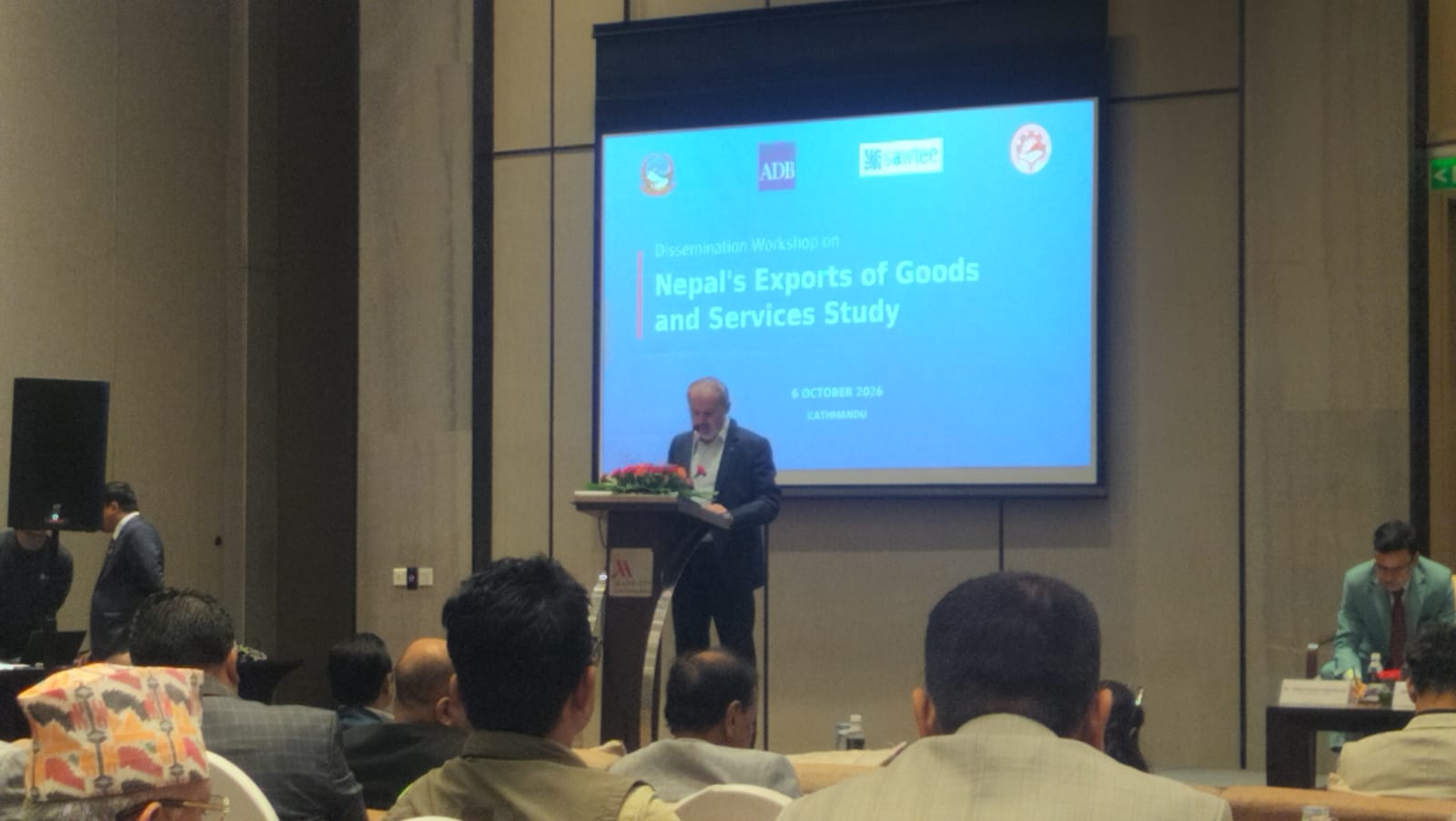
Kathmandu. Problems ranging from financial access to infrastructure, customs, skilled manpower and policy ambiguity are seen as major obstacles in the expansion of Nepal’s goods and services exports. A study by the Asian Development Bank (ADB) has pointed out the need for Nepal to take the economy from a remittance-based and private consumption-based situation to an export-oriented model by increasing production and competitiveness for export expansion.
According to the study, Nepal’s merchandise exports in the fiscal year 2024 were only 3.2 percent of the GDP. In the same year, Nepal’s merchandise exports were equal to about one-tenth of the imports. More than 70 percent of Nepal’s total goods exports go to India. The United States, the European Union, the United Kingdom, Turkey, and China are the other major markets.
The major commodities exported from Nepal include refined palm oil, soybean oil, carpet, felt, yarn and textiles. In a survey conducted by the ADB covering 50 Nepali firms, more than 83 percent of exporters cited financial access as a barrier to export expansion. Of them, 54.1 percent considered the problem of financial access as a major or serious obstacle.
According to businessmen, high interest rates, fluctuations in interest rates and asking for a large amount of collateral are the main problems for borrowing from banks and other sources. Taxes on the import of raw materials and intermediate materials used in production have also become a challenge for exports. About 47.1 percent of the firms surveyed considered the tax on imported raw materials as a major or serious obstacle.
The high cost of transportation and logistics in Nepal is another major problem of export expansion. In particular, the high cost of air transportation, the long time taken to send goods to some destinations, and the lack of proper storage facilities have been a problem for exporters, according to the study.
The lack of easy access to India’s western ports has increased the time and cost of shipping goods to some markets. The lack of quality warehouse and storage infrastructure required for perishable goods has also become a challenge.
Another problem is the lack of cheap and easy availability of land for the expansion of industries. About 64 percent of the firms cited access to cheap land as a hindrance, while about 40 percent considered it as a major or serious obstacle.
Traders say that weak trade infrastructure has increased the cost of exports. The poor condition of the roads and the lack of adequate warehouses and other infrastructure at the customs office have also added to the problem of exports.
Traders have complained that while importing raw materials, the customs levies tax on the basis of the reference value more than the actual transaction value. The study has also shown that frequent technical problems in the customs system, the closure of the system and the time taken to release the goods have also increased the cost of trade.
The inability of export-oriented industries to get the required skilled manpower has also been seen as a major challenge. In particular, the lack of skilled workers who can operate the machines and the high movement of employees have affected the production capacity.
Low labor productivity, tendency to absentee during holidays and lack of professionalism are also problems of the industry. According to the study, the exodus of skilled manpower has become an additional challenge for the export industry due to the increase in the number of Nepalis going abroad for employment.
Nepal’s exporters find it difficult to establish contact with foreign buyers in markets other than India. Traders exporting food and agricultural products are also facing problems in proving that they have met international standards and standards.
Exporters of commodities such as cement and plywood have challenged the time, expense and uncertainty it takes to get the Bureau of Indian Standards (BIS) certification required in India.
Fluctuations in the exchange rate can also increase the cost of raw materials and intermediate goods, according to the study. Despite the problems, the study has shown that a large number of Nepalese exports abroad can become an important opportunity for expansion.
According to the study, consumers of Nepali origin living abroad are ready to pay extra price for Nepali products. Nepali entrepreneurs and entrepreneurs living abroad are helping to take Nepal’s products to new markets through their market knowledge and business contacts.
Duty-free access to markets such as India, the European Union and the UK is also seen as an important opportunity for Nepal. Participation in international trade fairs, the expansion of digital technology and personal and business contacts in foreign markets can help expand exports, according to the study.
Although there is a huge potential in information technology (IT) and tourism for service exports, Nepal has not been able to fully utilize them. The study shows that the perception of weak cybersecurity in the IT sector, lack of clear provisions on data transfer, weak legal framework for data protection and weak protection of intellectual property rights make it difficult to work with large international customers.
The lack of a clear action plan for the development of the IT sector, limitations on the use of foreign currency in the purchase of software from abroad, and difficulty in opening branches or subsidiaries abroad have affected the international expansion of Nepali IT companies.
The study said that although the infrastructure is improving, including high-speed internet, it has not yet reached the level required for rapid development. The migration of skilled IT manpower abroad has also become a big challenge.
Although tourism is an important sector of Nepal’s service export, lack of an effective national strategy, confusion regarding destination development, lack of infrastructure and limited international air connectivity are the major problems.
According to the study, the distribution of tourism-related rights to the federal, provincial and local levels creates confusion and disputes at the hierarchy over destination management and fee collection.
The study concluded that it is difficult to attract tourists of other age groups as Nepal’s tourism promotion is mainly focused on mountaineering, trekking and adventure tourism. The study also found that the publicity strategy targeting Europe and America has not been effective enough for India, China and other neighboring markets.
Despite the problems, the study has shown that there is a lot of potential for tourism expansion in Nepal. The expansion of hotel infrastructure has increased the choice of accommodation for tourists of different income levels and interests.
The potential of MICE tourism has also increased as the capacity of hotels where conferences and events can be held is expanding. The study has pointed out that there is a huge potential for religious tourism due to Nepal’s rich cultural heritage and important religious sites for Hindus and Buddhists.
The ADB’s study has pointed out the need to simplify financial access, resolve problems related to interest rates and collateral, improve the tax and customs procedures on raw materials, and expand roads, transportation and storage infrastructure.
The ADB’s study has pointed out the need to simplify financial access, resolve problems related to interest rates and collateral, improve the tax and customs procedures on raw materials, and expand roads, transportation and storage infrastructure.
Similarly, policies to develop and retain skilled manpower, clear legal provisions in the IT sector, cybersecurity, data protection and strong protection of intellectual property rights are necessary.
According to the study, Nepal can tap the huge potential of exporting goods and services with a clear national strategy, development of new destinations, expansion of basic infrastructure, improvement of international air connectivity and promotion strategy as per the target market.















प्रतिक्रिया दिनुहोस्