



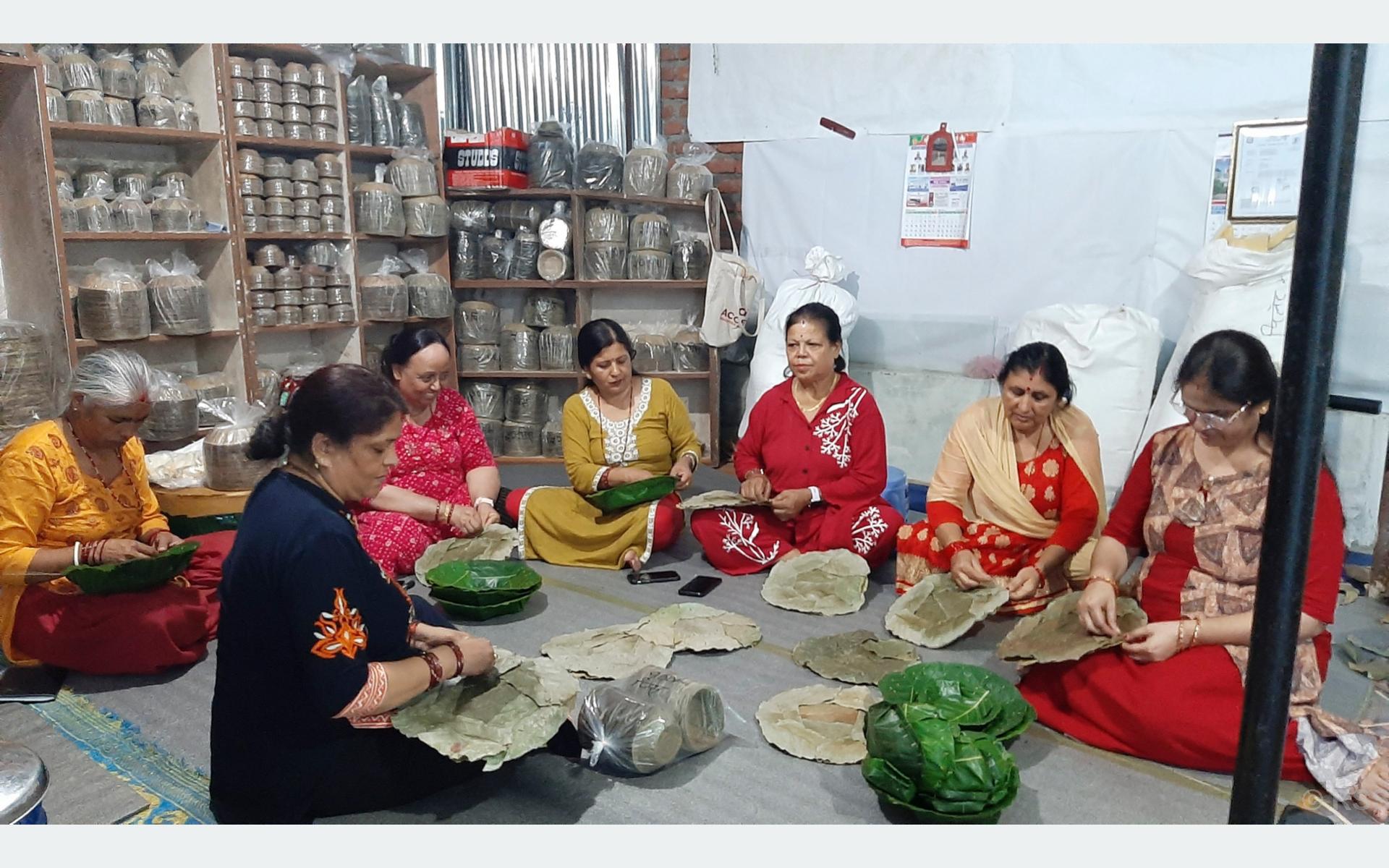
Palpa. Seven women of Tansen Municipality-2 have started Dunatpari Industries by using the leaves of the sal that are wasted in the forest. After commercializing the traditional skills, employment and income opportunities have been created for them.
Kalpana Poudel, the chairperson of the industry, said that the ‘Sisters Cottage Industry’, which was run with an investment of Rs 400,000, has been producing one thousand double the average daily. According to him, the industry earns between Rs 25,000 and Rs 30,000 per month.
Poudel said that commercial production has been started by combining the tradition of making dunatpari from sal leaves in the village with modern technology. He says that the dunatpari made by the machine is attractive and stronger than the hand-made.
“Dunatpari products have given women an opportunity to earn an income. It has also helped in replacing the plastic plates used in feasts,” she said.
Poudel said that although there are plenty of sal trees in the forests of the village, it is difficult to produce it according to the demand due to lack of manpower to collect leaves. One can earn five hundred to one thousand rupees daily by collecting leaves.
“We are also earning a good income from making profits and producing taparis. Instead of wasting time sitting at home, making and selling dunatpari has helped to manage the household expenses,” Poudel said.
After the establishment of the factory, women who used to spend time at home earlier have started getting involved in production regularly. Manju Regmi, the proprietor of the company, said that working together has not only helped in the exchange of skills but also created income opportunities.
The retail price of small duna produced by the factory is sold at Rs 2 per piece and Rs 100 in bulk at Rs 190. The four-cornered tapri is sold at seven per piece in retail and six in bulk. He said that Lafa is sold at Rs 13 in retail and Rs 11 in bulk.
The demand for the produced Dunatpari is not limited to the local market. Regmi said that the demand is also coming from outside the district. The products are sold by contacting the chaat shops and puja shops of the market.
“In the initial phase, many people have liked the produce. Sisters bring leaves from the villages. Since it is difficult to get leaves in the rainy season, we have collected them now and kept them in the warehouse,” said Regmi. After joining this enterprise, the income of women has increased. Women who earlier learned to weave tapri are now able to produce dunatpari on their own with the help of machines.
Entrepreneurs say that although the demand for Dunatpari is increasing in the market, it is difficult to produce according to the demand due to lack of raw materials and machines. Production has been affected due to lack of manpower to collect leaves in the forest areas where sal trees are abundant.
Secretary of the industry, Kalpana Pokharel Khanal, said that although one machine has been provided by the ward office, additional support is needed to increase the production as per the demand of the market. He said that it would be easier to expand the industry if the local government provides additional machines and helps in the management of raw materials.
“Earlier, I used to spend my days sitting at home, but now I have also earned income by working together with my sisters. A person earns up to Rs 5,000 a month by utilizing the leaves and free time wasted in the forest,” Khanal said.
The income from the industry has helped the women to manage their household expenses and meet their needs. Khanal suggested that the local government should also play a role in reducing the use of plastic utensils and promoting eco-friendly materials.
Dunatpari has been used in weddings, bratabandha, pujas, religious ceremonies and feasts. Dunatpari production has helped in preserving traditional skills and culture as well as creating employment and income opportunities at the local level.
















प्रतिक्रिया दिनुहोस्