



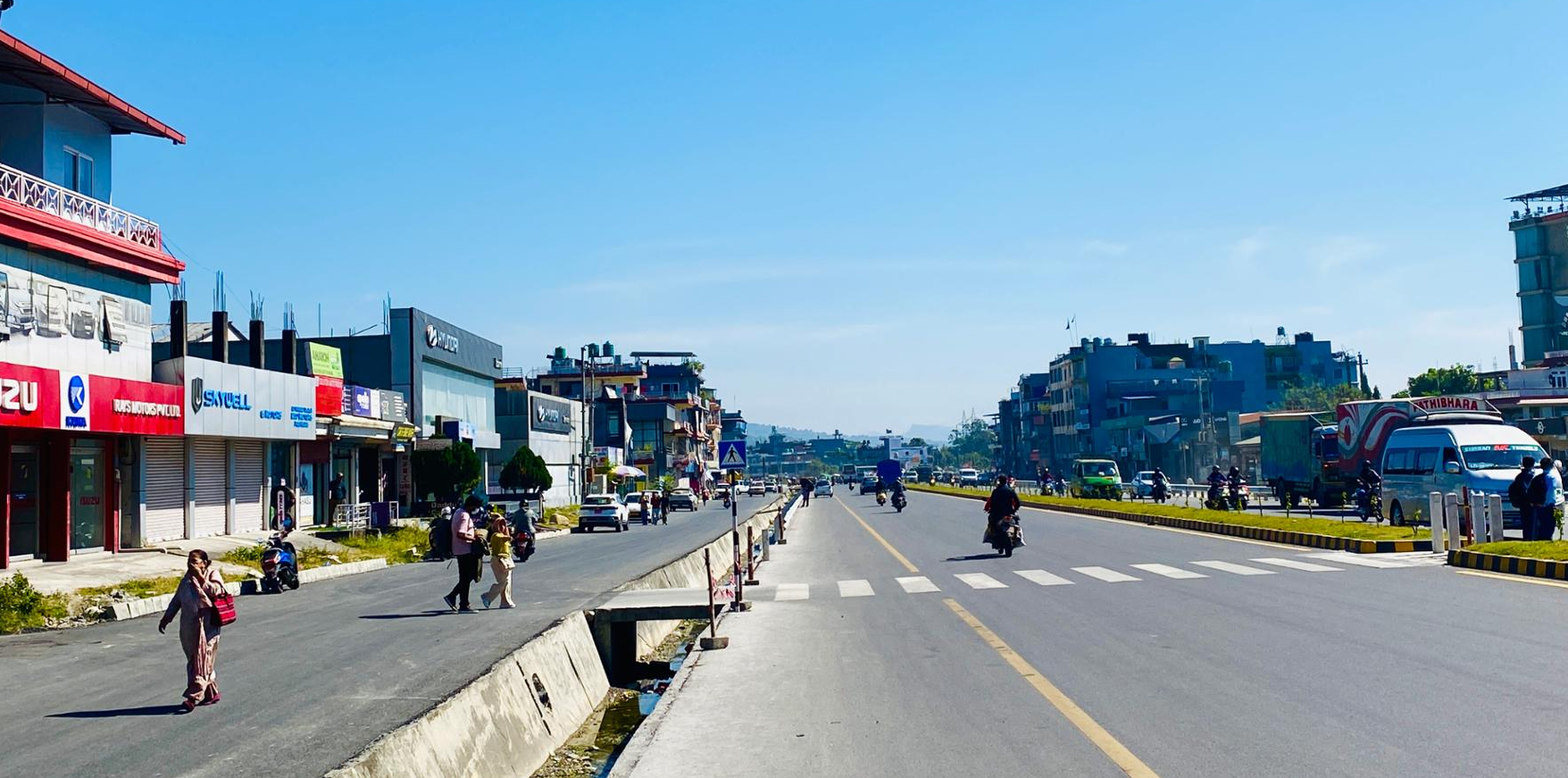
Gandaki. Wires hanging from pole to pole. Disorganized and dilapidated poles on the roadside.
On the one hand, the risk of accidents, on the other, the urban beauty is affected. Until some time ago, these were eye-catching sights on the main highway of Pokhara and the surrounding settlements. But now the situation in some places of Pokhara has changed.
The roads have been opened after the removal of the messy electric poles and wires. The beauty of the city has also returned. The compulsion to explore the mountains has been removed from the wires of the Tarang-Tundrung and Gujumujj wires. Along with the electric wires, the management of telephone, cable and internet wires has also gone along.
The main urban areas of Pokhara have been freed from the web of wires after the Nepal Electricity Authority (NEA) started laying electric wires underground four years ago. Under the Pokhara-Bharatpur Distribution System Strengthening Project, the work of laying the electric wires underground in 223 km area is underground. According to the chief engineer of the project, Anand Subedi, 165.7 km of wires have been laid. He said that electricity has already been supplied in 55.2 kilometers.
“The physical progress of the project in Pokhara has reached 82 per cent and the project is expected to be completed by mid-April,” said engineer Subedi. He said that electricity service has been provided to more than 400 houses along the Prithvi Highway from Pokhara Metropolis-14 Chauthe to Kundahar, Amarsingh Chowk, Buddha Chowk and Seti Bridge. He said that the work of laying wires on the main road connecting Seti Bridge to Prithvi Chowk, Sabha Griha Chowk, Sirjana Chowk and Lakeside via Zero Kilometer has also been completed.
He said that wires have been laid on the inner roads of Lakeside and now only electricity is left to be connected. Currently, work is underway to lay wires on some sections of the road connecting Sabha Griha Chowk to Chipledhunga via New Road, and from Srijana Chowk to Tal Barahi Temple of Lakeside via Nagdhunga. “As the Seti bridge is under construction, it has not been possible to immediately supply electricity to the wires laid towards Prithvi Chowk,” said Engineer Subedi. ”
The project is working to lay wires along the main highway as well as the auxiliary roads. Along with the electric wires, optical fibers have also been laid for telephone, cable and internet wires. “Along with electricity, the work of laying the cables of the cable and telecommunication service providers is also going on underground, all the wires of the existing overhead system have been removed,” said Engineer Subedi. In the first phase, the project has laid the wires underground targeting the main urban areas of Pokhara and the places where tourists visit more.
According to the project office, Rs 1.70 billion will be spent on the underground wire and strengthening the distribution system in Pokhara. Engineer Subedi said that the wire was laid underground by digging the road using ‘horizontal directional drilling’ technology. In January 2022, the Indian company Tata Projects got the contract to complete the work in two years, but the work of laying the wire in Pokhara started only after 15 months.
Engineer Subedi said that although the work started late due to the delay in engineering, design and equipment procurement, the physical progress of the project has been slow due to the delay in the construction company. The removal of dilapidated poles and wires along with the installation of underground electric wires has also contributed to the beauty of Pokhara, which is clean and green. Sujit Kumar Devkota, chief of the District Traffic Office, Kaski, said that the risk of accidents will also be reduced due to the management of dilapidated electric poles and wires.
According to him, people lose their lives due to accidents caused by unmanaged wires and poles. Such accidents occur due to vehicles colliding with poles and electrocution. “Removing the unmanaged wires and poles will not only reduce the risk of electrical accidents but also reduce the risk of traffic accidents,” he said, adding, “It would be very good if the electric wires could be installed underground throughout Pokhara city.” The Pokhara Distribution Center of the Nepal Electricity Authority (NEA) has said that a big budget is needed to replace old poles and wires across the Pokhara Valley.
According to the center, there is a need to replace the power line that was four decades ago and install a new one. NEA is running a plan to lay underground wires in big cities like Kathmandu, Pokhara and Bharatpur. Engineer Subedi said that the electric wires have been laid underground in 156.33 km area of Bharatpur under the Pokhara-Bharatpur Distribution System Strengthening Project. He said that 95 percent of the work has been completed in Bharatpur. He said that the total physical progress of the project in Pokhara and Bharatpur has reached 88 percent.
The underground wire is considered to be more efficient and reliable. Engineer Subedi said that although it is an expensive system, the underground system is suitable to handle the increasing demand of customers and the pressure of electricity. He said that more than five billion budget is needed to lay the electric wires under the ground throughout the Pokhara Valley. “This is an expensive project, the government cannot make a big investment at the same time, it will be expanded to other places of Pokhara as well,” he said. The NEA has implemented this project in Pokhara and Bharatpur with the concessional loan assistance of the Asian Development Bank.

















प्रतिक्रिया दिनुहोस्