Rising temperatures spark debate as climate threatens global health crisis
भोटेकोशी बाढीको पनि चर्चा
लगानी न्यूज
At a time when global warming is adding challenges to the earth’s natural balance and human existence, the United Nations Climate Change Conference (COP31) that began in Antalya, Turkey on Monday has started serious discussions and debates on the seriousness of the climate crisis and ways to deal with it.
At a time when rising temperatures, extreme weather events and climate-induced disasters are posing challenges to the ecological balance of the earth and human existence, the summit deliberated on the steps to be taken by the world community to deal with them.TAG_OPEN_div_120
On the same day (Monday) as the World Meteorological Organization (WMO) study showed that the abnormal sequence of global warming is continuing, the debate on this issue has heated up at the ongoing COP31. In the past, the COP used to discuss the issue of preventing warming, saying that the global warming is causing a climate-related crisis. The WMO warns that the risk of extreme heat and extreme weather events will increase by 2027 due to the powerful El Niño.
The WMO’s ‘State of Climate 2026’ report has found that 2026 will be one of the top four warmest years on record, El Niño will further increase temperatures and intensify climate-related risks, sea level and ocean temperatures are at an all-time high, and extreme weather events will cause significant human and economic losses.TAG_OPEN_div_116
TAG_OPEN_div_114 The report said that new records are being set in global temperature, sea level rise, and ocean temperature, and the effects of climate change will become more severe. According to the report, the last 12 years have been the hottest years on record. The four years from 2023 to 2026 have been the hottest years, according to the report.
The world’s average surface temperature from January to September 2026 was 1.47 degrees Celsius above the pre-industrial average, according to the report. Temperatures are expected to rise further by the end of the year as the impact of El Niño increases.
The WMO estimates that El Niño could reach its strongest position ever by December 2026 and its impact will last until early 2027. The report pointed out that the risk of warming will be high even in 2027 as the impact of El Niño on global temperatures will be greater in the following year than in the year of El Niño’s development.
TAG_OPEN_div_108 According to the WMO, the Earth’s energy imbalance is increasing. Due to the increasing emission of greenhouse gases, the balance between the energy that the Earth receives and sends out has been disturbed by the trapping of heat in the atmosphere. About 90 percent of the excess heat being stored on the Earth is being absorbed by the ocean. The year 2026 is expected to be the 10th year in a row that the ocean temperature will set a new record.
The sea level has reached an all-time high, and the surface temperature of the sea has also set new records in different months of 2026. The melting of glaciers is also continuing, according to the report. In 2025, the annual loss of ice from the glacier is equivalent to filling five Olympic-sized swimming pools every second.TAG_OPEN_div_106
Since 2014, the storage of fresh water has also been decreasing, according to the report. This risks creating further challenges to water availability, food security and human life. UN Secretary-General Antonio Guterres also expressed concern about rising temperatures. At the opening of the COP, he expressed concern that the effects of the powerful El Niño, which is already warming due to human-caused climate change, are adding to the effects of the powerful El Niño.
“I urge world leaders to rapidly reduce greenhouse gas emissions, make a just transition from fossil fuels to clean energy, and provide necessary financial and technical support to vulnerable countries,” he said.TAG_OPEN_div_102 ”
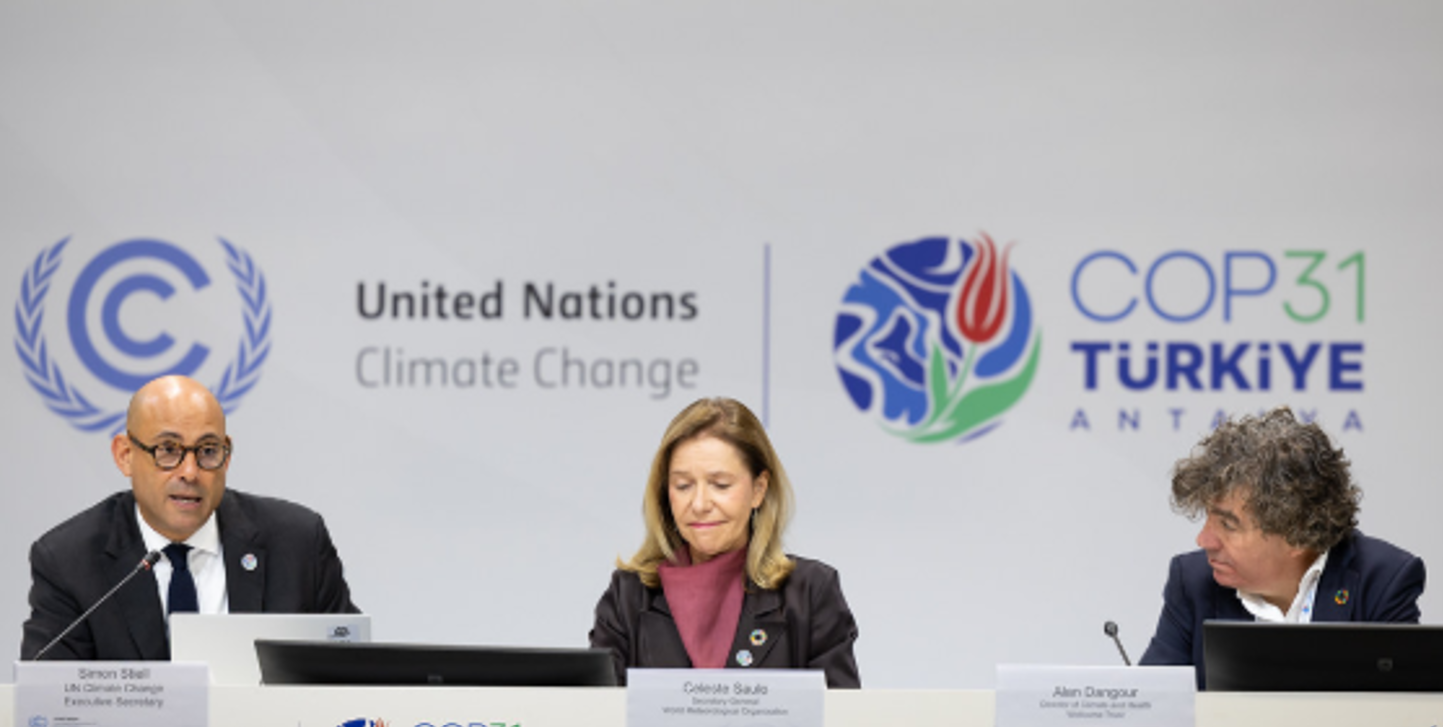
WMO Secretary-General Celeste Saulo has said that El Niño will not add new heat to the Earth, but will speed up the process of releasing heat stored in the ocean. He said that because the temperature of the ocean is at an all-time high, the amount of heat released out will also be high.TAG_OPEN_div_100
} “The combined effects of climate change and El Niño are increasing the intensity of heatwaves, tropical cyclones, and extreme rainfall,” Saulo said, “Millions of people around the world have been exposed to extreme heat this year, and snowfall and rock slides and flash floods in Nepal have exposed the multi-hazard risk faced by communities in the high mountains.” ”
The report also points out the importance of weather forecasting, early warning systems and continuous scientific observation to reduce the risk of climate-related disasters. The number of countries with multi-hazard early warning systems increased from 56 in 2015 to 136 in 2025, according to the report.
Greenhouse gas emissions are also increasing continuously. The amount of carbon dioxide in the atmosphere has increased from 278 parts per million (ppm) in 1750 to 426.8 ppm in 2025. This is an increase of about 53 percent. Similarly, the amount of methane has increased by 167 percent and the amount of nitrous oxide has increased by 26 percent, according to the report.TAG_OPEN_div_94
The report, which was released by the WMO on the first day of COP31, includes available scientific data up to September 2026. The latest impact of El Niño, however, is not included in the report. The WMO said that the final climate report for 2026 will be released in March 2027.TAG_OPEN_div_92
Scientists around the world have also expressed concern that global warming due to climate change is having a serious impact on human health. Millions of people around the world are being affected by extreme heat, air pollution, drought and climate-related disasters.
Rasuwa Bhotekoshi flood also discussed
}
Simon Steele, executive secretary of the United Nations Climate Change Agency, also cited the Rasuwa Bhotekoshi floods as an example of a climate crisis. “The catastrophic disasters in China and Nepal have shown that the events occurring in the high mountains will also put low-lying and riverine communities at serious risk,” he said.TAG_OPEN_div_86
Steele released the WMO’s 2026 climate report and said that the effects of climate change are intensifying. He said that about 900 million people living in coastal areas are at risk due to rising sea levels.TAG_OPEN_div_84
Steele said that due to climate change, weather events such as heat waves, tropical cyclones and heavy rains are becoming more intense than previously estimated. He said that in 2026, thousands of people died due to extreme heat in Europe, and dangerous heat waves were also seen in many parts of India, Pakistan, Asia and North America.
TAG_OPEN_div_80Steele said that the expansion of early warning systems for climate risk reduction should be taken as a positive achievement. He said that the number of countries with multi-hazard early warning systems increased from 56 in 2015 to 136 in 2025.
However, he said that there is a need to continue the weather data collection and observation system in all regions of the world for effective early warning. He stressed that the Climate Conference (COP31) should ensure the necessary financial resources by taking immediate decisions on climate risks.TAG_OPEN_div_78
Climate poses a global health crisis
Alan Dangor, director of climate and health at Wellcome, a UK-based health and medical research charity, said climate change was emerging as a global health crisis.TAG_OPEN_div_74
In 2025, 52 percent of the world’s land area will be affected by at least TAG_OPEN_div_72 one month of extreme drought, which will severely affect farmers, outdoor workers, and food security, he said.
Secretary at the Ministry of Agriculture, Forests and Environment, Dr Rajendra Prasad Mishra, said that Nepal should take ambitious steps to achieve the goal of limiting global temperature rise to 1.5 degrees Celsius compared to pre-industrial era.TAG_OPEN_div_70
This was the agreement on the world’s average temperature rise
}
The Paris Agreement, which was signed at the 21st COP in Paris from November 30 to December 12, 2015, aims to limit the global average temperature rise to 1.5 degrees Celsius and prevent it from rising to more than 2 degrees Celsius.TAG_OPEN_div_66
To achieve these goals, countries that are parties to the Paris Agreement will have to submit a Nationally Determined Contribution (NDC) every five years. Nepal has created an NDC to cover the period up to 2035. The third NDC includes the Sustainable Development Goals (SDGs) by 2035, mobilization of domestic and international financial resources, and climate implementation plans at the local level, along with a detailed blueprint for climate mitigation, adaptation, and financial management.TAG_OPEN_div_64
In the third NDC, Nepal aims to contribute to the management of the climate crisis by supporting global efforts to limit global temperature rise to within 1.5 degrees Celsius. Currently, the NDC implementation plan has been prepared.





















प्रतिक्रिया दिनुहोस्