



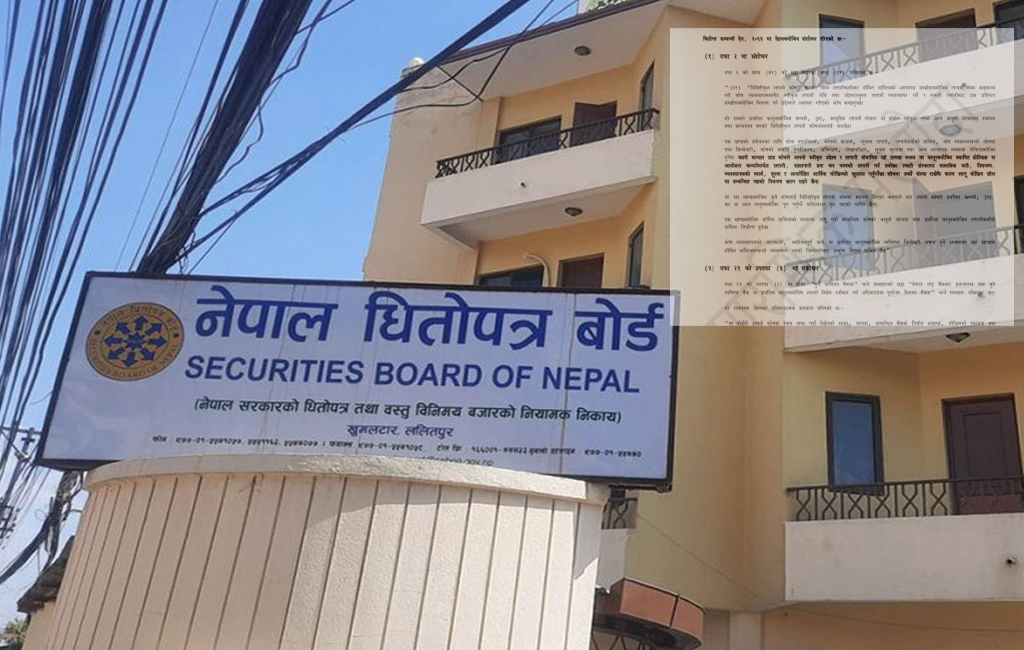
Kathmandu. The government is going to amend the Securities Act, 2063 through an ordinance. The Securities Act is going to be amended from the Ordinance, 2083 to amend some of the Nepal Acts related to investment and infrastructure.
The government is trying to address the demands of investors and stakeholders while amending the Act. The regulatory body is also trying to make some changes in the board. The draft of the ordinance prepared by the government states that about 15 sections of the Act are being amended to be amended.
The Ordinance clearly defines the Specialised Investment Fund and clarifies this. Similarly, in the draft ordinance, a provision has been made to solve the problems that have been facing the hydropower company in the Public Issue (IPO) for a long time.
Sub-sections (1A) and (b) have been added to Section 30 in the draft. It states, “(1A) Notwithstanding anything contained in sub-section (1), the application for public issue of such an institution shall not be rejected merely on the ground that the body operating a hydropower project under construction permitted under the prevailing law has completed at least 50 per cent of the certified physical progress of the project and has fulfilled other necessary conditions relating to the public issue of securities.” ”
While granting approval for public release, the Board has to disclose 8 additional issues. These include that the physical progress of the project has been certified by an independent and qualified technical evaluator, the total cost of the project, the pending work to be completed, the necessary additional investment and financial resources are assured, the progress of the project construction, possible delays, cost escalation and other major risks clearly mentioned in the prospectus, the status of power purchase agreement, generation license and other necessary regulatory approvals, a clear plan regarding the utilization of the funds received from the public release, the estimated period of completion of the project and the probable time of commercial production to be opened, the amount received from the public release should be ensured to be used for the approved purpose of the project, and other criteria set by the Board for the protection of investors.
While examining the said application, the Board has to ensure the sufficiency of the facts and hazard information mentioned in the prospectus and decide whether to grant approval in accordance with the prevailing law. In making such a decision, only the reason for the commercial production of the project cannot be made a ground for rejection.
Provided that, the Board may reject the application stating the reasons if the financial feasibility of the project, construction progress, necessary approvals, guarantee of additional financial resources or protection of investors are not fulfilled.
It is stated that the Board shall not be deemed to have ensured the financial return, condition of completion of construction or security of investment of the concerned project merely because the public issue has been approved.
Similarly, sub-section (1C) has been added to Section 30. “If an organization submits an application with necessary details and documents for approval for the issuance of right shares to the existing shareholders, the Board shall decide whether to grant approval or not within 30 working days from the date of completion of the application,” the draft reads, “If additional details or documents are required in the application, the Board shall ask for such details or documents within 7 working days from the date of receipt of the application.” In case of further details or documents, the period for making the decision shall be calculated from the date of receipt of such details or documents. If the Board is unable to grant approval, it shall inform the concerned institution in writing or electronically, clearly stating the factual and legal reasons for the same.
The time limit referred to in this sub-section shall not be deemed to have waived the conditions relating to capital, financial statements, approval of shareholders, justification of issue and investor protection to be fulfilled in accordance with the prevailing law. The approval for the issuance of right shares shall not be deemed to have been automatically obtained merely because the decision has not been taken within the stipulated period under this sub-section,” the draft reads.
Earlier, Sebon had been obstructing the issuance of right shares on various pretexts, including the instructions of the audit committee. That hurdle is now going to be reduced.

Similarly, sub-section (3A) has been added to Section 3 in the draft. “(3A) While appointing or nominating a chairman or member to the Board pursuant to sub-section (2), the concerned person shall have to assess the educational qualifications, professional experience, regulatory knowledge, impartiality, integrity, conflict of interest and impact on regulatory independence. The draft states, “A member representing a regulated body or a professional sector shall not be entitled to participate in regulatory decisions directly related to the institution he represents or the institution he represents. Such a member shall disclose his or her interest pursuant to Section 18 in respect of the direct or indirect interest of himself or the institution he represents.”
Similarly, the government is going to amend the sub-section (5) of Section 7 through the ordinance. Instead of sub-section (5) of Section 7 of the Ordinance, the committee referred to in sub-section (3) shall publish a public notice for the appointment of the Chairman and select the qualified candidates on the basis of open competition. The committee shall recommend the names of at least 3 candidates to the Government of Nepal after evaluating the candidate’s educational qualifications, professional experience, knowledge of the stock market and regulatory knowledge, leadership ability, impartiality, integrity, conflict of interest and the proposed plan of action.
The basis of evaluation, weightage, and procedure to be used in the selection process shall be determined before publishing the public notice. The committee shall maintain a record of the evaluation of the candidate and the reasons for the recommendation,” the draft reads, adding, “The selection process under this sub-section shall be transparent, competitive and fair. However, in case the number of eligible candidates is less than three as per the prevailing law, the committee may make a recommendation from among the available qualified candidates clearly stating the reasons for the same. The recommendation under this sub-section shall clearly state the qualifications of the candidate and the basis of evaluation. ”
Similarly, sub-section (7) of Section 7 has been amended. “The Inquiry Committee constituted for the purpose of removing the Chairman from office under this sub-section shall be impartial and independent. The Inquiry Committee shall not consist of a person having a direct or indirect interest in the allegations or matters concerned.
The committee will have to evaluate the available evidence and the explanation submitted by the concerned chairman and submit a report to the government with factual and legal basis. When the government decides to remove the chairman from office, the factual and legal basis of such a decision should be clearly stated.
The concerned chairman shall not be allowed to take a decision to remove him from office without giving him a proper opportunity to present the details of the allegations, the evidence and the basis of the allegations. This provision shall not be deemed to have altered the basis or authority of his discharge under the prevailing law,” the draft reads.
Similarly, Section 19 has also been amended. Clause (f) of Section 11 states, “A person who has a financial or business interest, directly or indirectly, in a stock exchange, securities business or an institution regulated by the Board, which prevents him from acting independently and fairly as a chairman or member, but as an ordinary investor, shall not be deemed to be disqualified under this section merely by virtue of his investment in securities which are publicly transacted.”
In the event of a conflict of interest arising out of such an investment, the interest has to be disclosed and managed in accordance with Section 18. In determining disqualification under this section, the nature, impact and actual risk to the fair performance of the interest concerned shall have to be taken into consideration,” it said.
Similarly, sub-section (3) has been added to Section 12. “While taking a decision to remove the Chairman or a member from office under this Section, the factual and legal grounds of the removal of office shall be clearly stated. Before taking such a decision, the concerned person shall be informed of the allegations and the evidence based thereon, the appropriate opportunity to present the evidence shall be evaluated and the evidence presented by the person concerned shall be evaluated and decided with reasons. The procedure under this sub-section shall not affect the right to judicial remedies available under the prevailing law.”
2-TAG_OPEN_a_89 hour discussion between SEBON and Regulatory Commission to manage hydropower sector, emphasis on policy uniformity – Lagani News
Similarly, Section 18 contains some new things. The Chairman, Members and officials involved in regulatory decisions of the Board shall disclose the details of their or their family members’ direct or indirect financial and business interests related to the stock exchange, securities business or institution regulated by the Board, as prescribed. The concerned Chairman, Member or office bearer shall not be allowed to participate in the decision, recommendation, evaluation, discussion or other regulatory process in matters of interest.
The details that are detached from the decision-making process shall be mentioned in the record of the meeting or decision concerned. If any question arises as to whether there is a conflict of interest of the Chairman or a member on any matter, the Board shall take a decision on the matter without the participation of the concerned person.
The Board shall enforce a Code of Conduct for Identification of Conflicts of Interest, Disclosure, Control Records and Monitoring. The Chairman, Members and officials involved in regulatory decisions shall update such details when they are appointed to the post, in each financial year and when there is a significant change in the Statement of Interest.
The personal details and business privacy received will be protected in accordance with the prevailing law. In case of violation of liability, action will be taken as per the prevailing law.
In managing a conflict of interest, the concerned person may be excluded from the decision-making process, necessary details may be made public or other appropriate managerial measures may be adopted. Provided that, in the event of a disqualification arising out of a conflict of interest in accordance with the prevailing law, such disqualification shall not be deemed to have been terminated merely on account of the use of managerial measures. The Board may prescribe the necessary procedures for the recording and management of conflicts of interest.
Similarly, the government has added sub-section (3) to Section 19 in the draft. In which the Board can make necessary arrangements related to technical and professional manpower, organization structure, capacity development of employees, performance evaluation and human resource management to make its regulatory performance effective within the limits of the approved budget and available resources.
Qualification, open competition, transparency and institutional requirements shall be taken into account while managing the manpower under this sub-section. The Board may give priority to the development of specialized technical capacity relating to the regulation of the securities market, risk analysis, information technology, cyber security, market monitoring, research and regulatory enforcement. The provisions under this sub-section shall not be deemed to exempt the obligation to comply with the provisions relating to the organizational structure, creation of positions, terms of service or other approvals required by the prevailing law.”
Similarly, sub-section (5A) of Section 22 states that “the Board shall prepare and approve a plan of annual budget and resources necessary for the performance of its statutory functions in accordance with this Act and the prevailing laws.” Similarly, the funds of the Board shall be used on a priority basis for regulatory performance, investor protection, market monitoring, research, enforcement, information technology development, cyber security and institutional capacity building.
Similarly, the government has added sub-section (3) to Section 26 through an ordinance. After sub-section (2) of Section 26, it is mentioned that 10 new subjects should be included in the annual report, among other things.
These include the status of the stock market and major trends, performance of securities issuance, registration and approval, market monitoring, inspection and regulatory enforcement, investor protection and grievance management, disclosure and management of conflicts of interest, financial condition of the board, budget implementation and auditing, corporate governance, human resources and technical capacity development, major achievements of regulatory performance, challenges and priorities for improvement, risk management of stock market and market stability and other issues deemed necessary by the Board.
The report must be made publicly available, except for information and personal details that are required to be kept confidential under the prevailing law, and the Board may include key statistics and achievements in the report that can be evaluated for regulatory performance.
The government has added a new clause related to foreign investment in the Specialised Investment Fund through an ordinance. Section 30A has been added after Section 30A of the Act. It has a special provision regarding foreign investment in the Specialised Investment Fund.
According to the Foreign Investment and Technology Transfer Act, 2075, a lump sum foreign investment can be approved at the fund level while bringing foreign investment in a specialized investment fund registered or licensed as per the prevailing law.
Subject to such approval, the Fund may solicit and receive investment amount from the foreign investor as per the agreement.
There are 8 things to be considered while approving and receiving foreign investment. These include the legal status and regulatory approval of the fund and fund manager, the identity of the foreign investor and the details of the actual beneficiaries, the legal provisions related to foreign ownership and control, the legal source of investment, the nature of the business of the industry or company receiving the investment from the fund, the legal provisions regarding the areas where foreign investment is prohibited or restricted, the procedure for the receipt and documentation of foreign currency and other regulatory conditions as required by the prevailing law.
The Fund will not be allowed to invest in foreign investment prohibited areas only because of the approval of foreign investment at the level of the Fund under the said Section or without obtaining other approvals required in accordance with the prevailing law. The Board may, in coordination with the foreign investment approving body and the Nepal Rastra Bank, make provisions relating to the acquisition, documentation, exchange of information and regulatory reports pursuant to this Section.
The concerned fund or fund manager shall record the details of the amount of foreign investment approved at the fund level, investment commitment, actual acquisition, utilization of investment and remaining investment commitments as prescribed.
The concerned fund, fund manager or investor shall not be deemed to have been exempted from the prevailing tax, foreign exchange, prevention of money laundering or any other obligation under the law merely by virtue of receiving foreign investment.
Foreign investment approval, receipt of amount, documentation and other necessary provisions shall be as prescribed subject to the prevailing laws.
It is stated that the approval and legal status of the Specialized Investment Fund which was operating with approval in accordance with the prevailing law prior to the promulgation of this Ordinance shall not be deemed invalid merely because of this Ordinance.
It is stated that the procedural provisions under this Ordinance can be applied to the applications related to public issue, right share issue and Specialized Investment Fund which are under consideration before the Board at the time of the promulgation of this Ordinance.
The appointment of the Chairman and members of the Board appointed by law prior to the commencement of this Ordinance shall not be deemed to be invalid merely by virtue of this Ordinance. Provided that, after the commencement of this Ordinance, the provisions relating to the disclosure and management of conflicts of interest shall come into force.
The securities issue, investment fund and other regulatory decisions approved by law prior to the commencement of this Ordinance shall not be deemed to have been null and void merely by reason of this Ordinance. The rules, guidelines, procedures and standards required under the Ordinance may be determined subject to the prevailing laws. The draft states that while implementing the provisions relating to foreign investment in the Specialised Investment Fund under the Ordinance, the approval and recording process under the Foreign Investment and Transfer Laws and Foreign Exchange Laws should be followed.
“The provisions as per the ordinance shall not be deemed to have adversely affected the rights of the investors, the liabilities of the fund and other statutory responsibilities created in accordance with the prevailing law,” the draft reads.















प्रतिक्रिया दिनुहोस्