



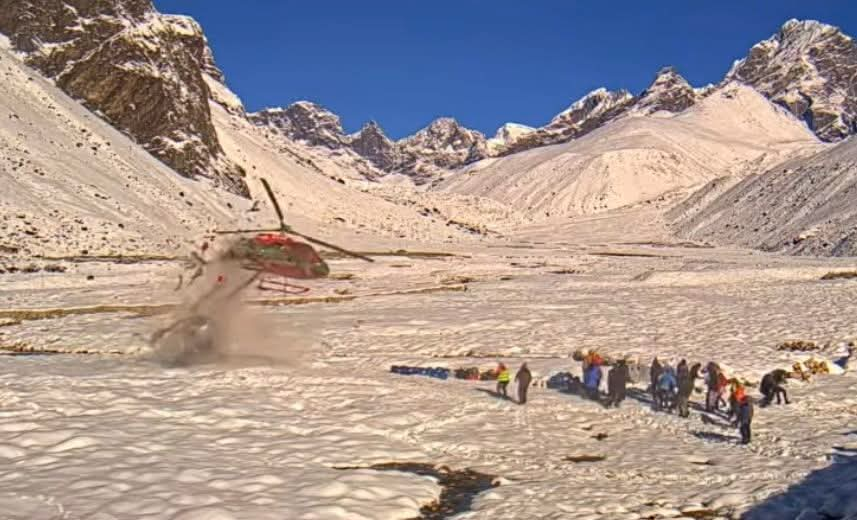
Solukhumbu. Famous worldwide for its mountains, glaciers, and trekking, including the world’s highest peak Mount Everest, Solukhumbu’s skies have become a busy area for helicopter flights over the past decade.
A large number of helicopters operate daily for rescue, tourist transport, mountain viewing, mountaineering, and various commercial purposes. However, increased air traffic alongside tourist activities has also increased security risks.
Looking at helicopter accidents in various areas of Solukhumbu over the past decade, experts are concerned that this risk is not unusual. There have been incidents ranging from human loss of life, driver death, passenger injuries, and helicopters being completely wrecked. In some cases, technical problems, in others adverse weather, conditions at landing sites, and human and managerial weaknesses have been observed.
The last time, on Kartik 17, two helicopters collided at the Feruche helipad in Pasangalhamu Rural Municipality-4, Khumbu, resulting in the death of a foreign tourist and injuries to three others. The District Police Office in Solukhumbu reported that the Festel Air and Air Dynasty helicopters collided while landing. In that accident, an Indian citizen died, while a passenger from New Zealand and the crew of both helicopters were injured.
The incident, which occurred at around 8:12 a.m., has raised serious questions about the safety arrangements for helicopter takeoffs and landings in the Himalayan region of Solukhumbu. Since the Fereche area lies outside the direct communication reach of Lukla Airport’s air traffic control, coordination among pilots during takeoffs and landings there is extremely important. However, the actual cause of the accident will only be confirmed through official investigation, said Police Inspector Mausam Tamang, information officer at the District Police Office Solukhumbu. The increasing pressure of helicopter operations in Solukhumbu’s skies also signals the need to reconsider the balance between the effectiveness of regulation, corporate commercial competition, and passenger safety.
Five accidents in a decade
According to the records of the District Police Office in Solukhumbu, five major helicopter accidents and serious incidents in Solukhumbu from 2073 to 2083 have highlighted safety challenges. On September 9, 2073, a Mountain Air helicopter crashed in Buksa located in Juving, district. While flying with a patient, the engine shut down just seconds after leaving the ground, causing the pilot to make an emergency landing. Although the front part of the helicopter hit the ground and was damaged during landing, all six people on board were unharmed.
Similarly, on Asar 26, 2079, a Manang Air helicopter crashed at the cemetery in Lamjura. Five Mexican nationals, including Captain Chet Bahadur Gurung, were on board the 9N-AMV callsign helicopter. All six people died in the crash. Preliminary reports pointed to adverse weather as a possible cause. On 27th Ashwin 2079, a Manang Air helicopter crashed during landing in Lobuche. Only the pilot, Prakash Kumar Sedhai, was on board the 9N-ANJ callsign helicopter. After the accident, the helicopter caught fire. The seriously injured driver was rescued and taken to India via Kathmandu for further treatment, but he died during treatment.
Similarly, on October 12, 2082, an Altitude Air helicopter crashed at the Lobuche helipad. The helicopter carrying tourists from Lukla skidded and overturned while landing on the snow-covered helipad. The helicopter crew was unharmed, but the helicopter suffered significant damage. On Kartik 17, 2083, during a landing at Feruche, a helicopter belonging to Fistel Air and Air Dynasty collided mid-air. The accident resulted in the death of an Indian tourist, while another passenger and the crew of both helicopters were injured. According to tourism entrepreneur Ang Thiring Sherpa, this incident raised questions about managing the movement of more than one helicopter at the same helipad, coordinating communications, and prioritizing landings.
{{TAG_OPEN_strong_50}What caused the accident?
Helicopter flights in Nepal’s Himalayan geography are considered challenging in themselves. Tall mountains, narrow valleys, rapidly changing weather, wind pressure, snowfall, fog, and limited landing zones make flying risky, but there is no way to escape by simply citing the weather as the cause of all accidents. The government investigation report into the Lobuche accident on October 29, 2025, has revealed important facts about it.
According to the final report released on March 23, 2026, by the Aircraft Accident Investigation Agency under the Ministry of Culture, Tourism and Civil Aviation, there was no technical fault in the helicopter involved in the accident. The helicopter was airworthy and had undergone regular maintenance. The report concluded that the main cause of the accident was the helicopter’s skid becoming unbalanced during landing on a snow-covered helipad and excessive control response from the pilot when trying to adjust it.
The report also revealed weaknesses in the operational management of the Lukla company. Contributing factors to the accident included the absence of necessary responsible staff during busy weather, inorganized pre-flight risk assessments, and insufficient information about the weather and landing site to the pilot. More importantly, the report notes that there was no weather monitoring center in Lobuche. There was also no direct radio communication access to the Lukla Air Traffic Service Center.
The state’s regulatory presence in Khumbu is weak
{{TAG_OPEN_div_70}The helicopter crash incidents in Solukhumbu have also raised questions about the Civil Aviation Authority’s regulatory and monitoring system. Drivers say that during flights and landings in areas above Lukla such as Feruche, Lobuche, Gorcep, and Kalaphar, there is no effective air traffic control system everywhere. In some places, drivers are compelled to communicate with each other to coordinate takeoff and landing.













प्रतिक्रिया दिनुहोस्