

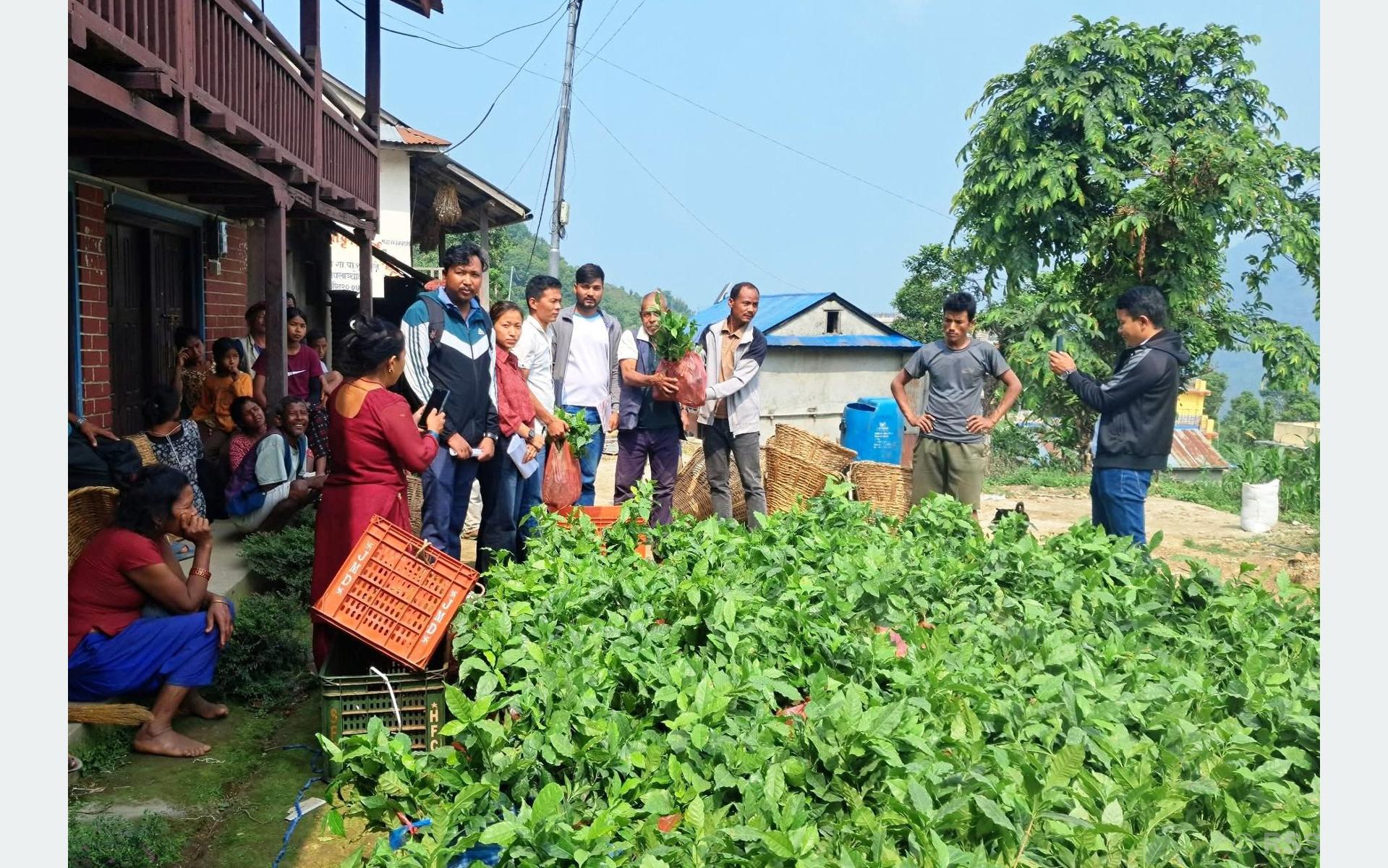
Kathmandu. Kavrepalanchowk – Two local levels located in the hilly area of Kavrepalanchowk (beyond the Mahabharat mountain range) are being developed as coffee hubs. In order to attract and encourage farmers, the programme ‘Whoever plants a coffee plant, he gets Rs 20 note’ has been continued for the past few years. Under this programme, the rural municipality provides Rs 20 to farmers digging a hollow for planting saplings and Rs 35 per kg at the selling rate.
Mahabharat and Khanikhola rural municipalities in the district have been promoting coffee farming in order to attract farmers towards coffee farming and expand coffee farming in the country. Mahabharat has launched a campaign of Rs 20 for planting a coffee sapling, while Khanikhola has launched a program called ‘Subsidy to Whoever Produces Coffee’ to attract people to coffee farming.
In the last two years, 224,000 coffee saplings have been distributed to local farmers under the ‘Whoever Plants Coffee Plant, He Gets Rs 20 Note’ campaign launched two years ago with the objective of developing Mahabharat Rural Municipality as a coffee hub.
According to Kanchha Lal Jimba, chairperson of the rural municipality, Mahabharat has declared five wards as coffee pocket zones in the initial phase. According to him, the agriculture section of the rural municipality has been providing grant amount to the farmers who have been certified by digging pits as per their slogan. The rural municipality has already distributed 224,000 coffee saplings this year and last year. Of the saplings provided by the rural municipality, 40,000 saplings were produced in Mahabharat while the remaining saplings were purchased from other parts of the district and Dolakha and Lalitpur.
Mahabharat has also imparted training to farmers on coffee processing technology under the Bagmati Province government’s ‘One Ward One Product’ programme. The training was imparted to coffee processing technology to attract farmers towards coffee farming and increase quality production and productivity in coordination with Mahabharat Small Farmers Agriculture Cooperatives Limited with the support of Bagmati Province Ministry of Agriculture and Livestock Development and District Agriculture Development Office, Dhulikhel. According to Jimba, the rural municipality is currently cultivating coffee in one thousand five hundred ropanis of land. The rural municipality has also developed a work procedure to provide production-based subsidy to coffee farmers.
The District Agriculture Development Office (DADO) has said it has provided necessary support for planting saplings, technology transfer and irrigation under the partnership programme with rural municipality and state governments to expand coffee farming. Kul Prasad Dawadi, chief of the office, said that around 20,000 to 40,000 coffee saplings have been provided annually and emphasis has been laid on quality coffee production by making the existing coffee farming technology-friendly. According to him, the office has been providing assistance to the farmers to process the coffee in the initial phase, distribute tarpaulin sheets for drying it and to solve the problems of diseases seen in the coffee.
Shankhalal Thokar of Mahabharat Rural Municipality-4, Kolatar Lamagaun earns over Rs 1.6 million annually from coffee farming. He said he started commercial coffee farming five years ago and now he is also running a coffee nursery. “This year we produced about two tons of coffee, our income is good, and I am preparing to plant new coffee saplings this year as well,” Thokar said. He has cultivated coffee on 18 ropanis of land along with his brothers’ land.
According to locals, coffee can be sold at Rs 130 per kg raw and Rs 830 per kg after being cleaned and dried. Khanikhola Rural Municipality has been providing subsidy at the rate of Rs 35 per kg to the entire rural municipality with the objective of increasing the economic standard of the farmers along with the coffee pocket area. Indra Bahadur Thing, chairperson of the rural municipality, said that the rural municipality has been distributing the grant to farmers associated with 11 organizations including farmers’ groups and agriculture cooperatives in the initial phase. In the first phase, five lakh rupees were distributed to all farmers’ groups.
According to Thing, a budget of Rs 2 million to Rs 35 lakh has been allocated annually to encourage coffee farmers. Similarly, it has been distributing 20,000 to 35,000 coffee saplings to local farmers every year. According to the rural municipality, farmers of the rural municipality have been attracted to coffee farming since last few years.
The rural municipality has been providing subsidy on coffee to the farmers who have been enjoying commercial coffee farming for the past three years after their crops like maize, millet and buckwheat were found difficult to sustain their livelihood throughout the year. The rural municipality has been providing Rs 35 subsidy for one kilogram of coffee produced by the farmers. The plan is to subsidize farmers who produce more, Thing said. Currently, around 60 to 70 tonnes of coffee is produced in the rural municipality. “The remaining amount of the allocated budget is spent on distributing more saplings to the farmers, and some of the money is also being invested in the promotion of nurseries,” Thing said. The number of farmers in the rural municipality has increased from 11 farmers’ groups to 17. Coffee is produced in all areas except Jagathali, Taaldhunga, Mahankal and Majhitar in the rural municipality.
Meanwhile, more than 1.14 lakh coffee saplings will be planted in the Mahabharat in the current fiscal year. Mahabharat has expedited the campaign of ‘Prosperity through Coffee Production, Building Mahabharata’ through this programme. Chairman Jimba said that works are being carried out with the target of planting more than 114,000 coffee saplings in this fiscal year by conducting various targeted programmes. According to him, the rural municipality is running this new program to attract and encourage farmers towards coffee farming under the ‘Whoever plants a coffee plant, he gets Rs 20 note’. The programme also aims to plant additional 30,000 saplings in various wards of the targeted groups.
According to the rural municipality, the saplings have been distributed to wards 1, 6 and 7 and the saplings will be gradually distributed to the remaining wards within a few days. Similarly, around 32,000 coffee saplings have been planted in ward no. 5 this year. Similarly, 17,000 saplings were planted in ward no 2 and 3 for commercial coffee production under the Block Development Programme. The rural municipality has said that the coffee promotion programme is currently in the implementation phase and around 35,000 more saplings will be planted this year and more than 114,000 saplings will be planted this year.
In order to make the farmers prosperous through coffee farming, the rural municipality is not only limited to planting saplings but has also been providing other technical and physical support to the farmers for the sustainable development of coffee farming. According to Jimba, the small-irrigation project has been designed to distribute modern agricultural equipment, build coffee drying houses, and establish coffee gardens with mulching and drip irrigation to increase the quality of coffee. Likewise, constructive activities like establishment of coffee nursery at local level, distribution of saplings for shade, on-site training for farmers and study visit have also been carried out simultaneously, said Jimba.
In the first week of May, 6,800 coffee saplings were distributed to 71 families of Mahabharata-6. According to the field monitoring carried out by the Agriculture and Livestock Section of the rural municipality, only six thousand eight hundred pits were dug and distributed accordingly. According to ward chair Ramesh Lungeli, around 13,000 coffee saplings were demanded in the ward. According to Lungeli, despite the attraction of farmers, they have not been able to distribute saplings as per the demand.
The commercial coffee production of Mahabharat rural municipality located in the southeastern part of Kavrepalanchok district has been modernized. According to the rural municipality, coffee is being cultivated in 1,433 ropanis of land. There are around one thousand two hundred commercial coffee farmers in the rural municipality.
Jimba said that developing coffee production as a pocket area has been prioritized in the policies and programs of each year. Jimba said that the distribution of saplings has also been taken forward as a campaign as farmers in the district have started making coffee as their main source of income by abandoning traditional crops like maize and millet. Subash Jimba of ward no. 5 said that farmers in the district have been selling coffee worth Rs 5 to Rs 1.2 million from their coffee farming. According to him, farmers have been getting attracted towards coffee farming in the last few years as coffee farming is good and the problem of marketing has been removed.
Babulal Ghalan of Ward No. 6, who has been involved in coffee farming for the past 12 years, said he was happy after receiving grant from the rural municipality. After the establishment of the pulping center at the hillside, farmers are now getting Rs 5 to six hundred per kg by discarding the peel and selling it before processing. It is said that a sapling planted once gives income for 50 years. A ropani earns between Rs 25,000 and Rs 30,000 annually.















प्रतिक्रिया दिनुहोस्