

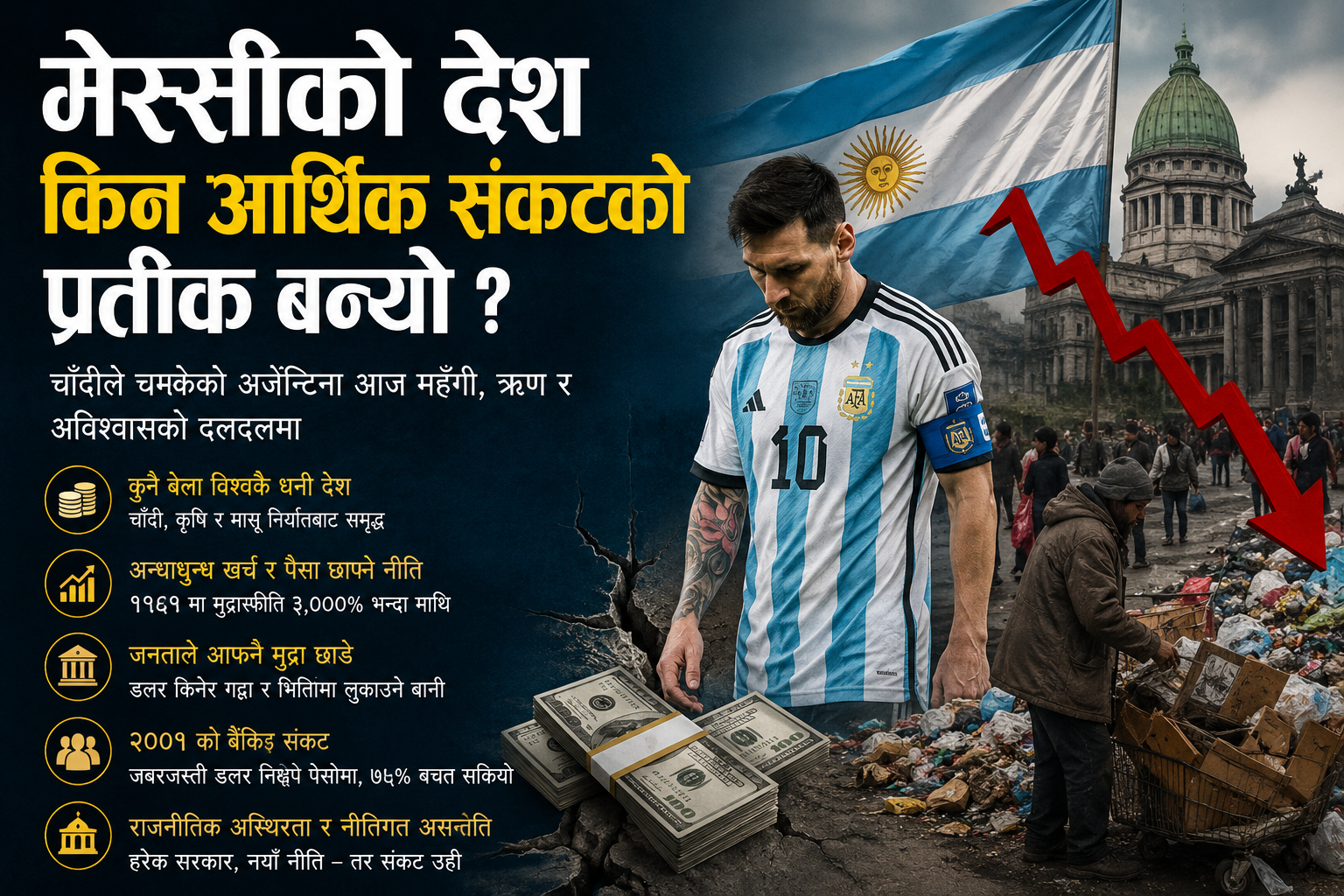
As soon as the World Cup begins, there is a lot of buzz around the world – Brazil and Argentina.TAG_OPEN_p_176 When the name of Argentina comes to Nepal, the first thing that comes to mind is Lionel Messi. Diego Maradona for the older generation.
But this country, which has won the world on the football field, is famous in economic history for a different reason.TAG_OPEN_p_175
When it comes to financial crises, inflation, currency devaluation, banking crises and government financial mismanagement in universities around the world, Argentina’s name comes to the forefront.TAG_OPEN_p_174 It comes like a compulsion. Once one of the richest countries in the world, the country has been grappling with an economic crisis for decades.
The question arises: Who made Argentina like this?
The answer is not the same. It is not the result of a wrong decision. This is the result of decades of policy blunders, political instability, populist economic policies, excessive government spending, declining currency confidence, and weak institutional arrangements. Argentina experienced inflation of more than 3,000 percent in the late 1980s.
Land born of silver
}
TAG_OPEN_p_170 The name Argentina comes from the Latin word “argentum”, meaning silver.
During the Spanish colonial period, the region was famous for its silver and agricultural products.TAG_OPEN_p_169 With its vast grasslands, fertile land, and livestock, Argentina became the world’s leading food and meat exporter.
In the late nineteenth and early twentieth centuries, Argentina’s economy grew so fast that its per capita income was equal to that of many developed countries in Europe, conquering some.
Buenos Aires was once known as the Paris of South America.TAG_OPEN_p_167 Railroads were expanding. Millions of migrants from Europe were coming to Argentina in search of jobs.
TAG_OPEN_p_166 At the time, many economists considered Argentina to be a future superpower.
But the foundation of prosperity was not strong.TAG_OPEN_p_165
Excessive dependence on agriculture and export{
}
Argentina’s prosperity was mainly based on agricultural exports.TAG_OPEN_p_163 Wheat, corn, meat and agricultural products were bringing in foreign exchange.
When world trade was good, everything seemed fine.
But after World War I, World War II, and the global financial crisis of 1929, export markets began to weaken.TAG_OPEN_p_161 The export-dependent economy suffered a major setback.
TAG_OPEN_p_160 Meanwhile, the political leadership began to focus more on immediate political gains than on diversifying the economy.
Popular Politics R Economic Reality
TAG_OPEN_p_158 Juan Perón came to power in 1946.
He brought policies centered on the working class. Salaries went up, Social Security went up. Government intervention expanded. Industries were nationalized.
People got relief in the initial phase.
However, the question was raised – where would the source of such a huge expenditure come from?TAG_OPEN_p_155
Expenses outpaced government revenues. The budget deficit has increased. And the government opted for an easy way – to print money.
From there, the seeds of Argentina’s long-term problems were sown.TAG_OPEN_p_153
Why does printing money increase in cost?
According to the general law of economics, even if the amount of money in the market increases, the price increases if the production does not increase.TAG_OPEN_p_151
If there was Rs 100 for 100 items and suddenly it was made Rs 1,000, then the price of the item also increases.
This is what happened in Argentina.
The government resorted to the central bank to cover the expenses. The money supply grew. But production and productivity did not increase in the same proportion.
According to the
study, inflation in Argentina remained a structural problem for decades, eventually rising above 2,600-3,000 percent annually in 1989–90.
When people gave up their currency
As inflation soared, people began to lose faith in the peso.
People ran to the store on the day they were paid. Because by the time we waited the next week, the value of money would have decreased.
After
, people began to see the U.S. dollar as a safer alternative to the peso.
Buying a house, buying a car, saving, doing business – all started doing it in dollars.
Even today, Argentina has a culture of keeping large amounts of US dollars at home rather than in banks.TAG_OPEN_p_141
Banking System} Trust Why Broken ?
The crisis broke out in 2001.
The government has set a limit on withdrawal from banks. Millions of people were unable to withdraw money from their own accounts.
After
, the dollar deposit was converted to peso.
TAG_OPEN_p_136 For many families, lifetime savings ran out within a few months.
Argentina showed the world that once it loses public trust, it takes decades to restore the banking system.TAG_OPEN_p_135
Political Volatility{ Value
}
Another TAG_OPEN_p_133 major problem in Argentina was political instability.
Democracy came, went. Military rule came and went. The leftist policy came, and then the market-oriented reforms came.
Every government reversed the policies of the previous government.
Investors didn’t see the future. The industrialists could not make a long-term plan.
The lack of policy continuity further weakened the economy.
Current Argentina K } ?
Javier Mille, who takes office at the end of 2023, is trying to change a decades-old economic model.TAG_OPEN_p_127
} He has put forward the policy of cutting government expenditure, budget discipline, reducing ministries and stopping the tendency to print money to make losses. His government said it had adopted tough austerity policies to reduce inflation and reduce the fiscal deficit.
But there is also a price to be paid.
Critics argue that economic adjustment has put pressure on employment, income and consumption in the short term.TAG_OPEN_p_124 Proponents argue that drastic treatment is needed to cure decades of illness.
from Argentina{ } ?
Nepal and Argentina are not the same situation.TAG_OPEN_p_122 But there are some common challenges.
Nepal’s economy is still heavily dependent on remittances.TAG_OPEN_p_121 Foreign employment is the main source of foreign exchange. The contribution of the manufacturing sector is relatively weak. The contribution of the industry has not increased as expected over the years.
Today, consumption is increasing in Nepal, but production is not growing at such a rapid pace.TAG_OPEN_p_120
Imports are increasing.
From mobile phones to motorcycles, from petrol to electronics, from medicines to clothes, Nepal is heavily dependent on imports.TAG_OPEN_p_118
If a country prioritizes consumption over continuous production, the economy may weaken in the long run. This is the lesson of Argentine history.
How long will you rely on TAG_OPEN_p_116 remittances?
Remittances in Nepal have strengthened foreign exchange reserves.TAG_OPEN_p_115
But remittances are not a product in themselves. Remittances build houses, increase consumption, spend on education and health. But if industries are not opened, jobs will not be created in the long run. Argentina is heavily dependent on agricultural exports, while Nepal is heavily dependent on remittances. Dependencies vary, but the nature of the risk may be the same.
Confidence in the banking system in Argentina has weakened. The banking system in Nepal is still strong. But the cooperative crisis of recent years has sent an important message: It won’t take long to lose faith in financial institutions.
Once a citizen realizes that his money is not safe, the effects can spread throughout the economy.TAG_OPEN_p_112
Government Expenditure{} Quality
}
}
The budget in Nepal is increasing every year.TAG_OPEN_p_110 But the question is not the size of the expenditure, but the quality. The roads are incomplete. Projects are delayed. Capital expenditure is low. The cost of the project is increasing. Argentina also spent a lot of time populating. But there was not enough investment in the productive sector. Ultimately, spending created problems, not growth.
Most Big Text
}
The story of Argentina is not just the story of one country. It’s a warning. If one of the richest countries in the world is in crisis due to wrong policies, then no country is safe. Prosperity does not come from natural resources alone. Foreign currency alone is not enough. It’s not just political speeches.
Prosperity requires stable policies, strong institutions, production, investment, fiscal discipline, and public trust.TAG_OPEN_p_107
Messi led Argentina to victory in the World Cup.TAG_OPEN_p_106 But on the economic front, Argentina is still struggling to regain its lost glory. And perhaps Nepal could learn from that struggle in time and avert many future crises.









प्रतिक्रिया दिनुहोस्