

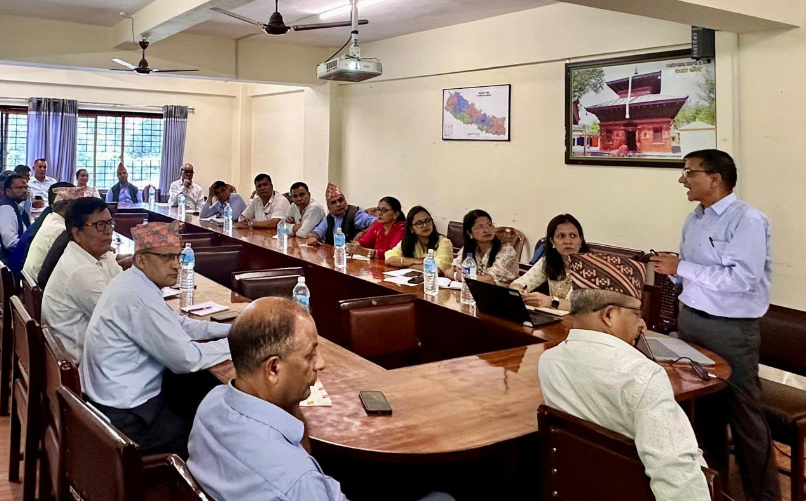
Kathmandu. Workshops organized in all seven provinces for the revision of the National Curriculum Framework, 2076 have received suggestions to reduce the curriculum load, make education employment and entrepreneurship-oriented, and include artificial intelligence (AI) with new technology in the curriculum.
At a workshop organized by Curriculum Development Centre, Sanothimi, Bhaktapur for revision of National Curriculum Framework-2076 BS in all seven provinces, the participants stressed the need to make the existing curriculum timely, practical, useful to life and in line with the local need.
During the discussion held in Koshi Province, suggestions were made to make education self-employment and entrepreneurship-oriented by linking it with local products and making learning student-centric, creative, practical and technology-friendly.
The participants said that with the expansion of technical and vocational education, there is a need for education that preserves patriotism, morality and traditional language, script and culture. It has also been suggested that schools and teachers should be given some responsibility for the formulation and implementation of the curriculum by making it flexible.
In Madhesh Province, the issue of reducing the curriculum content and curriculum load has been raised prominently. The participants have suggested that knowledge and skills related to local and potential sectors, including tourism, agriculture, should be included in the curriculum. It has been demanded that the technical content should be modified and the knowledge related to AI should also be included in the curriculum.
The participants of Madhes have stressed on giving priority to moral and spiritual education, evaluation through student participation in social work, participation of teachers in curriculum development and capacity development of teachers. It has also been suggested that students should be proficient in mother tongue, Nepali and English languages and topics that can create employment through local knowledge and skills should be included.
Likewise, the committee has suggested developing the principal as an educational leader rather than an administrator, giving authority to the local level in formulating local curriculum, providing psycho-social counseling to the students and emphasizing on parent education.
Entrepreneurship and employment-oriented education, compulsory parental education, moral education and promotion of local knowledge, skills and culture have been emphasized in Bagmati State.
The participants of Gandaki Province said that education should be made practical, useful, skill-oriented and employment-oriented. It has been suggested that self-reliant and skilled manpower should be produced through pre-vocational, agricultural and technical education and local geography, history, art, culture and diversity should be included in the curriculum.
There have been suggestions that the curriculum should be reduced as the curriculum is high in Lumbini Province, the curriculum should be developed to develop the feeling of patriotism and creativity should be developed through the use of AI. The participants said that the curriculum is necessary to enable the youth to become self-reliant and create employment in the country rather than forcing them to migrate abroad.
It has been suggested that early childhood development and education should be brought into the school structure in Karnali Province within a period of two years, monitoring and evaluation of the actual implementation of the curriculum should be made effective and the confusion created by the frequent curriculum changes should be ended. The participants also stressed on the need to provide necessary support to the teachers from various quarters.
Although the program was conducted at PABSON Far West and Ministry of Social Development, Dhangadhi in the Far-Western Province, the details of the main suggestions received from the discussion have not been provided.
As per the ministerial decision of the Ministry of Education and Sports, the National Curriculum Framework Revision Task Force has collected suggestions and feedback from stakeholders at the field level from 28 districts of all seven provinces with the objective of making the curriculum timely, practical, useful and effective. Teachers, students, principals, parents, experts, policy makers, local levels and other stakeholders have been directly interacted with the teachers, students, principals, guardians, experts, policy makers, local levels and other stakeholders.
According to Mahendra Parajuli, executive director of the Curriculum Development Center, in the first phase, suggestions will be collected from 28 districts. After that, suggestions will be taken from all 77 Education Development and Coordination Units and suggestions will also be received through the center’s website.
The suggestions received from the workshops in all the seven provinces have shown the common view that the curriculum load should be reduced by linking the national curriculum framework with local needs, employment, entrepreneurship, technology, ethics and life skills. Based on the suggestions received, the Curriculum Development Center has said that it will take the necessary process for the revision of the National Curriculum Framework, 2076.













प्रतिक्रिया दिनुहोस्