

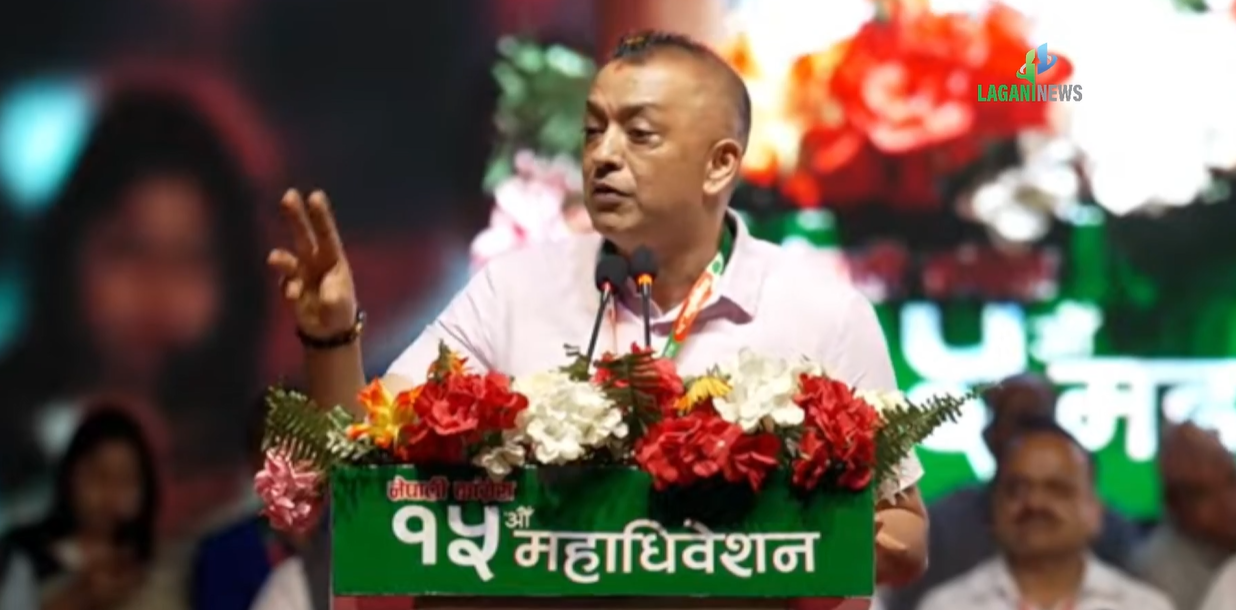
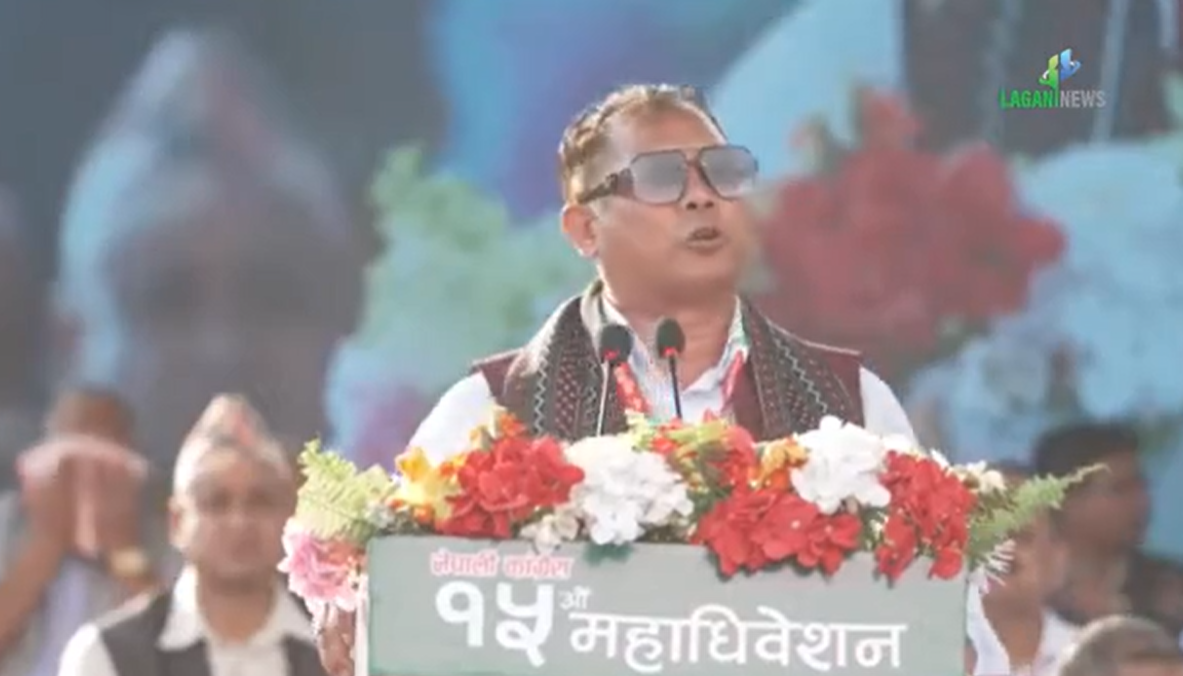
KATHMANDU: Nepali Congress President Gagan Kumar Thapa has made a ruthless introspection on the shortcomings of the Nepali Congress in the last two decades of political journey in the political report to be presented at the party’s 15th General Convention.
He has admitted that the NC has prioritized position and power over political objectives, limited policy cooperation to give-and-take, divided public appointments and adopted the tendency to protect its side.
According to Thapa, such practices not only weakened the moral credibility of the NC but also undermined the autonomy of public institutions and the trust of citizens towards political parties.
He said that the achievements of political changes played by the NC in a leading role should not be denied, but the main weakness of the party was its failure to translate those achievements into results to be felt in the daily life of the people.
Stating that the people’s movement of 2062/063 had raised expectations for peace, democracy, inclusion and new opportunities and the peace process, the Constituent Assembly and the Constitution of 2072 had provided an institutional base to it, Thapa accepted the federal democratic republic, fundamental rights, representation and expansion of local government as the important achievements.
However, he concludes that the expectations of the citizens are not limited to the constitution and the creation of the political structure. The citizens wanted easy access to justice, quality education, reliable health care, dignified employment and a future in their own country. He said that although it is expected that with the addition of rights to the constitution, there will be less humiliation in government offices, if representation increases, one’s voice will reach the decision-making process and after peace, production, enterprise and employment will increase, for many citizens, the gap between expectations and daily experience has not been reduced.
Thapa also admitted that the country has not been able to change its priorities after the promulgation of the constitution. He concluded that although a huge amount of energy was spent in the first decade in the transition from conflict to peace and constitution, the same energy should have been focused on public service, constitution implementation and economic transformation in the second decade, but the NC has not been able to change its priorities, working style and institutional capacity accordingly.
}’We gave importance to position and power over purpose’
In the report’s strongest self-admission, Thapa said the NC should not take responsibility for the two decades of governance shortcomings on others.
According to him, the Congress has “given importance to position and power rather than objectives”. The report states that the policy cooperation is limited to give-and-take, the tendency to defend one’s own side on the question of corruption and irregularities, the practice of sharing in public appointments and undermining the dignity of merit has undermined the moral credibility of the party and the autonomy of the institution.
According to Thapa, the tendency to halt programmes and policies along with the change in government has disrupted policy continuity and the NC’s real achievements have been overshadowed due to poor performance of the leadership and decreasing credibility.
He also admitted that it was a mistake on the part of the NC leadership not to establish the importance of achievements in the people’s experience and to maintain trust on the basis of that.
Thapa said that the life of the party is also limited to ticket distribution and factional equations rather than the concerns of the citizens. He said that due to the election-centric organization, study, policy making and community work have become weak and the closeness to the leadership has dominated rather than the capacity of the people.
Stating that the pre-poll alliance has weakened the NC’s independent identity and public relations, Thapa said that it would reaffirm the direction of contesting with its own candidate on its own election symbol.
The report also states that not giving adequate participation to the youth and compromising on political prices for short-term power has eroded the trust of democratic citizens. Thapa concludes that this trust can be restored not through publicity but only by listening to criticism, correcting mistakes and enforcing the rules in one’s favor.
We could not understand the changing psychology of the youth
Thapa said that the Nepali Congress has not been able to translate the changing demographic structure, settlement and new expectations of the citizens into a political agenda.
“The NC has not been able to change the working style of policy, organization and governance at a time when the new generation is looking for opportunities, participation and results in their lives, digital and new media have expanded access to information and expression, internal migration and foreign employment have changed the lives of families and communities,” he said.
The report states that the lack of employment and the compulsion to go abroad have weakened the confidence that the future can be built in Nepal, but the leadership has not taken it seriously enough. Thapa has made it clear that the Congress cannot escape its weakness by blaming only the adverse situation.
He concludes that these weaknesses, unfulfilled expectations and growing distance from the citizens are deepening dissatisfaction. He said that despite the change in the political system and leadership, the expected improvement in daily life has turned into distrust of the government and public institutions.
Thapa states in the report of September 7 and 24, 2002 that the leadership has not been able to give credible answers to the new generation especially when they are looking for opportunities, impartiality and participation in the decision-making process.
}’The revolt of August cannot be dismissed as a conspiracy’
Thapa has described the people’s uprising of 2082 Bhadra as an expression of the accumulated citizen dissatisfaction with the repeated failure of the leadership, the declining credibility of public institutions, misgovernance and corruption.
Stating that the new generation is looking for an account of the present work rather than remembering the historical contribution of the Congress, he admitted that these questions were also aimed at the Congress as a partner in the then power. He concluded that the Congress failed to listen to the voice of the citizens in time, understand the seriousness of the problem and intervene effectively for improvement.
Thapa also commented on two trends in the wake of the August uprising. He said that the forces in power, instead of giving an account of the shortcomings of their governance, are trying to deny the real discontent of the citizens by describing the agitation as a conspiracy.
On the other hand, the forces that claim to be new are trying to be the sole agents of change by using the anger of the citizens and the energy of the movement to suit their own political interests.
Thapa concludes that both these tendencies are trying to interpret the free conscience of the citizens as per their convenience. According to him, public anger is not anyone’s private political property. Those in power cannot deny the voice of the citizens, and the new political force cannot claim full ownership of it.
‘Not all conclusions of justified outrage are correct’
Thapa said that although the Nepali Congress considers the main demands of the agitation in August as genuine and legitimate, all the conclusions drawn from it are not correct.
“It is unacceptable to justify the dismantling of the institution, to consider violence and destruction as instruments of change and to consider the will of any individual as an alternative to the democratic process,” the report said.
He said that the political answer of the Congress should be to listen to the demands of the citizens, correct its mistakes and make democratic institutions capable of delivering results.
Expressing his condolences to the families of the victims and paying tribute to those who lost their lives in the September 7 and 24 incidents, Thapa said that the questions raised about the sequence, nature and responsibility of the incident should be answered through facts and evidence.
“Whoever is responsible for killings, repression, human rights violations, violence and destruction should be held accountable to the law and the victims should be brought to justice,” he said.
“A party seeking trust from youths should not limit its commitment to justice to a statement, but to turn it into an investigation, the legal process and continuous dialogue with the victims,” he said.
Congress in the role of opposition after defeat
}
Stating that the main political message of the people’s uprising was the demand for change in policy, working procedure, political tendency and leadership, Thapa said the NC has gone to the second special central general convention to address the demand.
He admitted that although the resolution of self-review, public apology, change in leadership and working style and national renaissance had been forwarded from the special general convention, it has not immediately restored the trust of the citizens.
He concluded that the burden of past political experience has not been removed immediately and the change of the Congress in the eyes of the citizens has been slow and inadequate.
Stating that the people’s mandate has given the responsibility of the opposition to the Nepali Congress after its defeat in the election, Thapa said that the government should now focus on monitoring the government, representing the people’s demands and building credible alternatives.
He warned that if the apology sought from the people is not translated into a program and practice, it will also be a cause of further disappointment.
Thapa has also proposed to form a special task force comprising independent youth experts to make an objective study of the policy demands of the youths and the underlying causes of public discontent. The report states that the recommendations of the task force will be mandatorily implemented in the formulation of the party’s strategic policy.
‘Defeat does not define history and future’
Thapa has concluded that the 15th general convention should give continuity to the party renewal that began with the second special general convention and translate the election message into clear policy, organizational reforms and public accountability.
He added that the NC’s electoral debacle should be understood not only as a result of the recent election results but also as the result of the growing distance between the people and the party in the two-decade-long political journey, the power-centric political practice, the unfulfilled promises and the changing aspirations of the new generation.
“Defeat does not define our entire history and future, but it does not absolve us of the responsibility of correcting mistakes by understanding its meaning,” Thapa said, concluding that the party’s 15th general convention was an opportunity for political reconstruction much bigger than leadership change.
The main message of his report is that the Nepali Congress cannot sustain the politics of the future by relying only on its past contributions and that it needs to show change in power, organization and political behavior to restore trust with the citizens.















प्रतिक्रिया दिनुहोस्