

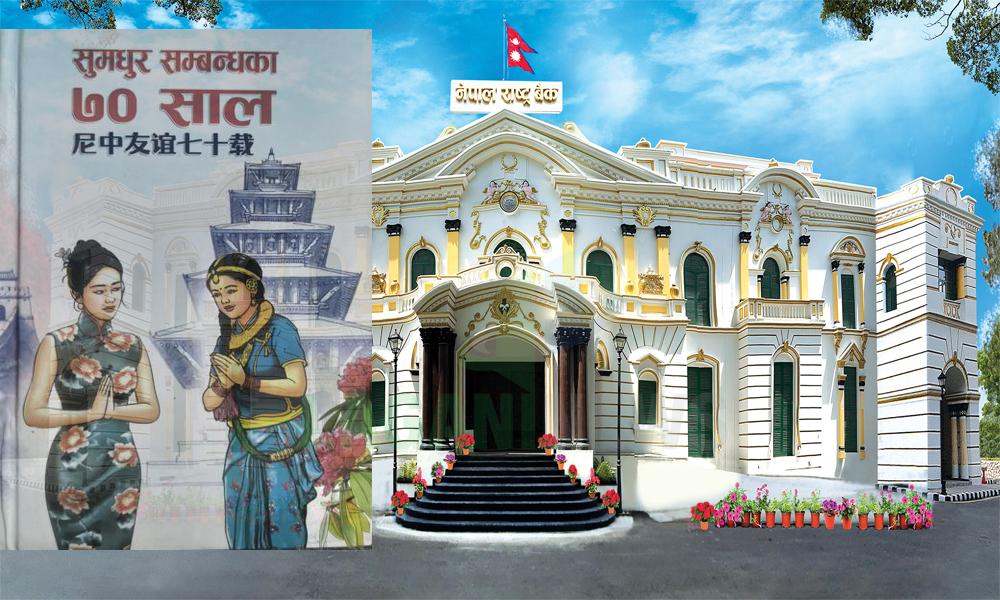
Nepal and China established diplomatic relations on April 26, 1956, almost eight months before the government fixed the capital of Nepal Rastra Bank at Rs 10 million.
The establishment of the People’s Republic of China on October 1, 1949 and the collapse of the 104-year-old Rana dynasty in Nepal two years later was a remarkable coincidence.
Prime Minister Tanka Prasad Acharya, Minister for Foreign Affairs Chuda Prasad Sharma and Chief of Economic Affairs Gunjaman Singh had given authenticity to the first economic cooperation agreement signed between the two countries in October 1956.
The Nepali currency notes issued from Nepal’s standard country food were used only in the limited hilly districts including the capital Kathmandu. At the same time, Prime Minister Zhou Enlai came to Nepal on his first visit to Nepal in 1957.
Foreign people are not allowed to enter the temple of Pashupatinath, the deity of Hindus. However, at that time, Chinese guests were given special permission to enter the temple. There, Zhou Enlai offered an offering of 500 Indian rupees. At that time, the exchange rate of one US dollar was 4.26 rupees and in India, gold was around 100 per tola.
In this way, the offering offered by Chou Enla used to bring five tolas of gold. Compared to the present market price, its value is five lakhs.
It was natural for the very clever king to be touched by the news of the Prime Minister of another country offering Indian rupees in a famous temple of a sovereign country. It is said that the king immediately instructed the Prime Minister, the Finance Minister and the first Governor to use Nepali currency strategically. The King had also considered the compulsion of using Indian currency in Nepal to Prime Minister Acharya and Governor of the Rastra Bank Himalaya Shumsher Rana. After that, the central bank opened branches, branches, exchange counters all over Nepal and increased the circulation of Nepali rupees instead of Indian rupees.
The Nepal Rastra Bank (NRB) records show that the campaign to circulate Nepali currency notes has been started especially in most of the districts of the Terai region bordering India.
This is the first time that China has formally provided an assistance of Rs 100 million to Nepal after signing an economic cooperation agreement with China.
Former Finance and Foreign Minister, Governor and Ambassador. According to Bhesh Bahadur Thapa, the foundation of the Rastra Bank was laid with the same cash provided by China.
On page 83 of Thapa’s book ‘Rashtra-Vyafar’, it is written, “During that period, there was a hostile relationship between India and China. As soon as China gave Rs 10 crore, India also used to give Rs 10 crore. At that time, China provided cash. In fact, the Rastra Bank was started with the same money. ‘
The same foreign currency provided by China was used as the collateral for the bank’s capital at that time and the Nepali notes printed in the De La Rue Company of Britain.
For a decade, Chinese government companies have been printing and minting Nepali notes and coins of different denominations. China Bank Note Printing and Minting Corporation, established one hundred and five years ago, prints and mints its own Chinese currency notes and coins along with other countries. The cost of printing Nepali notes in bordering countries is very low.
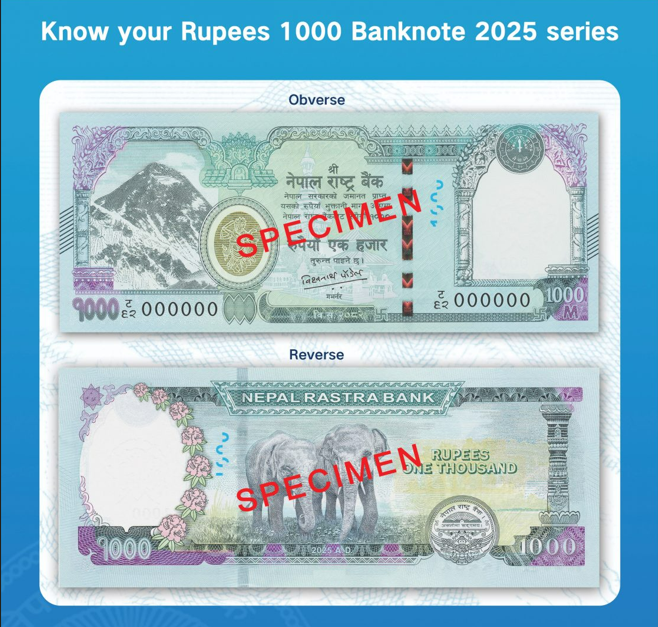
The cost of other rates like the Nepali 100 rupees, which was first printed in 2015 and introduced since 2016, has been very low so far. Officials of the Nepal Rastra Bank say that the quality of the notes printed there is better than elsewhere.
In this way, the economic cooperation between the two countries, which started with the first batch of cash assistance, has expanded and China has become the closest friend in Nepal’s economic development. Now, China has become the second largest importer of goods for Nepal in terms of foreign trade. Whereas 70 years ago, Nepal’s trade with the Tibet Autonomous Region towards China was negligible.
Businessmen, students and tourists of both countries will be able to trade in Chinese Yuan only after the Nepal Rastra Bank (NRB) put the Chinese Yuan on the exchange list since 2002.
With the development of technology, the changes in the international payment system have also been adopted by the banks of Nepal and China. Wallets of the Chinese digital payment system, WeChat Pay and AliPay, have also been arranged in Nepal in recent times.
If we look at the statistics of last year, China has become the largest country in Nepal for investment. As of May 2080/81, Chinese businessmen have invested more than Rs 224 billion in foreign currency in various sectors of Nepal. According to the report of the Department of Industry, this amount has been invested in 2,448 businesses and projects.
from ’70 Years of Good Relations’ published by Nepal-China Media Forum














प्रतिक्रिया दिनुहोस्