

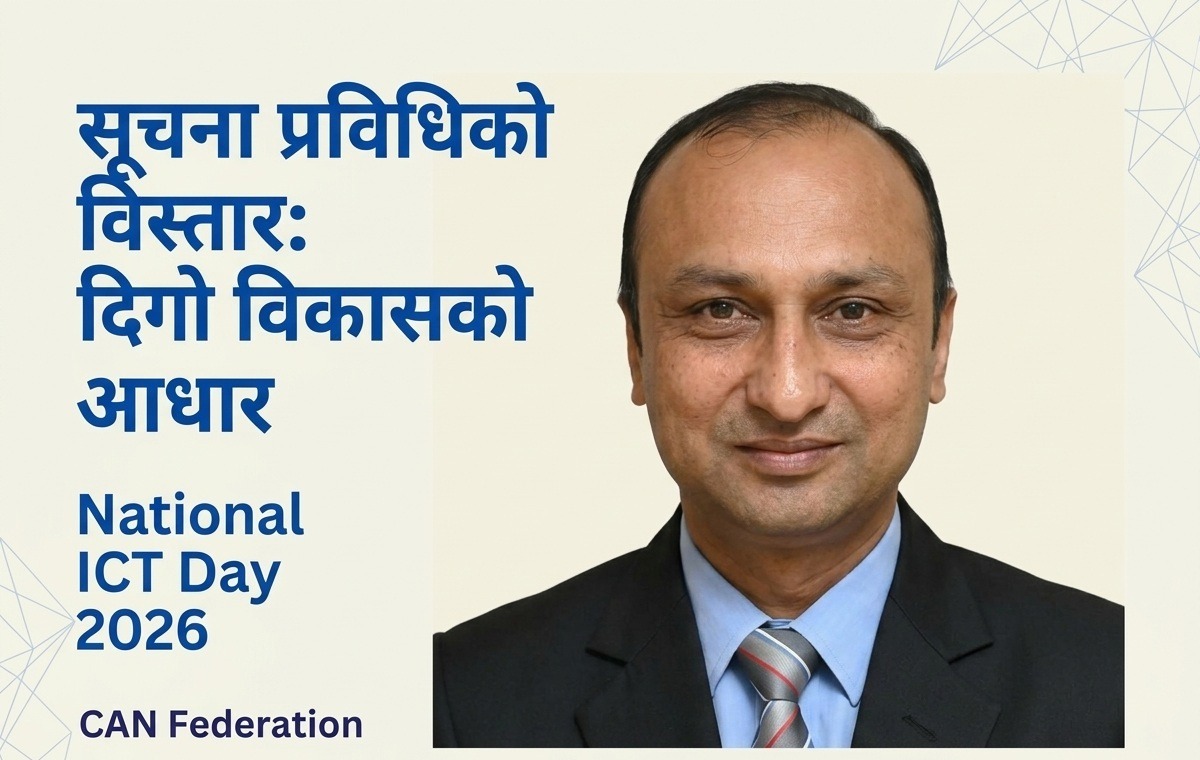
Every year on May 2, 2019 is celebrated as the TAG_OPEN_b_214 National Information and Communication Technology {} {{TAG_CLOSE_b_209}. This year, various programs will be organized across the country with the slogan ‘{TAG_OPEN_b_207}}information } } Sustainable {TAG_CLOSE_b_204}}} {TAG_CLOSE_b_202} It was celebrated with grandeur.
This day commemorates the historic day when the first computer ‘IBM 1401’ was introduced in Nepal for the first time for the 1971 census (2028 B.S.). This article dwells in detail on Nepal’s digital transformation, achievements, challenges and the way forward.
1. ICT Historical Historical Reference } and Relevance
}
Although the history of technology in Nepal is not very old, it has made a big leap in a short time. May 2 has been declared as National Information and Communication Technology Day in connection with the establishment of the CAN }{{TAG_CLOSE_b_191 TAG_OPEN_b_191}} Federation held TAG_OPEN_b_192 in May and the historical context of the introduction of computers.
The Day started at the initiative of the CAN Federation for the past 10 years has now been celebrated by the government in a big way. Starting from April 24, the ‘‘ICT ‘ has been playing an important role in spreading awareness about technology in the villages.
2. Evolution TAG_OPEN_b_184 TAG_CLOSE_b_185 of technology: {Alarm to AI}
Nepali society has entered the modern digital age from the traditional lifestyle of yesterday. This rapid development of technology has touched every aspect of people’s lives:
- {{TAG_OPEN_b_181}Digital Lifestyle: Mobile banking, e-commerce, telemedicine, and online education are no longer a luxury but a daily necessity.
- Smart Technology and AI: Nepalis are beginning to use the latest technologies ranging from smartwatches to health check-ups to robotics and artificial intelligence.
- {{TAG_OPEN_b_175}Economic Contribution: The contribution of the IT sector to Nepal’s GDP is continuously increasing and the potential of software export is very strong.
3. Policy Reforms and ‘Digital Nepal’ }Dream{{PLACEHOLDER_single_tags_ 57}}
According to CAN Federation Senior Vice President and Information Technology Expert Chiranjibi Adhikari{} Policy stability and government investment are indispensable for the development of the technology sector.
“The government should not delay in increasing investment and removing policy hurdles if Nepal is to be made prosperous through information technology,” he said. Technology is no longer a luxury, it is an engine of growth. ” — Chiranjibi Officer
}
Government’s Previous Policies }
}
- AI Policy Draft (2081 Magh 22): The concept paper and draft on Artificial Intelligence has been prepared and approved by the Cabinet on August 11, 2002.
- National AI }} and (2082 {TAG_CLOSE_b_145}}24): The National AI Center has been established to develop and regulate AI .
- {{TAG_OPEN_b_143}Digital {} Service System: The Department of Information Technology (DoIT) has launched services such as Citizen App, Unified Office Management System, Centralized E-attendance and Centralized SMS Gateway.
4. Digital Extensions Stats }} and Social Effects
The National Statistical Office’s ‘Nepal Multi-Indicator Survey 2081/}82′ shows the accessibility of technology in Nepal and its social aspects as follows:
| pointer | Details / Statistics |
| Internet Access | 82 percent of households use a device with internet access |
| sexual access (} | |
| Sexual Access (Female) | 81.6 percent of women aged 15 to 49 have a mobile phone |
| R&D } |
According to media expert Ujjwal Acharya{} with the expansion of technology, social media algorithms are having a big impact on information flow and public opinion formation. The growing trend of click-based content and disinformation has added a new challenge to the credibility of journalism.
5. Cyber Security: Main Challenge and Sensitivity
With the increase in the use of the internet, the cases of cybercrime are also increasing rapidly in Nepal. According to the statistics recently made public by the Inspector General of Police Dan Bahadur Karki} the situation of cybercrime is very sensitive:
- Complaint } Status: So far, more than 10,000 cases of financial fraud, 4,000 fake accounts and 3,000 cases of harassment have been registered.
- Registered {} Social Network: Meta’s major platforms like Facebook, Instagram and WhatsApp are not officially registered in Nepal. Currently, only a limited number of platforms like TikTok, Viber and WeTalk are registered.
To reduce cyber risk, it is the need of the hour to adhere to ‘{national minimum security {TAG_OPEN_b_93}}}’, establish strong data centers, and make cybersecurity education mandatory right from the school level.
6. Conclusion and Upcoming Path
Nepal is at a crucial juncture of digital transformation. There is a need to work with the goal of making Nepal a major technology exporter of South Asia by 2030.
Despite improvements in infrastructure expansion and services, inclusive accessibility, technology, literacy, }quality Internet, and Effective Regulation{ are still a challenge. The dream of }’ digital {{{TAG_CLOSE_b_76 TAG_OPEN_b_76}} can be realized only through the PPP model and appropriate policy clarity.

















प्रतिक्रिया दिनुहोस्