

Jhapa. KATHMANDU: Doctors and public health workers have drawn the attention of the government to ban the sale and distribution of iodise-depleted salt in Nepal, expressing serious concern over the increasing risk of public health problems caused by iodine deficiency in Nepal.
Expressing concern over the open Nepal-India border, Indian salt is being sold openly in supermarkets and grocery shops in the country, they urged all three tiers of government to carry out market monitoring and seize such salt to affect the health of consumers.
On the other hand, after the government allowed the private sector to enter the sale and distribution of salt, the risk of serious health problems due to iodine deficiency in the market has increased in the future.
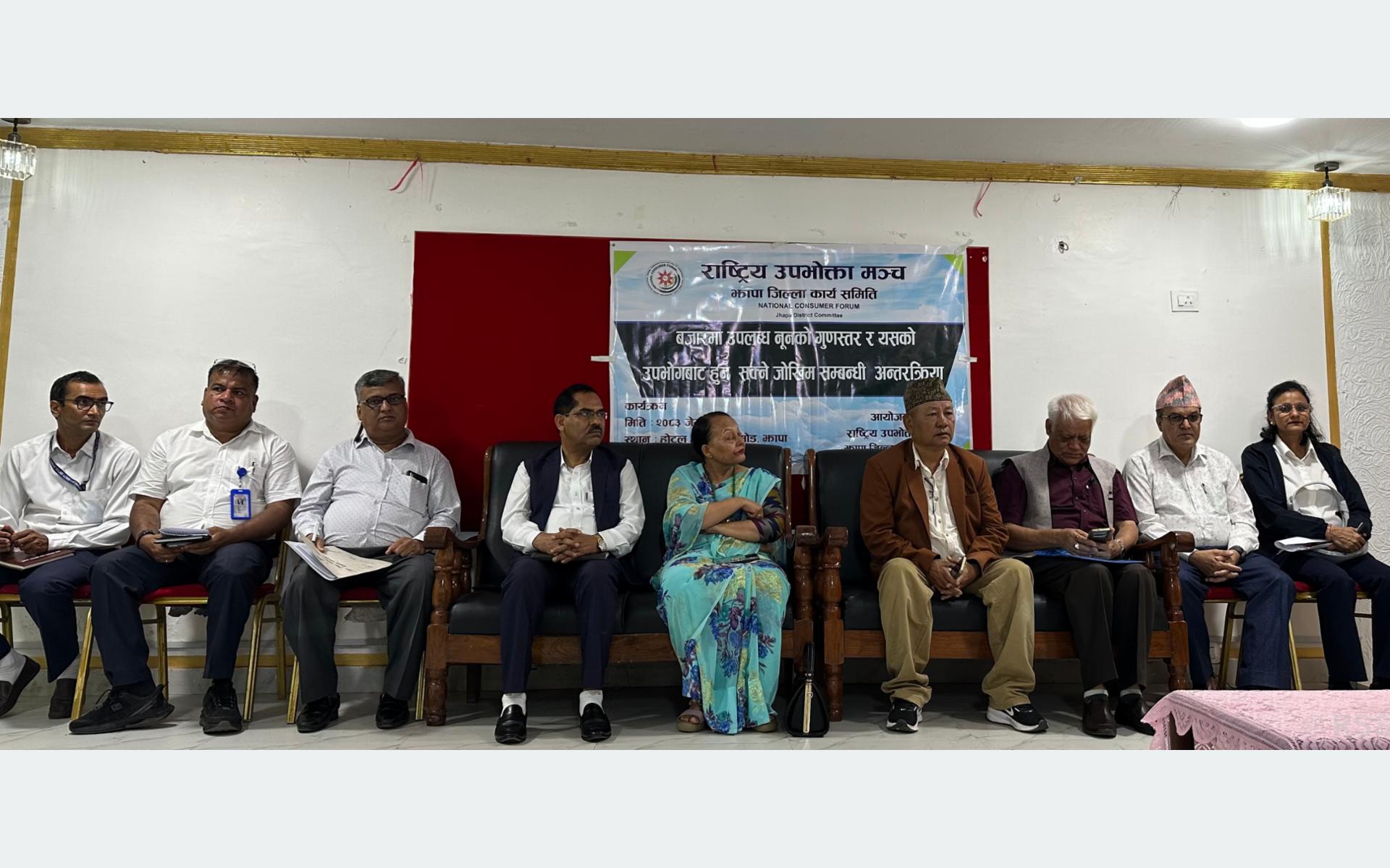
Pediatrician Dr Tanka Bahrarakoti pointed out that the health of children and pregnant women could be at risk especially if the use of non-iodised salt increased. Speaking at a programme on ‘quality of salt available in the market and health related to its consumption’ organised by the National Consumers’ Forum here today, he said, “If the consumption of salt without iodise increases there may be a risk of public health problems caused by the deficiency of iodise”. This should be taken seriously. The sale and distribution of iodized salt should be banned immediately. ”
Sri Lanka is currently facing a public health problem caused by iodized salt. He argues that such a fate should not be allowed to come to Nepal.
The government had paved the way for the production and sale of iodised salt to the private sector from July 17, 2082. The Department of Food Technology and Quality Control, Kathmandu, on April 18 had tested the quality of ‘Himalayan Pink Rock Salt’ and found no iodine levels.
Indian substandard salt called ‘black salt’ is being sold openly in the market. The Indian government has set 30 ppm for salt and 15 ppm when it reaches the kitchen.
As per the standards set by the World Health Organization (WHO), the government has been enforcing the requirement of 50 ppm of iodised salt at the production level, 30 ppm at the place of sale and 15 ppm when used by the consumers. According to doctors, iodised salt should have water content of six per cent, sodium chloride at least 96 per cent and water dissolves at least 1 per cent. If 96 percent of them are not sodium, then there is a problem with blood pressure.
In the case of ordinary salt, the government has set limits on hydrogen, sodium chloride and other soluble substances.
According to Dr Bahrarakoti, former additional secretary at the Ministry of Health and Population at the time, iodine is a micronutrient that is essential for the body on a daily basis. Salt helps to release thyroid hormones from the thyroid gland. It helps in the regular functioning of the body, such as the functioning of cells, the growth and development of the brain. Iodine is also needed for the production of hormones needed for physical and mental development.
“Children and pregnant women need iodised salt. In such a situation, two children should eat iodized salt in the right amount. ”
The government has been urging people to eat only iodised salt with the mark marked on two children, saying “let’s eat less, in the right quantity”. Chief of the District Public Health Office, Brij Kumar Das said that the deficiency of iodine in children can lead to poor mental development, poor studies, mental retardation, speech impairment, deterioration of eyes and physical development.
“Iodine deficiency in adults can lead to goitre, thyroid, loss of mental and physical capacity,” he said. Iodine deficiency is the main cause of neurological cretinism in children. Problems such as thyroid cancer, loss of fertility, miscarriage can also be seen. To reduce this situation, iodized salt with the mark of two children of the Salt Trading Corporation should be used in combination. Urging all not to use salt haphazardly, he said the shortage of iodine could pose a risk of public health problems.
On the occasion, Mayor of Birtamod Municipality, Pabitra Mahatara Prasain, pledged to carry out market monitoring and sell salt without iodized salt. He said, “Awareness should be created to use only iodised salt with the mark ‘two children’ in the kitchen.” ”
Assistant Chief District Officer Tej Prakash Prasain said the market monitoring would be carried out to curb the import of salt from the customs and stop the sale and distribution of salt without iodise. Traders are said to bring salt from the customs for other purposes.
Chief of the Department of Food Technology and Quality Control, Jhapa, Subash Chandra Osti, said that the government has not allowed the import of salt, saying it is highly necessary for the human body as iodised salt. “Though the import of salt is not allowed, iodised salt is found in the market,” he said. This should be discouraged. ”
Assistant Manager of the Salt Trading Corporation Brajesh Jha said that salt has been supplied even in difficult conditions. According to him, in the last fiscal year, the corporation had sold 210,000 tonnes of iodised salt. On the other hand, the corporation has been stocking salt that lasts for six months in its warehouse to avoid immediate disruption in the supply of salt. “The supply and distribution of iodised salt has been carried out regularly as per the mandate of the government,” he said. ”
On the occasion, Forum central chair Premlal Maharjan said there was no alternative to iodised salt and demanded immediate market monitoring to confiscate the non-iodised salt. He said, “The entry of the private sector in the sale and distribution of salt has played with the health of the consumers. Iodized salt began to appear in the market. Such a situation should be stopped immediately. ”
Access 100%: Goitre problem Zero
In the last decade, Nepal has made historic success in the eradication of endemic goiter. Before 1965, one in two people was suffering from various diseases caused by iodine deficiency. Since 1973, the government had ordered the import of iodised salt, after 55 per cent of the population was found to have mumps.
In the past, the majority of the people living in the hilly and mountainous areas had to suffer from the acute problem of goitre due to the lack of iodised salt. It was considered unusual to have a lump in the front of the neck. In a way, the goiter was considered a symbol of beauty. The problem of goitre has come down to zero in the last decade after the government launched a nationwide campaign to distribute iodised salt through the Throat Disease Control Program.
According to the latest study report of the Nepal Health Research Council, the problem of goitre caused by the lack of iodised salt has been cured when the access to iodised salt is almost hundred percent. The government’s policy of providing easy access to iodised salt to the general public and the efficient distribution management of the Salt Trading Corporation, which implemented this policy, have reduced the problem of mumps to zero in the rural areas.
According to the ‘Internal Evaluation Report 2073’ conducted by the National Planning Commission, the program has become successful due to the efficient salt distribution system of the Salt Trading Corporation in the remote areas. Iodine-deficient goitre has dropped to zero in the decade, especially in the hilly and mountainous regions, while other problems of hyperthyroidism, mental and physical capacity have been declining. According to the Ministry of Industry, Commerce and Supplies, the campaign to eradicate throat disease from the fiscal year 2070/71 to the last fiscal year has achieved 100 percent success.















प्रतिक्रिया दिनुहोस्