

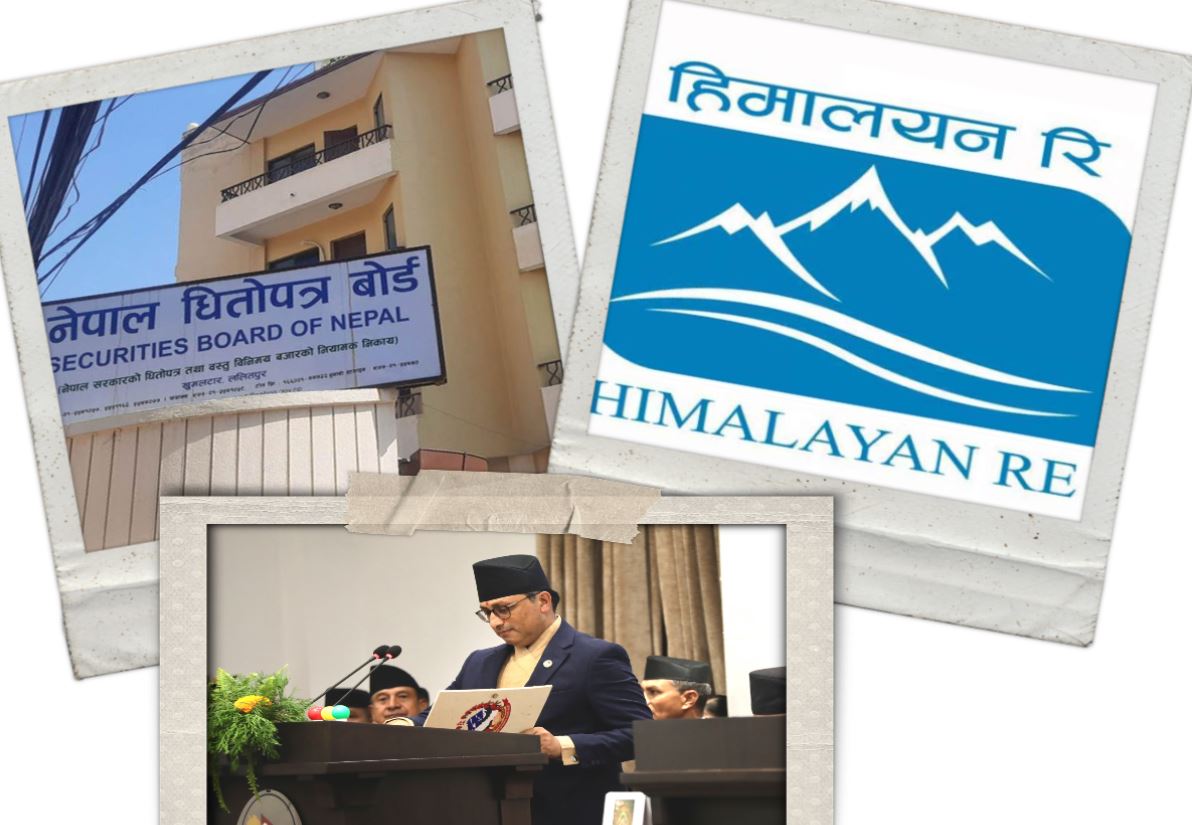
Kathmandu. Himalayan Reinsurance, which has emerged from the state and threatening the regulator, is now weakening due to the state’s policy.
Deepak Bhatta, a businessman who can exert pressure on the state power very closely, got the license of Himalayan Reinsurance on Jestha 16, 2078 BS during the then NCP-led government.
At that time, KP Oli was the Prime Minister and Bishnu Poudel was the Finance Minister. The same government had appointed former secretary Surya Silwal as the chairman of the Insurance Authority. Silwal gave the license to Himalayan Re.
Himalayan Reinsurance Company is one of the most popular companies in the state. Ever since Himalayan Reinsurance Company got its license, no one has stopped making policies and regulations that suit it.
The company benefited greatly by threatening the regulatory body. But now, due to the state, it is gradually becoming weak. Himalayan Reinsurance is an example of how the company can become weak in a short time if the state wants it, even if it is pushed by the state, and by threatening the regulatory body.
Legal facilitation from the board to bring IPO
The Securities Board of Nepal (SEBON) had amended the rules to allow Himalayan Reinsurance Company to issue ordinary shares (IPO) at a premium price.
Ramesh Hamal, who was the chairman of the board at the time, had made it very easy to bring the IPO at a premium price by amending the Securities Registration and Issue Regulations-2073. It should be noted that it was Bhatta who appointed Hamal to the board. In any case, Hamal has amended the rules to allow this company to come up with an IPO.
At the time, Sebon leadership had little to do with changing the rules to allow the company to issue shares at a premium. Bhatta was in control of the board, from the upper level of the staff to the leadership, to the Talukdar Ministry of Sebon.
In the old regulation, only public companies could invest in such companies. Also, there was a provision that no more than 5 percent investment was allowed. The investment was also to be made only by the companies licensed by the board.
Hamal later amended the bylaws and made the public company a private company. The investment was increased from 5 percent to 15 percent. The board removed the word “licensed”. Earlier, there was a provision to issue shares at a premium if they were making a profit for 3 consecutive years. Later, he amended it to allow Himalayan Reel to issue an IPO, which would require 2 years to make a profit.
In order to be allowed to issue IPO at a premium, it should have completed 2 years to go public from Pvt. Ltd. to 1 fiscal year.
Sub-rule 25 of the Securities Registration and Issue Regulations, 2076 BS was amended regarding capital and other issues. Rule 25 provides that securities can be issued at a premium.
Clause 25 (A) states that the organization has been operating on net profit for the last three years. This was later amended to provide that an organization that has been making a profit for the last two years with a paid-up capital of at least one billion rupees may issue securities at a premium.
Likewise, the board amended the regulation and added sub-rule 3 (a) to Rule 9 to make Himalayan Reinsurance easier. It stipulated that “as a public company, it has completed a period of one fiscal year by carrying out the necessary works to carry on the business as per its objective”.
Provided that a company which has been converted into a public limited company after the completion of at least two financial years after the completion of at least two financial years after which the company has been registered as a private limited company and has been converted into a public limited company, the audit report of the last fiscal year has been approved by the general meeting after the completion of the general meeting, such period shall not be required to expire.” This confirms the change in the rules for sending money to Himalayan Re Insurance, which is Bhatta’s main investment.
At the time, Sebon did not put the regulations on its website for a long time. At that time, the board had amended the law and there is confusion about how the Himalayan Reinsurance will be operated now.
Ease to raise billions when the board amends the law
}
Due to the amendment of the law by the board, the company, which was originally invested by Bhatta, had raised a large amount of money from the public. The company, which was legally simplified by the Board, had issued shares at Rs 206 per share, adding a premium of Rs 106 to the face value.
The company had issued 2.49 crore units of shares at Rs 100 per share to the general public and was expected to raise Rs 2.49 billion. However, the board had raised Rs 5.12 billion by selling the shares at Rs 206 per share.
Himalayan Reinsurance Company has collected more than Rs 2.63 billion due to SEBON’s legal facilitation. The company had issued the IPO on December 12, 2080. The company’s stock auction has not yet opened.
How does this company, which once used to be interested in reinsurance, now do business? That’s the question for everyone. As per the decision of the Insurance Authority of Nepal (NEA) on May 12, the company has been barred from doing new reinsurance business until the end of this fiscal year as per the clause 136 (1) of the Insurance Authority Act, 2079.
Likewise, Himalayan Relay Authority had taken action in the third week of March as per Section 134 (1) (b) of the Insurance Authority Act, 2079.
The decision taken by the authority on May 29 has prevented the company from adding new business. What policies will the company take in the future and how will it be financially viable? This has raised questions. The budget brought by the government for the coming fiscal year has also helped to further strengthen this question. Experts argue that the company’s business has been further narrowed.
Finance Minister Dr. Yubaraj Khatiwada allocates budget for the upcoming fiscal year Swarnim Wagle said that the government has made an arrangement that at least 20 percent of the insurance policy to be issued by the insurance company should be from Nepal Reinsurance Company.
Similarly, in the budget for the coming fiscal year, we will make a provision that the group insurance fund of long-term nature will be led and operated by Nepal Reinsurance Company. In order to reduce the risk, we will make arrangements to share a certain portion of the reinsurance with foreign reinsurance companies.
This is going to be a big blow to the Himalayan Rico business. Similarly, there are indications that the Foreign Employment Temporary Life Insurance (Bridge) currently being operated under the leadership of Himalayan Rico will also go to Nepal Reinsurance Company. This will make it difficult for the company to do business.
At that time, Bhatta had worked to expand the business of Himalayan Reinsurance by exerting pressure and influence from the regulatory body. Not only this, the government has also made arrangements in the budget for the coming fiscal year to re-insure the security programs run by the Employees Provident Fund, Citizen Investment Trust, Deposit and Credit Guarantee Fund, Health Insurance Board and Social Security Fund through Nepal Reinsurance Company.
Wagle, the current finance minister, has not liked Bhatta and those around him for a long time. As a result, there is also a discussion about whether he has taken a tougher policy towards the company now. The then government had tried to grant license to new stock when Wagle was a lawmaker last time. He was very opposed to the new stock going into the hands of the Bhatt Group. Wagle has been saying that the license raj should be abolished even today.
At the same time, the directors and CEO of Himalayan Re Insurance have also been booked for insurance offences and money laundering. This is also said to further weaken the company.
Mukunda Chhetri of Nepal Rastra Bank was the board director when the regulation was amended to facilitate Himalayan Reinsurance. He is currently running for president of the Securities Board. A total of 47 people had applied for the post of chairman of the board. Among them, the committee has selected the names of 4 members and submitted them to the government (Finance Minister). Chhetri’s name is also among the 4 people.
Currently, Nepal Bank has 5 percent stake in Himalayan Reinsurance Bank and Rastriya Banijya Bank has 5 percent shareholding.














प्रतिक्रिया दिनुहोस्