



Kailali. When Nepal’s longest Karnali River, which flows from above, reaches Chisapani of Kailali, it seems as if it has stopped for a moment to admire its beauty. The wonderful dialogue between nature and technology is reflected when the Chisapani bridge on a pillar above the river shakes with the wind. The beauty of the river, the surrounding green hills and bridges add beauty to it, which easily captivates anyone who visits it.
Not only the small geography of Chisapani, nature has given a lot to the Far West, but for years those gifts have been confined within the limits of possibility. Therefore, a question that has remained unanswered for decades is whether these natural resources can ever become the basis of prosperity. One of these ambitious projects is the Jalpadevi Cable Car.
Various infrastructures are being constructed under this project from Chisapani of Lamkichuha Municipality-3 to Rajkanda area of Mohanyal Rural Municipality-7 of Kailali. The project, which is being constructed with the main investment of IME Group, is seen as an important infrastructure for tourism and economic development of the Far-West. The project is estimated to invest around Rs 6 billion in different phases, including a three.1-kilometer-long cable car, hotel, restaurant, skywalk, park, trekking route and other tourism infrastructures.
Many believe that this project will lay the foundation for the economic future of the Far-West and establish Chisapani as an attractive tourist destination in Nepal. Therefore, it is not only seen as an infrastructure but also as a big dream related to tourism, employment and economic development of the Far-West.
Pushpa Raj Kunwar, president of the Federation of Nepalese Chambers of Commerce and Industry (FNCCI), Far-West said that such a big tourism project with private investment should be taken as a historic opportunity. “The construction of such a big private investment tourism project in the Far-West is historic in itself,” he said. Hotel, transport, agriculture, trade and service sectors will all be directly benefited after the operation of the cable car. ”
Similarly, President of Tikapur and Lamki Chamber of Commerce and Industry, Santosh Khadka and Padam Raj Chaulagain said that this big investment project in the far-western region is the pride of the people of the province and it will help to attract more investment in the state.
Dreams of prosperity will hang with the gondola
About a decade ago, local businessmen had an ambitious dream of developing tourism infrastructure in Chisapani area. A total of 99 businessmen from different sectors were associated with that dream. The project, which could not move ahead for a long time due to various reasons, has reached the construction phase after the participation of IME Group. The foundation stone of the project was laid on Poush 13, 2081 BS and the construction started last year.
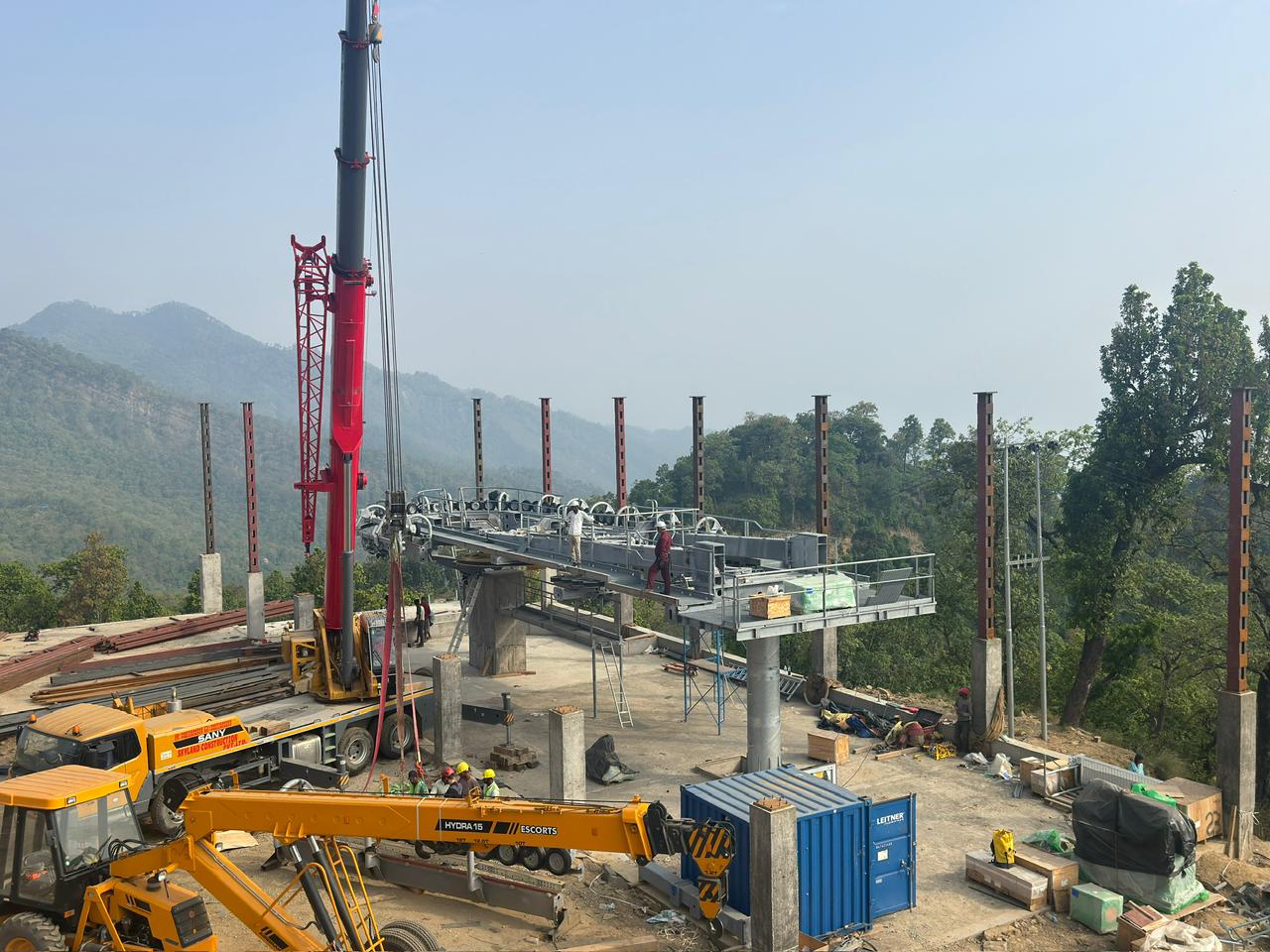
According to project engineer Bijay Poudel, the construction of the project is moving ahead in a speedy manner. Currently, the construction of poles and bottom and top stations are in the final stage. After that, the technical process of pulling the wires and installing the gondola will move forward.
“We are working with a target to complete the project on time. The project is expected to be operational by mid-October. We are carrying out the first phase of works with this goal,” he said, adding that the works of erection of poles, bottom and top station construction are in the process of completion. After that, the technical work of stringing and installing gondolas will move forward. ”
Currently, a hotel, restaurant, park, Jalapadevi temple, sky walk, walking trail and other tourist infrastructures are being constructed at the top station while a five-star hotel, banquet hall and other facilities are being constructed at the bottom station. Engineer Poudel said, “The infrastructure being constructed here will establish this area as a major tourist destination of the country.” ”
Dipak Timilsena, president of Lamkichuha Chamber of Commerce and Industry, said that the dream of some 13 years ago has started to materialize. He said that Rajkanda will become an excellent hill station for both local and foreign tourists looking for coolness to escape the extreme heat of Kailali if the cable car project comes into operation. Timilsina believes that the infrastructure to be constructed here will help to prolong tourists’ stay, increase expenses and make the local economy dynamic.
Basis for tourism and economic reform
At present, there are not many infrastructures in Chisapani area except the Chisapani bridge, however, about five to seven hundred domestic tourists visit the area every day, according to experts. Most of the tourists who come to Nepal spend a few hours and return home after spending a few hours, but with the new infrastructure coming into operation, their stay will be prolonged, according to Devraj Jaishi, a tourism entrepreneur.
The cable car to be built here will connect Chisapani to Rajkanda, but its impact will not be limited to just a few minutes’ journey. The infrastructure to be constructed here is expected to establish Rajkanda as a new tourism hub. For this, adventure tourism like jungle safari, rafting (water tourism) should be developed in Bardiya National Park as a package, said Jaisi.
“The state should also work as per the policy of the destination far-west. A new journey of prosperity can be taken from Karnali Chisapani, if the possibilities of Karnali can be developed by combining it in a package. The cable car and the structures associated with it can be taken as its base,” he said.
It is believed that the local community should get the biggest benefit of tourism development. Hotel entrepreneur Tanka Parajuli believes that the operation of the Jalpadevi cable car project will help create employment opportunities at the local level. “Once the project comes into operation, there will definitely be an increase in the number of domestic and foreign tourists who will find a market for the products produced in Rajkanda and nearby villages,” he said. This will help farmers to increase production and attract youths towards entrepreneurship. Therefore, it is a matter of great happiness that such projects are constructed in our area and it is necessary to create a feeling among the locals that such projects are common property,” he said.
Opening new job doors
For many youths in the far west, the last option for employment is still India or the Gulf countries. The vacant houses, the shrinking social structure of the elderly and children speak to this reality, but the locals hope that the Jalpadevi Cable Car Project will be able to stop this trend to some extent.
With the operation of the cable car, hotels, resorts, restaurants, transportation, entertainment and service sectors will be expanded. Entrepreneur Kalu Hamal expects that thousands of jobs will be created directly and indirectly from these activities.
“There is only one bridge so far, now the infrastructure including cable car will be added. This will increase the attraction of tourists. “There are many options here for adventurous tourists such as water tourism, Jalpadevi for religious believers and for those who enjoy air-conditioned weather,” he said, “Kathmandu is six hundred kilometers from here, but only Delhi is four hundred.” By creating an environment for tourists to come from different places of India with a large population, new possibilities can be established along the banks of the Karnali River by keeping the cable car at the center, which will create many employment opportunities at the local level. ”
Hamal suggested that the government should work for the development of public land by making an integrated package as new tourism potentials can be explored not only in Rajkanda area but also in the area of three to four hundred kilometers of Kanali River.
Kishor Tharu, president of Basera Tharu Homestay Balchaur, said he was confident that with the arrival of tourists, there would be a situation to welcome guests at home and reap financial benefits. “With the operation of the cable car, it will be easier to reap economic benefits by publicizing our indigenous skills, civilization and culture,” he said. We are hopeful that local agro products, handicrafts, hotel business and small enterprises will get a new lease of life,” he said.
The geography of this place is important for the project. The open border, easy road network and proximity to the vast Indian market have the potential to develop this region as an inter-country tourist destination. Due to the open border with India, close market and easy transport access, the potential of this area is huge. We have direct access to two large Indian states, Uttarakhand and Uttar Pradesh, which have a population of more than 270 million. It can be easily reached by road from Delhi, Lucknow, Bareilly, Dehradun and other cities. Local businessmen and citizens suggest that the project should be publicized extensively and it can be multi-dimensional.
This area could also become an attractive destination for Indian tourists due to easy road access from Gaddachauki of Kanchanpur (125 kilometres), Gauriphanta of Kailali (around 88 kilometres) and Rupaidiha transit point of Banke (93 kilometres). Similarly, the cool environment of Rajkanda, the panoramic view of the Karnali River, the thrilling cable car journey and religious tourism can be the main attractions for Indian tourists looking for relief especially in the summer season.
Geographically, Chisapani is like the confluence of Sudurpaschim, Karnali and Lumbini provinces. Rajan Chaudhary of Bardiya, who has been working as a guide for long, said that Karnali is a suitable destination for recreation, jungle safari, water tourism and other types of tourists having religious faith.
“Lately, Nepalis are developing the habit of going to new places and enjoying themselves. There is an easy road network to connect Chisapani to Chisapani which has a large population area of India at a distance of about two to three hours. Chisapani can also be reached by road from cities like Banbasa, Khatima, Haldwani and Rudrapur in Uttarakhand. Even if only a small fraction of the tourists coming from there can be attracted, a big change can be made in the economy of the Far-West through tourism. Jalpadevi cable car is becoming a strong base for it,” he said.
Future Roadmap to Prosperity and Multi-Provincial Investment
Chandra Prasad Dhakal, chairman of IME Group and Jalpadevi Cable Car Pvt Ltd, said that the project should be seen as a means of economic transformation rather than just a tourism project. Regarding the multidimensional economic and social impact of this project on the development of the Far-West, he said, “The number of tourists can be increased, their stay extended and the local economy can be strengthened only by expanding investment in tourism infrastructure in Nepal.” We are confident that this project, which is going to be constructed keeping that in mind, will be a carrier of economic prosperity in the Far-West. ”
According to Dhakal, the Jalpadevi cable car is an important chapter of the long-term vision to expand tourism infrastructure across the country. “Our goal is not to be limited to a single project but to develop such big tourism infrastructures in all seven provinces,” he said. We are moving ahead with the same strategic plan. This will contribute to the economic transformation of the entire country,” he said.
The Jalpadevi Cable Car is expected to transform the natural and cultural heritages along the Karnali bank into economic opportunities. The Chisapani bridge, Karnali River and Rajkanda in a single tourism circuit are expected to boost the tourism potential of the far-west region. -rasas











प्रतिक्रिया दिनुहोस्