

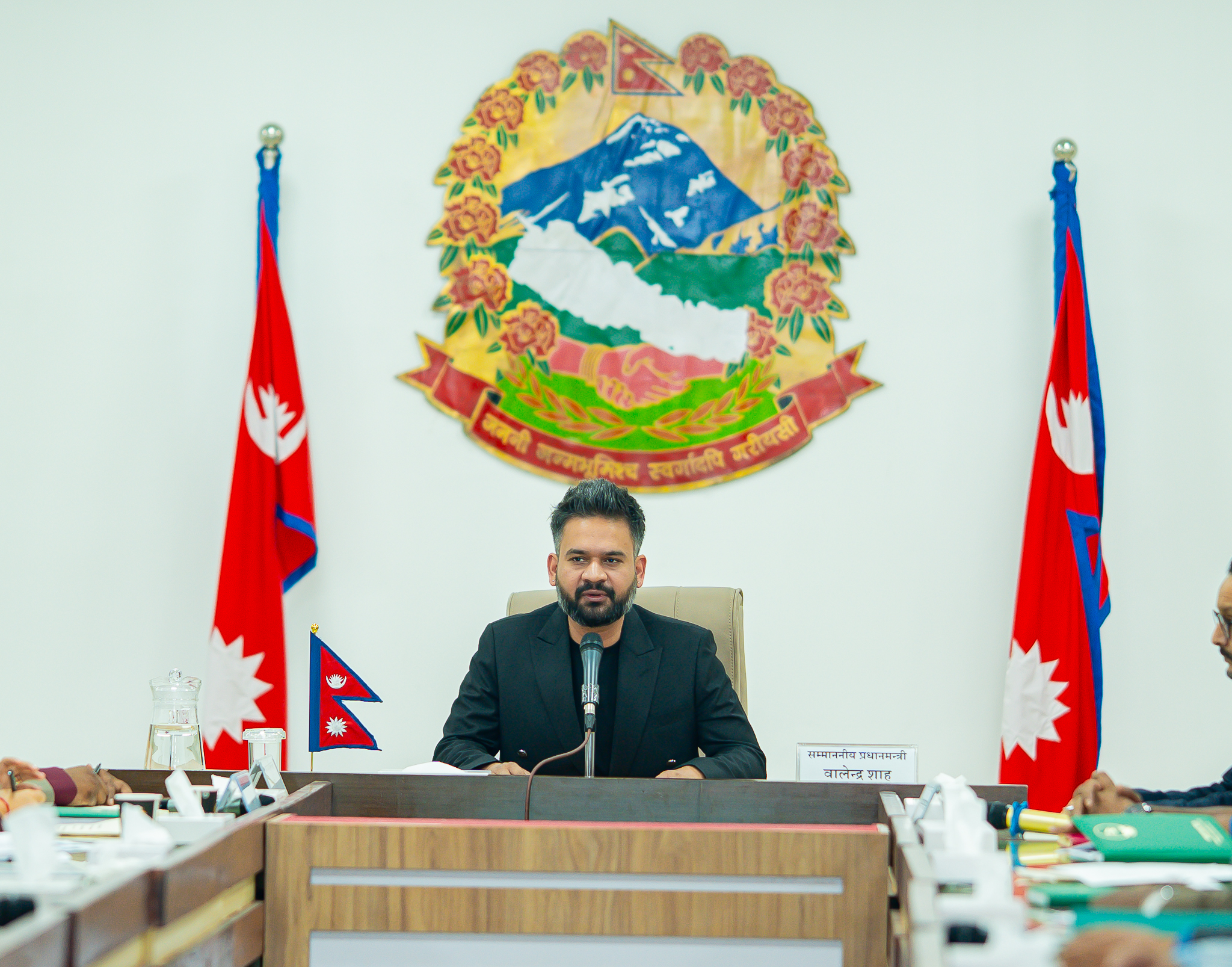
Kathmandu. The government led by Prime Minister Balendra Shah has issued around four dozen directives, working procedures and directives targeting various ministries, commissions, secretariats, provinces and local levels as well as its subordinate bodies, focusing on governance reforms, effectiveness of service delivery and promotion of good governance.
The Office of the Prime Minister and Council of Ministers has so far issued around 40 directives, working procedures and directive circulars since the formation of the incumbent government with the objective of making the administrative mechanism efficient, transparent, accountable and people-oriented. Most of these directives, working procedures and directive circulars are directly related to the effective implementation of the 100 agendas related to governance reforms released by the government.
The directives, working procedures and directives of the government are mainly focused on administrative reforms, service delivery, austerity, agriculture and trade promotion, natural resource management, prevention of corruption, good governance, public accountability, education, health, foreign employment, health insurance reform and addressing citizens’ grievances.
According to Prime Minister’s press and research expert Deepa Dahal, the guidelines have been issued with the goal of ending administrative dilly-dally, emphasizing on digital governance, removing unnecessary procedural hassles, maintaining frugality in government expenses and providing quick and effective services to citizens.
In order to make the administrative process efficient, the decision making process would be limited to three levels by implementing the ‘Business Process Reengineering’ (BPR) guidelines while directing all government bodies to strengthen the Integrated Office Management System (GIOMS) and carry out work activities through the digital system.
Likewise, emphasis has been laid on prioritizing reform programmes such as ‘zero remaining files’ campaign, grievance management, update of details and maintaining institutional memory. The circular has enforced strict provisions to maintain austerity in government expenditure, purchase new materials except essential materials, repair and use old materials and prevent misuse of vehicles.
The directive was issued to stop the foreign travel of the civil servants for the time being so as not to affect the governance reforms. Likewise, directives have been issued to operate cold stores in full capacity for the promotion of agriculture and production sector, increase consumption of milk and milk products, manage details of import of agricultural products and make the situation of chemical fertilizers distribution transparent and stock.
A letter has been sent to all the ministries to approve the decision on O&M guidelines by mid-July. Guidance for the preparation of annual action plan for the fiscal year 2083÷84 and the concept of the annual program have also been issued.
Directives on providing details of financial management of madrasas, relieving of the post of vice-chancellor and office bearers of various universities and bodies, conducting classes on television of all secondary level subjects, strengthening Nepal Drugs Limited, stipend and working hours of MBBS and BDS intern doctors, management of Nepali workers going for foreign employment, health insurance program reform and management of non-governmental organizations (NGOs÷INGOs) and social welfare councils. A Circular of Procedure and Instructions has been issued.
A special directive has been issued to control illegal excavation, collection and transportation of river-based and mine-based products for the conservation of natural resources. All ministries, commissions, secretariats and offices have been directed to effectively control corruption-related activities. In order to increase the accountability of the government bodies towards the citizens, the directive has also been issued to regularly update the details of the office chief, spokesperson and information officer and to compulsorily address the complaints by picking up the phone during office hours.
Office of the Prime Minister and Council of Ministers under secretary and assistant spokesperson Srijana Sharma said that the Office of the Prime Minister has been coordinating and facilitating among the ministries, commissions, secretariats, provinces and local levels as an apex body for coordination, monitoring and evaluation of the government. According to him, the Office of the Prime Minister has issued these documents to the bodies concerned from time to time to effectively implement the agendas forwarded by the government, maintain coordination among the ministries and speed up the overall governance reforms.
Stating that most of the directives, working procedures and directives issued in the last three months are related to the implementation of the agenda related to governance reforms of the government, he said progress details are regularly sought from the ministries and bodies concerned for the implementation of these directives, monitoring them and making necessary facilitations.
“Works cannot be completed only by issuing directives, working procedures and directive circulars, regular follow-up is carried out to ensure their implementation,” Sharma said. The Office of the Prime Minister and Council of Ministers has been coordinating with the bodies concerned to resolve problems in course of implementation. ”
According to Sharma, the directives of regular nature are in the process of continuous monitoring while the directives are evaluated on the basis of progress indicators. According to the Office of the Prime Minister, most of the ministries and bodies have been implementing the directives, working procedures and directive circulars with high priority.
According to the Prime Minister’s Office, the documents are technology-friendly governance, simplification of decision making process, discipline in public expenditure, sustainable management of natural resources, corruption control, reforms in education, health and health insurance and public accountability delivery.
















प्रतिक्रिया दिनुहोस्