

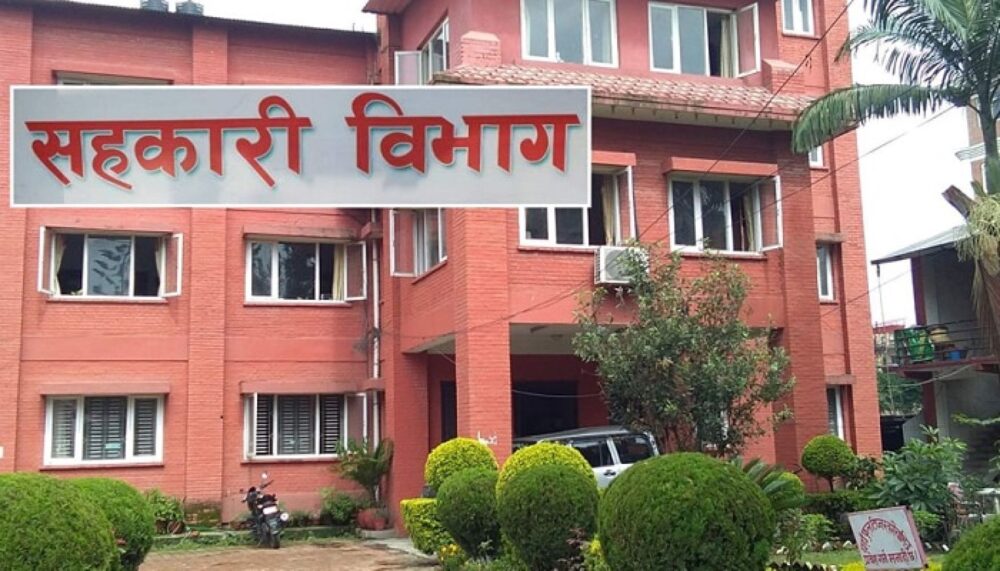
Kathmandu. Nepal’s cooperative sector has been facing criticism in the last few years for financial irregularities, lack of good governance, non-refund of money to savers and weak management.
At present, the cooperatives are also finding it difficult to maintain public trust. The challenge before the government and cooperatives is to re-establish the cooperatives that are in trouble by restoring public trust. In order to reduce this challenge, the department has also intensified promotional programs along with regulation.
The Department has laid emphasis on capacity building of cooperatives and thematic associations across the country, focusing on capacity building, financial discipline, use of technology, legal reform and good governance.
According to the department, regulation alone is not enough to make the cooperative sector systematic, transparent and accountable in recent period. The Department has been carrying out various programmes in coordination with the Cooperatives Regulation Authority, National Cooperative Federation, National Cooperative Bank and 22 Central Thematic Cooperative Federations.
The Department has given continuity to training, orientation, interaction and technical facilitation, prioritizing institutional strengthening of the cooperative sector, promoting good governance, legal and policy capacity development, fiscal discipline and technology-friendly management. According to the department, such programs will be further expanded in the coming days.
Property Laundering Prevention Special Priority
}
The Department has given special priority to money laundering and suspicious financial transactions through some cooperatives in recent years. According to the Department, the training on Money Laundering and Combating Financing of Terrorist Activities (AML/CFT) has been intensified targeting the directors, managers, employees and employees of the regulatory bodies.
According to the department, 525 directors, managers, employees and representatives of the bodies concerned have received such training so far. According to the department, the training will be conducted on identification of suspicious transactions, legal liability, risk assessment, member identification system (KYM) and financial discipline.
According to department officials, such training will be further widened in the coming days as cooperatives need to adopt risk management as per international standards while carrying out financial transactions.
Emphasis on accounting and financial discipline
A systematic accounting system is essential to maintain financial transparency in cooperatives. The Department has been continuously conducting capacity building programmes in this area as well.
According to the department, more than 175 people including representatives and employees of cooperatives have been imparted training through training on accounting system management in the last two fiscal years.
Likewise, training on financial risk management has been conducted for managers and employees of cooperatives. The training focused on financial risk identification, liquidity management, internal control system, risk mitigation and institutional sustainability is expected to make the management of cooperatives more professional.
According to the department, 90 office-bearers of various cooperatives have been imparted training on amending the bylaws and preparing new bylaws. The Department believes that such training would be useful in revising the bylaws as per the changing legal system and institutional needs.
Still challenges in COPOMIS implementation
}
The Department has been prioritizing the implementation of the Cooperatives’ Integrated Information Management System (COPOMIS) developed with the objective of connecting the cooperative sector to the digital system.
COPOMIS aims to document the financial statements, number of members, savings, loans, operating conditions and other administrative details of the cooperatives in an integrated manner. This is expected to make regulation more effective and provide reliable data for policy making.
The Department has been conducting both theoretical and practical training. Deputy Registrar and Information Officer of the Department, Suchitra Rai, said that 200 representatives of cooperatives and employees of the regulatory body were imparted training on COPOMIS in the last and current fiscal year.
However, not all cooperatives across the country have been able to join COPOMIS yet. The Department and regulatory bodies need to take more effective initiatives to fully implement the information system.

According to Rai, the details of the societies and defunct cooperatives that have entered double details are being studied to make the system more effective. After the study, the department is preparing to make the data accurate, up-to-date and reliable.
Similarly, the Department has been making monitoring the utility and effectiveness of government grants provided to cooperatives in the past more effective.
Although the distribution of new grants has been stopped for the past four years, the issue of whether or not the grants under the seeds capital, capital assistance and other headings have been properly utilized is now in the priority of the Department.
According to the Department, the cooperatives that have received grants under different headings after the fiscal year 2073/74 BS are being monitored on-site. So far, more than five dozen cooperatives have come in contact with the department, and the actual number is expected to be much higher.
According to department officials, the evaluation of the effectiveness of the grant is expected to help make government assistance programs more systematic in the future.
With the increase in the number of cooperatives, the management of cooperatives that have problems in operation, become inactive or financially weak has become challenging. Keeping this in mind, the Department has been conducting orientation and interaction programmes for the effective implementation of the legal provisions related to the merger and division of cooperatives.
According to Sub-Registrar and Information Officer Rai, the office bearers of the concerned organizations are being regularly informed about the legal process, necessary criteria and procedures.
Although the department has intensified its promotional programs, it has continued its regulatory responsibilities. According to the department, regular monitoring, inspection and regulation of cooperatives that are under the direct jurisdiction of the department are continuing.
Currently, 20 cooperatives are operating savings and loan transactions among the institutions under the direct regulation of the department. According to the Department, monitoring is being carried out keeping in mind the financial condition of such institutions, good governance, law enforcement and protection of members’ interests.
Attempt to restore trust
The co-operative sector is now at an important stage of confidence building. It has become the prime responsibility of the state to make this sector, which is directly related to the interests of millions of savers, transparent, accountable and technology-friendly.
According to the department, it has been continuing promotional programmes simultaneously with the focus of capacity building, fiscal discipline, good governance, expansion of digital system, legal reform and regulatory consolidation.













प्रतिक्रिया दिनुहोस्