

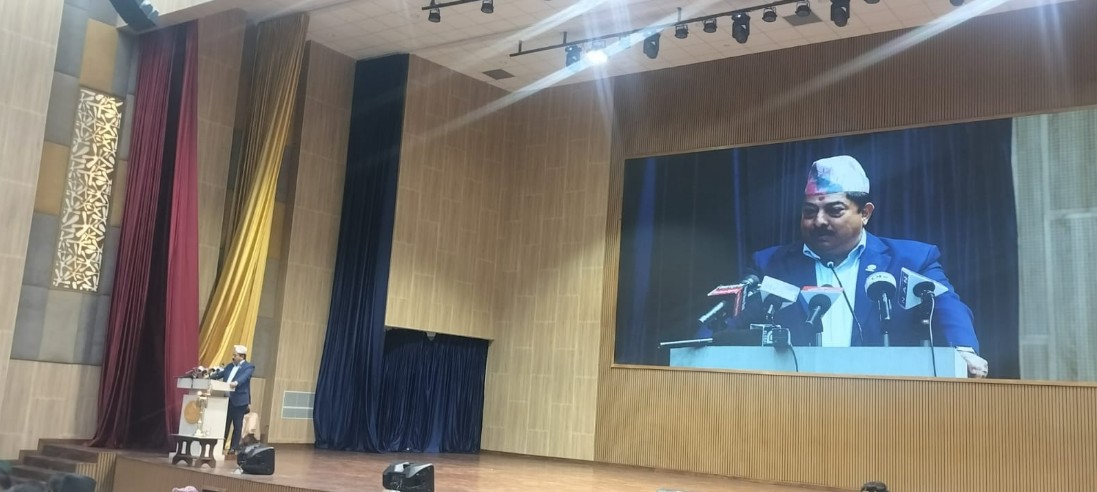
Kathmandu. KATHMANDU: The stakeholders have drawn the attention of the government to the lack of improvement in road infrastructure, traffic management and road safety in the country in the last two decades.
Anjan Shrestha, president of the Federation of Nepalese Chambers of Commerce and Industry (FNCCI), has said that time has come to pay special attention to the road infrastructure from the capital to the municipality level. According to him, a review should be done on how many vehicles have been added to the roads in the last 20 years and how much the road and traffic infrastructure has been expanded accordingly.
According to him, although the number of vehicles is increasing, traffic management and road capacity have not been expanded accordingly. According to him, the condition of the road will remain the same but the number of vehicles is increasing and the number of accidents, traffic jams and difficulties in travel are increasing.
Shrestha also urged the government to open the registration of new vehicles during the Dashain festival. Saying high customs duty has made vehicles costlier in Nepal, he urged the government to reconsider tax and customs policy.
President of Confederation of Nepalese Industries (CNI), Birendra Raj Pandey, said employment opportunities could be created if investment was increased in infrastructure sector. He also stressed on the need of keeping the automobile sector in the government’s priority.
According to him, the investment in road, transport and other infrastructure can directly increase economic activities and also create employment opportunities. Therefore, infrastructure development should be promoted as the basis of long-term economic development.
Federation of Nepalese Transport Entrepreneurs (FNTE) President Saroj Sitaula said that the transport sector has been facing problems due to the lack of uniform policies of the federal and provincial governments. He stressed the need of effective coordination among all three tiers of government while formulating transport policy.
Sitaula demanded that the government provide grants and incentives for the construction of charging stations in view of the increasing use of electric vehicles (EVs). He said that EV users are facing problems due to lack of charging infrastructure.
Stating that the import of spare parts of fake and substandard vehicles is increasing in Nepal, he demanded the government to control this. He said that the use of substandard parts can also have a serious impact on vehicle safety, so market monitoring and regulation should be made effective.
Inspector General of Nepal Police, Dan Bahadur Karki, also urged the government to put road safety in top priority. According to him, the negligence of the driver should not be blamed only after a road accident.
According to him, haphazard parking on the roads, lack of lane discipline and lack of effective road engineering have added to the challenges of road safety. He stressed the need for effective role of road infrastructure, traffic management and bodies concerned along with drivers.
According to Karki, 29,988 road accidents took place in the country in the last fiscal year. This is an increase of about 4 percent compared to the previous fiscal year.
About 47,000 people were injured in the accident and an average of seven people died every day. According to him, 69 per cent of road accidents are related to motorcycles. He said that cars and other vehicles are also the cause of accidents.
Inspector General of Police (IGP) Karki said that electric vehicle users have been receiving various complaints about the issue of spare parts. He suggested that the bodies concerned should take the problems related to technical and spare parts seen in EVs seriously.
He also stressed the need to pay attention not only to the number of vehicles but also to the condition of roads and other infrastructures required for the same.
The stakeholders have urged the government to improve the overall policy on transport and road safety, with the message that it should not only bring vehicles, but also pay attention to the construction of vehicles and safe transportation system.
With the increase in the number of vehicles in Nepal, there is a need to address road capacity expansion, traffic management, parking, charging infrastructure, availability of quality spare parts and road safety in an integrated manner.












प्रतिक्रिया दिनुहोस्