

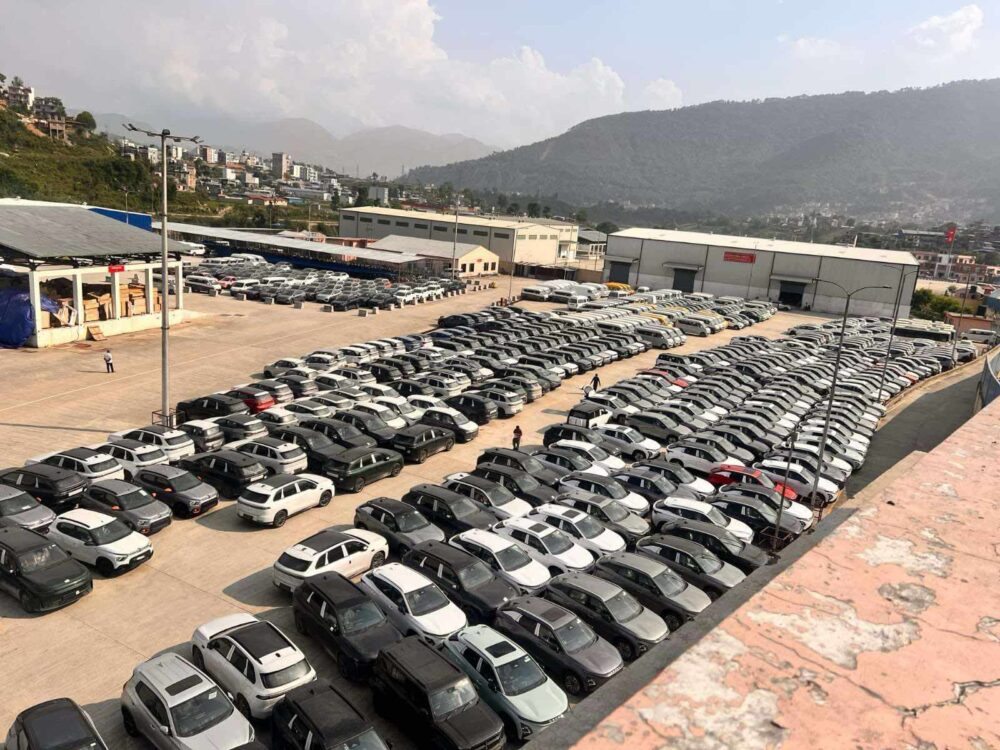
Kathmandu. Electric vehicles have become the choice of customers after the government adopted a policy to promote electric vehicles (EVs). People are attracted to electric vehicles as they cost much less than petroleum products, are environmentally friendly and have good health.
Reducing the dependence on petroleum products, tax and financial incentive measures and easy investment have also been the choice of the general public along with imports. According to the National Transport Policy 2083 released by the Ministry of Infrastructure Development recently, electric vehicles share more than 70 percent of the private cars imported in Nepal.
KATHMANDU: Nepal has secured the second position in the market share of electric vehicles in terms of sales of new vehicles in the world. It is only behind Norway. Dhruba Thapa, former president of NADA Automobiles Association of Nepal, said that people’s interest in electric vehicles is increasing in Nepal. Out of the total import of four-wheelers in Nepal, more than 70 percent are electric vehicles. This shows that people’s attraction towards electric vehicles has increased in the district,” he said, “Along with the import of electric vehicles, it has become necessary to give special emphasis on the infrastructure including charging stations and roads.” ”
According to former chairman Thapa, electric vehicles worth Rs 15 lakh to Rs 40 million have been imported in Nepal. “Nepali consumers are increasingly enticing to go from affordable four wheelers to electric vehicles with modern features,” he said.
The National Transport Policy 2083 has also been implemented to promote electric vehicles and charging stations. The policy endorsed by the meeting of the Council of Ministers on July 9, 2083 has the main goal of making the integrated transport system of Nepal safe, accessible, sustainable and competitive, contributing to economic prosperity, social inclusion and regional integration.
The government of Nepal has been taking various initiatives through regional forums such as BBIN, SASEC and BIMSTEC to promote regional connectivity, economic corridors and cross-border transport. In the context of the growing risks and impacts of climate change, Nepal has been reaffirming its commitment to the Paris Agreement and has been giving priority to the development of a climate-resilient, green and sustainable transport system.
Electric vehicles {{TAG_OPEN_strong_35 TAG_CLOSE_strong_35}}
} reach 63,000 electric vehicles {{}
According to the National Transport Policy 2083, the total number of electric vehicles registered in Nepal has reached 63,280 in the fiscal year 2082/83. A total of 62,49,732 vehicles have been registered across the country till mid-March of the fiscal year 2082/83. Among the registered vehicles, more than 50 lakh are motorcycles. Motorcycles account for more than 80 per cent.
More than two thousand charging stations are ready
According to Sagarmani Adhikari, assistant manager of the Nepal Electricity Authority (NEA) charging station project, charging stations for around two thousand electric vehicles have already been set up across the country. “Charging stations for electric vehicles have been set up in almost every city of the country,” he said, adding, “The government alone has more than one hundred charging stations while the private sector has already set up charging stations.” He said that the construction of charging stations is also going on with the increase in the preference of people towards electric vehicles.
“People’s attraction towards electric vehicles is increasing as the government has introduced a policy to promote electric vehicles,” he said, adding, “The time has come for the government to introduce a policy to promote electric public vehicles rather than four-wheelers.” That arrangement could not be made. This will help to manage it in the long run. ”
This is the status of import
In the last fiscal year 2082/83, Nepal imported 10,845 electric vehicles worth Rs 25.55 billion. According to the Department of Customs, electric vehicles of various models ranging from 50 KW to 201 KW capacity were imported in the last fiscal year. According to the department, 3,680 electric jeeps, cars and vans with 50 KW capacity were imported in the last fiscal year.
Similarly, 6,357 electric vehicles with 51 KW to 100 KW capacity were imported in the last fiscal year. In the last fiscal year, 798 electric vehicles with 101 to 200 kilowatt capacity were imported in the country. Similarly, 10 electric vehicles with 201 KW capacity were imported in the last fiscal year.
According to the Department of Customs, 13,567 electric vehicles of various models were imported in the fiscal year 2081/82. According to the Department, 4,732 electric jeeps, cars and vans with 50 kilowatt capacity were imported in the fiscal year 2081/82 BS. Likewise, 7,431 electric jeeps, cars and vans with 51 KW to 100 KW capacity were imported in the same period worth Rs 18.62 billion. In the fiscal year 2081/82, 1,362 electric, jeeps, cars and vans with 101 KW to 200 KW capacity were imported worth Rs 4.53 billion.
Former president of Nada, Thapa also suggested that the government should implement the provision of importing electric vehicles by setting certain standards. “It would be very beneficial for the general public if the government had a policy of importing quality and reliable electric vehicles instead of inferior ones. He also requested the importers of electric vehicles to bring along the equipment required for the repair and maintenance of the vehicles.
According to the National Transport Policy, 2083 BS, motorcycles account for more than 80 percent of the total vehicle fleet. Two-wheelers are under excessive pressure, increasing road accidents, increasing traffic pressure and air pollution. The policy states that the Government of Nepal has been taking various policy and programmatic initiatives in the past with the objective of promoting environmental sustainability in the transport sector. Himal Lamsal/RSS














प्रतिक्रिया दिनुहोस्