



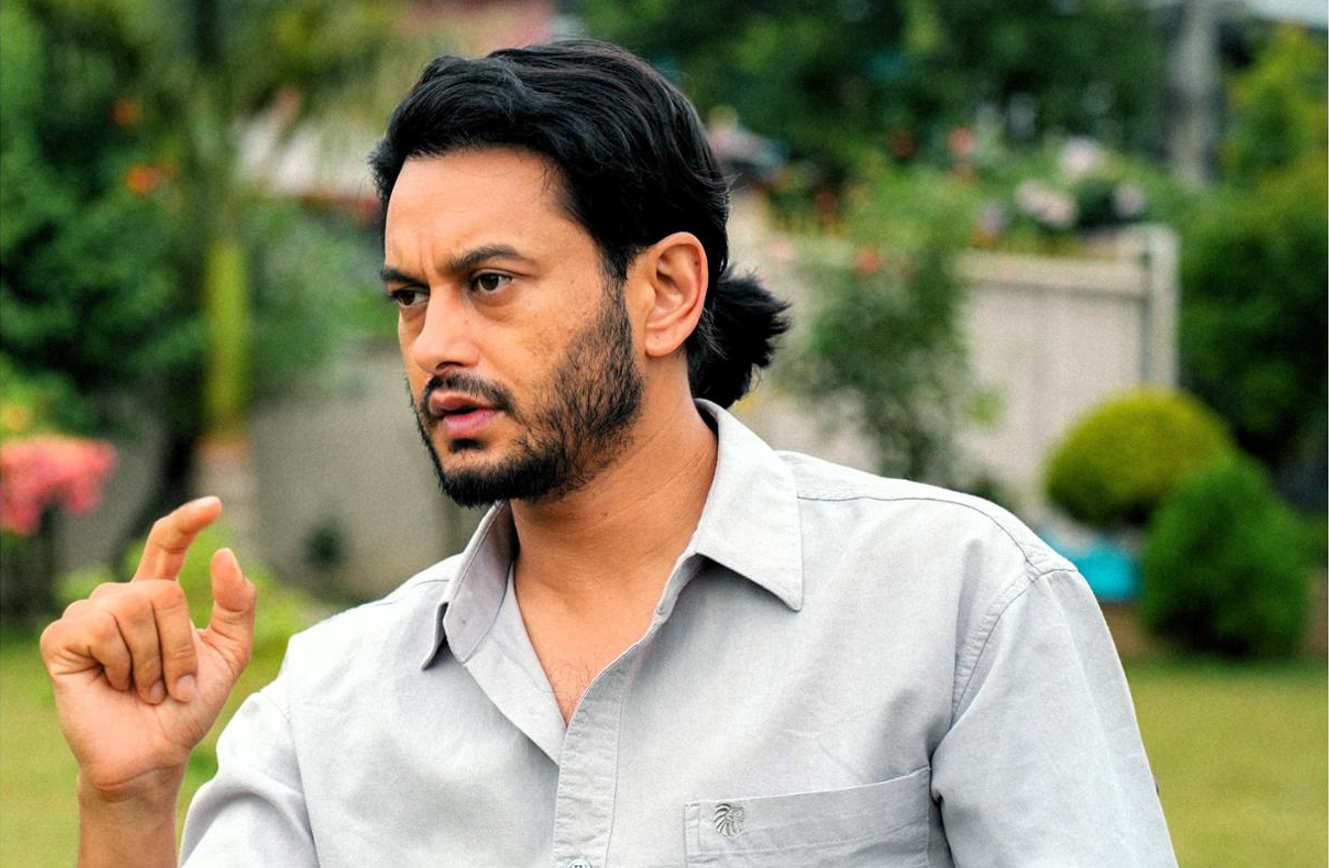
Pradeep Khadka, one of the most popular actors in the Nepali film industry, has been raising his voice for the conservation of nature with the help of camera and light.
As the ‘Climate Goodwill Ambassador’ of Karnali International Film Festival, he has been seriously presenting Nepal’s mountains, environment and climate justice agenda in national and international forums.
The recent devastating floods and landslides in the Bhotekoshi area of Rasuwa have once again proved the reality of how big a risk Nepal is at risk of climate change. Actor Khadka, who has been warning of a possible natural disaster for the last three years, expresses his concern that the country’s entire tourism and film industry ‘open studios’ will be destroyed if the mountains melt and turn into black stones. His main stand is that Nepal should have easy access to the ‘Loss and Damage Fund’ to compensate for the unimaginable losses that Nepal has suffered due to the excessive carbon emissions of developed countries.
Here is a conversation with actor and climate activist Pradeep Khadka focusing on the government’s preparedness for disaster management, climate justice and social responsibility of an artist:
You are an established and busy actor in the Nepali film industry. What is the reason behind suddenly focusing on the issue of climate change?
I am basically an artist and my workplace is the nature of this country. It is my big dream to promote Nepal as a major destination for ‘film tourism’ in the world. But when I saw our white mountains melting into black stone, I was shocked. If this unique beauty of mountains and nature is not there, how will the concept of our ‘open studio’ survive? If the natural studio is destroyed, what will we show to the world? This reality forced me to come out of the lens of the camera and speak for the conservation of nature. This is related to both my professional future and the existence of the country.
– For the past few years, you have been continuously raising your voice at home and abroad. Tell us in a way that the general public and the world community can understand, what is your main climate agenda?
My main agenda is to ‘encourage conservationists’. There is a concept of carbon trading in the world today, but there is a big gap in its practical aspect. If there is economic benefit only by cutting down forests, then where is the incentive for those who plant and grow trees? We are saving the world by providing oxygen. So, my position is clear that those who save nature should get a fair appreciation and economic benefits. This is what climate justice is all about.
For the last three years, he has been warning of the climate catastrophe that Nepal will face in national and international forums. How do you see the recent devastating floods in Bhotekoshi and Melamchi?
This is very heart-wrenching and the world needs to become more serious after this. This problem is not only a common problem of Nepal and our mountains, but of the people of the whole earth. We have destroyed the ecosystem of nature. See, monkeys have reached Jumla and started destroying crops. In a country like Iceland, where there were no mosquitoes, mosquitoes have been found since 2025. The cobra snakes found in the Terai are climbing the mountains. All this is the result or product of global warming. It has an impact from the mountains to the sea. Bhotekoshi is only an early sign. Even after this, we will have to face such crises again.
If there is economic benefit only by cutting down forests, then where is the incentive for those who plant and grow trees? We are saving the world by providing oxygen. So, my position is clear that those who save nature should get a fair appreciation and economic benefits. This is what climate justice is all about
You have repeatedly warned the government that ‘disaster can strike at any time, be prepared’. But what is your comment on the poor preparedness and policy apathy that wakes up only after the incident has happened?
This is very disappointing. Disaster management is not just about taking helicopters and distributing noodles. It is pre-event preparation. We do not have an early warning system. There is a dozer menace in the hills, roads have been dug without any engineering. The government should make the development model climate friendly. If those at the policy-making level continue to ignore the signs of nature, we will have to face even bigger human and economic losses in the future.
Low carbon emitting countries like Nepal have to pay a heavy price because of the rich and industrialized countries of the TAG_OPEN_strong_48 world. What do you think the next international lobbying should be like to get climate compensation from rich countries?
Nepal’s carbon emissions are less than 0.1 percent, but we are the fourth most risky country in the world. Now our international lobbying should not be in the style of ‘asking for grants or help’, but in the style of ‘claiming our rights and compensation’. We have done good by giving oxygen to the world through our mountains and forests. We should have easy and direct access to the ‘Loss and Damage Fund’. For this, our communication mechanism in the government, diplomatic missions and international forums needs to be very aggressive and evidence-based. Foreigners only give sympathy, but we need action, not sympathy.
Most artists are reluctant to speak out on social or political issues. How do you find a balance between being a glamorous stardom and being a serious climate activist?
No matter how much those who suffer discrimination shout that discrimination is wrong, until the discriminatory side is aware, there will be no solution. Nepal is an innocent victim of climate change. Film and art are powerful mediums that can convey this reality emotionally. ‘Glamorous stardom’ and being a serious activist are not contradictory, but complementary to each other. Stardom has given me a microphone, and the climate crisis has given me the content to speak on that microphone. The media attention I am getting is not only my personal property, it should be utilized in the interest of the nation. It is not only a balance, but a full use of responsibility.
We have done good by giving oxygen to the world through our mountains and forests. We should have easy and direct access to the Loss and Damage Fund. For this, our communication mechanism in government, diplomatic missions and international forums needs to be very aggressive and evidence-based. Foreigners only sympathize, but we now need ‘action’, not sympathy {
}
The melting of Nepal’s mountain ranges is rapid, which has increased the risk in the downstream areas. What immediate steps do you see to be taken to save our mountains?
The first step is mapping and continuous monitoring of vulnerable glacial lakes. Siren-equipped early warning systems should be strengthened in low-lying coastal settlements. In the long run, we must reduce the use of fossil fuels and increase the use of hydropower and electric vehicles. We need to seriously establish the narrative in international forums that melting mountains will dry up the water sources of billions of people in Asia.
Today’s youth will have to bear the biggest brunt of the crisis in the future. How can the youth be practically involved in this campaign instead of limiting them to social media only?
The younger generation is very aware. Now, Nepal should be able to speak forcefully about its problems and solutions in international forums like the United Nations Annual Climate Change Conference ‘COP’, and I am always ready to participate in it. It is not enough to drive trends on social media, but the younger generation must take the initiative to make environment-friendly choices in their daily lifestyle. They should personally focus on controlling carbon emissions and making the most of Nepal’s hydropower.
The narrative that melting of mountains dries up the water sources of billions of people in Asia should be seriously established
}
Finally, despite repeated warnings, how frustrating is there when the crisis escalates? What are your plans for the future?
Disappointment is certain, but we do not have the freedom to give up. As an actor, my plan is to bring the stories of the climate crisis to the world stage through films. As a goodwill ambassador, I will continue to work with the stakeholders of Nepal on policy changes and youth mobilization. The fight to save our nature is a long one, but when I see the energy of the youth, I believe that we will be able to overcome this crisis and build a secure future.












प्रतिक्रिया दिनुहोस्