



Kathmandu. A year ago, on September 23, the Zenji movement took place.
The Genji generations should have good governance, they need employment in the country, the income level of Nepalis should increase. On September 7, the students in campus uniform reached Maitighar Mandala at 9 am with a demand that there should be no inflation.
The then KP Oli-led government had banned social media at that time. The anger of the protesters was also turned towards social media.
Ending corruption, ending nepotism and favoritism, political patronage, ending middlemen, lack of accountability, unemployment, end of misgovernance and distrust of the state machinery were the main slogans of the movement.
The agitation started from Maitighar and moved towards the International Convention Center in Baneshwar. Shortly after the peaceful movement started, it turned into violence. At Baneshwar Chowk, students in college uniform were shot.
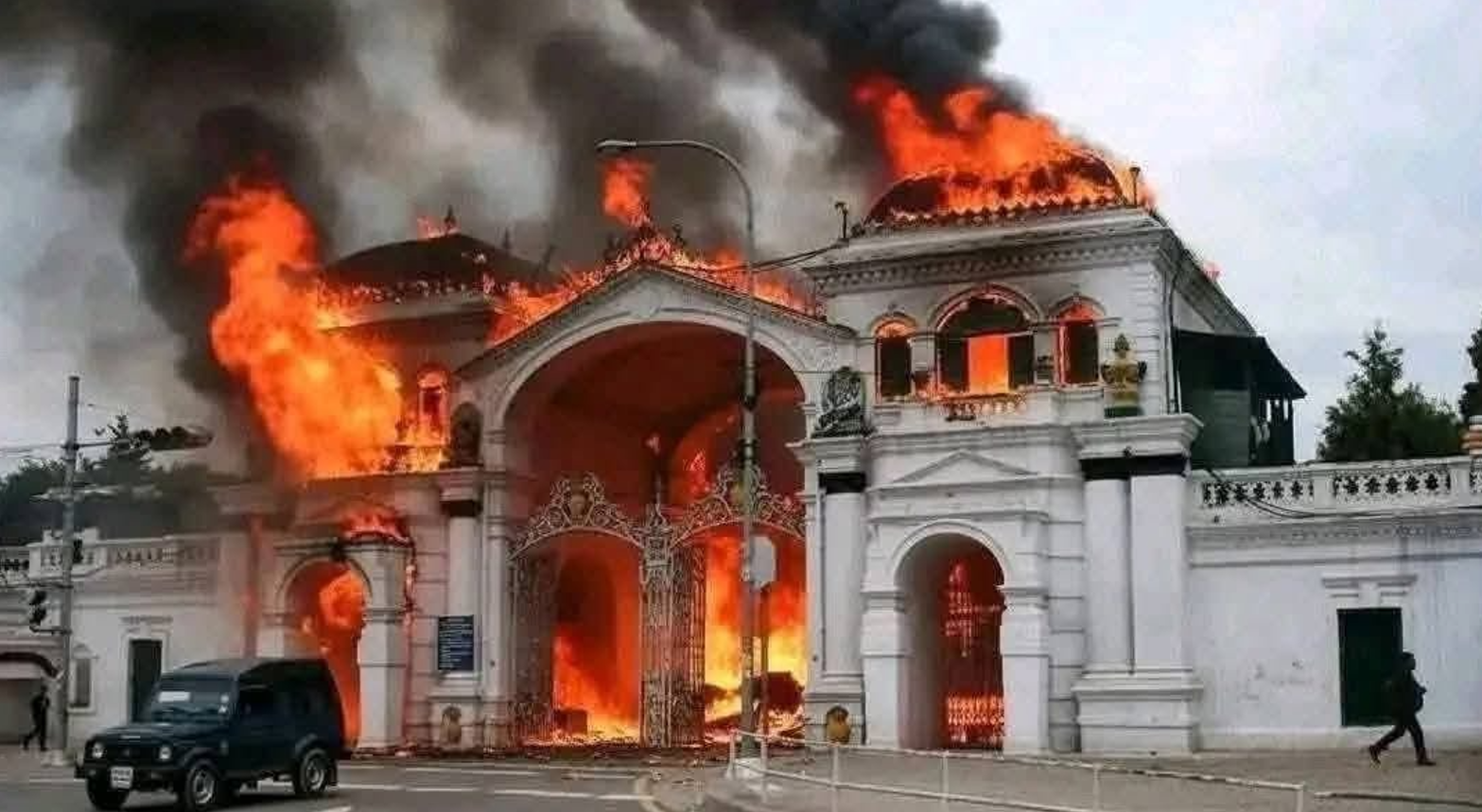
The agitation became violent. Groups wearing uniforms with TOB written on them were seen in the movement. The protesters broke the prohibitory order. The then Parliament building was demolished. The violent march of vandalism started from there, the main administrative building Singha Durbar, the Supreme Court and various district courts, the President’s residence, the police office, the government agencies, the fire broke out. Suddenly, black clouds started gathering in the sky.
According to the report, 76 people were killed and more than 2,500 injured during the protests in two days.
According to a study conducted by the government at the time, about 2,900 buildings were damaged in 55 districts across the country.
Of these, 419 are from the private sector. The JENJI agitation caused damage to infrastructure worth about Rs 78 billion. Of this, the private sector alone suffered a loss of Rs 36 billion.
The movement for good governance gave the country Sushila Karki a woman Prime Minister for the first time in the history of Nepal. Due to the movement, the government led by Oli collapsed. The elections to be held in 2084 were held in 2082. The old parties were reduced to smaller parties. New parties emerged. The youth got a chance. But how much of the Nepali people have been able to feel good governance during this period? This is the question now.
The election ended on March 21. On March 23, the government was formed under the leadership of senior leader Balendra Shah.
What work did the government do in 5 months of the formation of the government? Did it provide good governance in 5 months or not? Can the government be evaluated so soon? As the leaders and MPs of the RSP have said, nothing has been done in 35 years, isn’t it foolish to search for it in 5 months? These questions may also arise. Putting these questions aside, before the formation of this government, the RSP had promised to do the work during the elections, the promise of work that it would do in 100 days and the government had said that it would do whatever it would do for good governance. It is time to ask whether these works have been done or not.
And, the leaders of the Genji movement complain that the present government has not been able to work according to the purpose for which the Genji movement was formed.
“There was already a government to do what the previous government did. The youths started the Jenji movement so that they could start doing better work than the previous government,” says Miraj Dhungana, a leader of the Jenji movement. It could not be done. It could not be done. ”
After Balendra Sah became the Prime Minister of the country on March 27, KP Oli and Ramesh Lekhak were arrested on the 14th. During the Jenji movement, the police opened fire on their instructions, they were arrested as criminals. Later, they were released by the order of the Supreme Court.
Before that, the government formed a commission of inquiry under the leadership of Gauri Bahadur Karki. The commission prepared a report of about 907 pages. The report had recommended legal action against the then Prime Minister KP Sharma Oli, Home Minister Ramesh Lekhak and the police leadership.
After Balendra Shah became the Prime Minister, the government decided to implement the recommendations of the commission. But many questions were raised about the impartiality of the commission’s report and the legal process. The report is still not available in the public domain. The then government had arrested Oli and the writers on the basis of a news published online.
Those who were found guilty in the report prepared by the National Human Rights Commission on the Jenji movement are now walking openly. Most of them were supported by the RSP. Its government has not implemented the suggestions.
Corruption has been taking root in the country for a long time. The Shah-led government brought a 100-point Good Governance Reform Action Plan in March 2082. A youth-led government. When the youth said that they would work, everyone applauded.
It included governance reforms, digital services, faster construction of public services, reducing political interference, controlling corruption, protection of government property, etc. It was said that the assets of political and high-ranking people would be investigated. The government formed a 5-member commission to investigate the assets of former and present politicians and high-ranking officials. This work has now been stopped.
The government has not been able to make measurable major reforms in controlling corruption after the Genji movement. However, the government tried to end the middleman rule by arresting some industrialists in a hurry and trying to reduce corruption.
The government arrested businessman Deepak Bhatta. He is now in custody for preliminary hearing. Other businessmen including Shekhar Golchha arrested by the government have been released on bail.
Bhatta was known as a powerful person in Nepal. He used to work as a middleman in the appointment of public bodies. He had the power to appoint a person of his choice in public bodies like Securities Board of Nepal, Insurance Authority, Nepal Stock Exchange, Civil Aviation Authority and transfer employees who did not work according to him within 24 hours. He had taken every government under his control.
This government has tried to bring such powerful middlemen under the purview of action. Does this alone bring good governance? Good governance will come only by arresting journalist Kishor Shrestha for personal anger and keeping him in custody for 5 days? Will good governance come by arresting industrialists like Shekhar Golchha and Shahil Agarwal without sufficient evidence? Now many people have such questions.
When the government handcuffed businessman Shankar Agrawal. After that, the private sector got scared. When Bhatt was arrested, there was a lot of speculation. Some tried to clean him up, while some said that this government will not spare anyone anymore.
The private sector had been saying ‘gold only’ for a long time. But when this government went at the speed of ‘shutting down whoever found it’ instead of gold, panic spread among everyone. The government seemed to get applause on social media rather than evidence. Former Finance Minister Bishnu Poudel was arrested. He was later released. The arrest of banker Jyoti Prakash Pandey and the arrest of the government industrialists made the private sector very scared.
Dhungana, the leader of the Genji movement, says that there is still a political transition period. The spirit of the Jenji movement has not been fulfilled.
Through the 100-point plan, this government aims to reduce political interference in the administration, increase the digital system and improve service delivery. There is no room to question the policies brought by the government. But the results of the structural reforms have not been seen. The government had and has a plan to make government services quick and hassle-free.
This is also the real test of good governance. In the 100-point plan, the government had said to digitize government services, reduce the lines, speed up service delivery and administrative restructuring. The government has been disappointed more than expected after the government has lined up the consumers on the streets all day for the distribution of gas. Miraj argues that the government, which was formed on the strength of social media, has not been able to rise above the discussion of social media and has not yet understood the essence of the people at the grassroots level.
Nepotism and political patronage were made the main issues in the Jenji movement. When the name of Education Minister Sammit Pokhrel was put forward during the formation of the government. Since then, he felt that Neppobaby was dominating the government. There have been complaints from time to time that there are many Neppobabies in the parliament as well.
The government has announced to reform the political and administrative structure, give priority to merit and accountability. If the government makes an announcement, it will not be done immediately. We have to see how far the necessary process has progressed for this. At present, the administrative structure has not improved because the government does not trust the employees and the employees do not trust the government.
Earlier, the employees did not want to go from the union to the state and local level. Now the employees do not want to stay in the union. Now the employees still do not trust the government completely. The government has not trusted the employees completely.
The government is still looking at the employees as being supported by the old political parties. Looking at the buildings of Singha Durbar that were burnt down under the pretext of the Jenji movement as soon as they entered Singha Durbar, the employees are still looking at the buildings of Singha Durbar, what kind of government is this, what is its stability? How can we believe it? They are confused.
The ministers of the government are like the CEOs of private companies. Ali used to shout loudly that the work to be done in the morning is to do it in the evening. For years, it will be done, this work will be done soon, the process has been done, the friends of the comment can do it by the evening, necessary research is being done for it. It is difficult for the employees who are accustomed to saying that the study is also being done in the evening.
Now the government is working to reduce the morale of the employees by not working on time. Still, the ministers have not been able to take the employees into confidence. The ministers have been saying that they have to work anyway. But they have not yet understood how to work. The result is visible in the service provided to the people.
The RSP is partly worried that the RSP will sink when the ministers try to intimidate the employees instead of intimidating them. At this time, if the work is done with the knowledge of the minister and the experience of the employees, then no one can stop this government from reaching the pinnacle of success.
It is a government that has won 182 seats. Now the government has to dispel the accusation that the employees have come to the foundation of the agitation and do not understand the procedure. Now the government has not been able to trust the employees, but it has not discriminated on the basis of political cover.
But the government’s shortcomings in gas management have started to disappoint many. The government, which arrested Bhatta to end middlemen, has not tried to facilitate the delivery of services by bringing middlemen to action in places like transport offices and bus parks. It is difficult to find a middleman in front of the Department of Foreign Employment. But now there is a shortage of gas in the market. The number of people who say ‘I brought gas by paying Rs 26’ is increasing.
When the government is saying that it will do this work in 100 days, the employees are also witness to it. This work is not possible without the employees. There is a concern in Singha Durbar that the government is not able to understand this.
In this one year, the Oli government fell, the parliament was dissolved, an interim government was formed, a new election was held, the old parties were reduced to smaller parties, and the new political force got a majority.
But the end of corruption, Nepal will come out of the grey list, nepotism and political patronage will be completely ended, government services will be completely hassle-free, the judicial process of those killed in the Genji movement has not yet reached the final conclusion.
All the recommendations of the commission have not been implemented. The beginning of improvement in good governance is being shown. Some people have also got services at home by starting the postal service which was in a dead state. They have also got passports and licenses at home by filling up a form of Rs 55.
In the 100-day progress report released by the government on July 3, 2008, 70 points have been implemented and the overall progress has been 87. It claimed that 2 percent progress has been made. Of the remaining points, 17 have more than 80 percent progress and 13 have less than 60 percent progress. However, the government has only 38 out of 100 points and 62 are still incomplete.
The government has started the process of returning the money of small savers of the troubled cooperatives during this period.
In that too, it is a good thing to recover the loans of the borrowers of the cooperative and return the savings. So far, the government has been saying that this amount has been given only in numbers. It has not been said on the basis of the amount.
The government had said that it would decide on the power purchase agreement and license within 6 months. The time allotted to do this work is about to expire. The result has been limited to the formation of the committee.
Even though there was a majority government in the country, the morale of the private sector could not increase. The private sector is now in a state of panic. The stock market is always like a red one. There is disappointment all around because the morale of the investors has not increased. The government is trying to reopen the closed industries. It does not want to know about the condition of the existing industries. Anjan Shrestha, president of the Federation of Nepalese Chambers of Commerce and Industry (FNCCI), says, “When the government tried to pick up the ground, it did not notice that the bullet had fallen. ”
The government has not been able to send ambassadors to different countries for about 9 months now. There is arbitrariness in the appointment. Now the Genji people have come to the conclusion that the government does not understand the country and the private sector government does not understand the importance and contribution of the private sector.












प्रतिक्रिया दिनुहोस्