

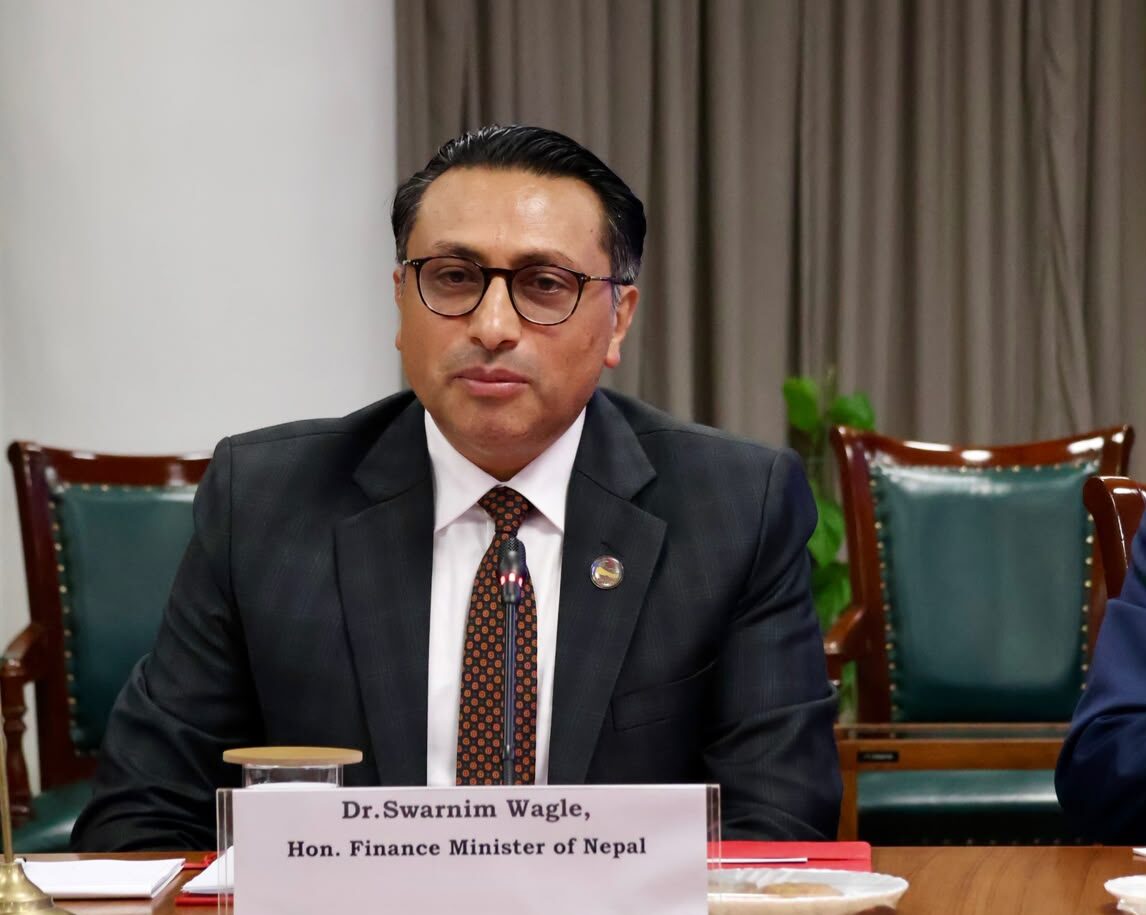
Kathmandu. There has been widespread criticism of the decision taken by the learned finance minister of the powerful government formed after the Jenji movement with nearly two-thirds of the votes.
Although no one can openly criticize the ministers of a powerful government, criticism of the economic policies taken by them in all spheres has started spreading like chaff.
The decisions taken by this government have benefited the people and investors today. Although it is a temporary benefit, there is also criticism in the long run.
The main reason why Dr Swarnim Wagle is being criticized for being the scholar of the powerful government is the policy of removing the 3 percent egalitarian tax levied on health and education and reducing the capital gains tax drastically.
The government removed the tax on health and education to compensate for the deficit. Education and health equality tax was imposed in the budget for the current financial year. After the tax was widely criticized, Prime Minister Balendra Shah announced that the tax was removed through social media on July 5, not by the Finance Minister. Finance Minister Wagle announced that Prime Minister Shah would not take the tax levied through the budget and the Finance Act through social media.
In the second week of July, the tax was also published in the Gazette. This decision of the government made all Nepalis happy. The tax imposed by the government for a fiscal year did not last even for a week. This government has not only removed the tax imposed by the government but has also reduced it. On the night of September 12, Finance Minister Wagle brought a 21-point capital market consolidation and revival action plan.
Through this, the capital gains tax was reduced. The action plan brought by him said, “In the case of the profits derived from the disposal of the interest of the entity listed on the board, the body operating in the stock exchange market shall maintain 3.75 percent of the profit amount of the interest owned for more than 300 sixty five days in the case of a resident natural person and 5 percent of the profit amount of the interest owned for a period of 365 days or less.”
The Cabinet meeting held on September 14 decided to reduce the capital gains tax. Along with this, the 10 percent profit tax for less than one year has been reduced to 5 percent and the 7.5 percent tax for more than one year has been reduced to 3.75 percent.
In the previous fiscal year, the tax was 5 percent for long-term investors and 7.5 percent for short-term investors. Stock investors are excited when Finance Minister Wagle reduced the tax. But former Finance Minister Prakash Sharan Mahat says that the change in tax rates before two months of the implementation of the budget should be compared with the decision-making capacity of the Finance Minister.
Former Minister Mahat said that the government’s frequent changes in tax rates have shown the immaturity of the Finance Minister and the government. “It is clear that the government has not shown farsightedness while bringing the budget due to changing the tax rates and removing taxes in a short span of time,” he questioned.
Mahat said that the government’s decision to run the tax rate in such a short time is a contradiction in itself. Mahat said that this is the main problem of bringing the budget without studying enough before bringing the budget.
In Nepal, the private sector has been demanding a stable tax policy for a long time. The tax brought by the government for a year will be beneficial for everyone in the short term. But in the long run, the tax policy of that government is not stable. It works to discourage the private sector by saying that it can run the tax rate whenever the government wants.
Former minister Mahat said that if the government fluctuates the tax rate at any time it wants, it will further shrink the morale of the private sector.
According to the provision of Section 18 of the Finance Act, the government can use the tax rate in special circumstances. However, even if it seems good for the time being to run the rate without tax, it will not give good guidance in the long run, said former Finance Minister Surendra Pandey.
But now there is no compulsion for the government to change the tax rates, he said.
“It is very unfortunate that the Finance Minister has not been able to predict tax rates even for a year,” he said.
“It is not good for the government to use the tax rate in this way immediately after the budget was brought. The failure to fix the tax rate even for a year is seen as the minister’s lack of competence or the minister’s lack of knowledge about it,” he said. ”
He said that it was wrong for the minister to not only increase the capital gains tax through the budget but also to impose taxes on education, health and electricity. The government has reduced the tax on personal income from 39 percent to 29 percent through the budget.
According to the budget, additional tax will be levied by 27 percent on taxable income above Rs 2.5 million and additional tax by 2 percentage points on taxable income above Rs 4 million.
Meanwhile, the tax on income up to Rs 6 lakh has been increased from 1 per cent to Rs 10 lakh. The government has increased the minimum income tax limit for individuals to Rs 10 lakh from the current financial year 2083/84.
According to the Ministry of Finance, the minimum income limit has been increased to reduce the tax burden. To compensate for this loss, taxes have been imposed on health, education and electricity. Pandey said that this is wrong in principle.
According to him, the arbitrary changes in tax rates in the budget show that the ministers lack practical knowledge rather than knowledge of economics.
The private sector demands that the government with a two-thirds majority should decide what its economic policy will be like and maintain a stable tax policy without intimidating the private sector.
Businessmen say that the policy taken by the government now is not like that of a stable government but also like an unstable government. The private sector demands that the private sector should also be able to feel the same way when there is a world-renowned finance minister.

















प्रतिक्रिया दिनुहोस्