

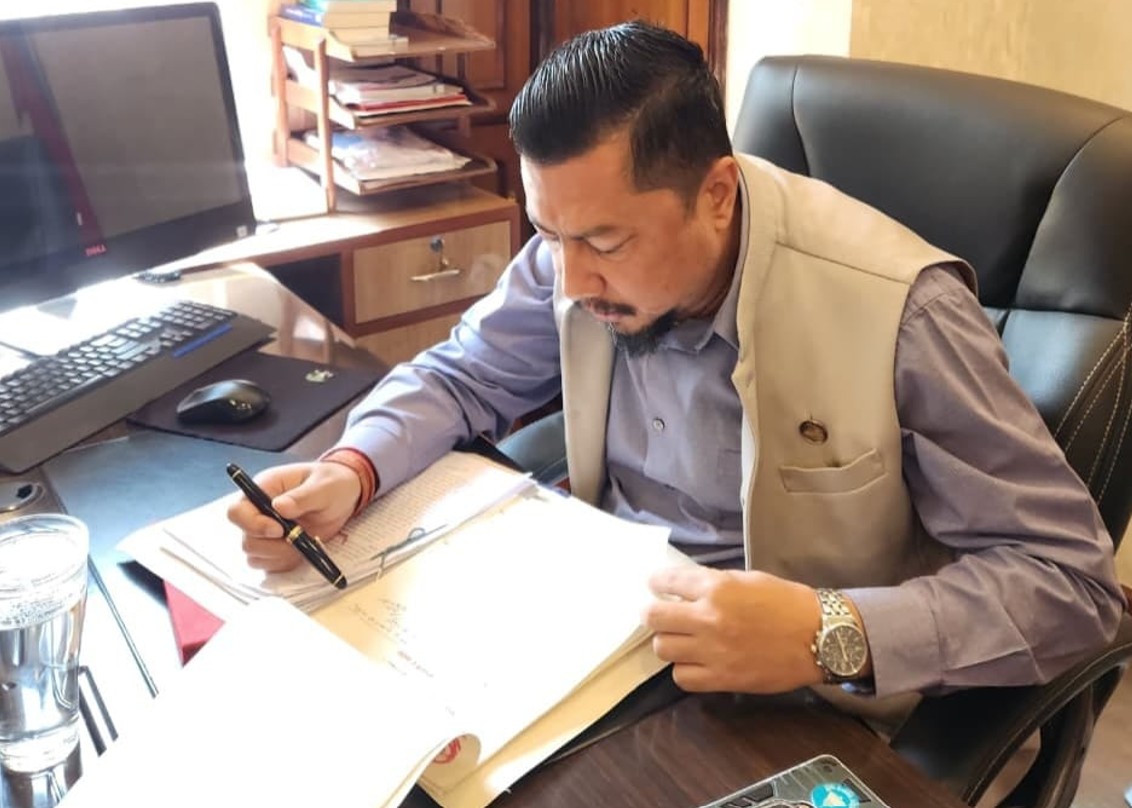
Kathmandu. For the first time, the way has been opened for the private sector for electricity trade.
Minister for Energy, Water Resources and Irrigation Biraj Bhakta Shrestha on Friday decided to issue a letter of intent to provide consent in principle to the private sector for inter-country electricity trade.
This decision of Minister Shrestha is seen as an important step towards broadening the scope of private investment and structural reform of Nepal’s energy sector. The ministerial decision made by Minister Shrestha on Friday has given an opportunity to the private sector, which is limited to power generation, to explore the market for electricity, identify potential domestic and foreign partners, and prepare necessary agreements for the purchase and sale of power.
This decision has opened the door to new business possibilities for the private sector, which has been demanding to participate in the inter-country electricity trade for a long time. Earlier, there was a provision for the private sector to construct power projects and generate electricity, but the necessary path for direct participation in the inter-country transaction of electricity trade was not cleared. Now, companies fulfilling the conditions set by the government will be able to study the feasibility of the business, identify the market, discuss with the partners and prepare the agreement.
The Letter of Intent has given the company in-principle consent to make necessary preparations before starting the inter-country power trade. The company receiving the Letter of Intent will be able to conduct technical, financial and commercial feasibility study, identify potential business partners, hold necessary discussions and coordination and prepare the agreement in accordance with the prevailing laws.
The formal operation of electricity trade, implementation of power purchase and sale agreements, booking of transmission capacity and the use of open access will have to complete the necessary licenses, approvals, consents and technical arrangements as per the relevant laws. This has allowed the government to allow the private sector to prepare for business. It is not possible to carry out transactions on the basis of letters of intent without fulfilling the provisions applicable to open access and use of the transmission system.
Along with the decision to provide opportunities to the private sector, the government has also put forward various conditions to prevent the misuse of the letter of intent. The company will have to ensure in its self-declaration that it is not blacklisted as per the prevailing law, the details and documents submitted are true and there is no intention to misuse the letter of intent.
No liability shall arise on the Government of Nepal from the agreement between the Company and the Partner, or to claim that the right to obtain the License has arisen on the basis of the Letter of Intent.
The company receiving the letter of intent has to submit a progress report to the ministry within 15 days of the end of each quarterly period. Similarly, the report should include the work completed, achievements, progress as per the set target, problems seen and future action plan. If necessary, the ministry can also ask for additional documents or clarifications.
The change in the ownership or share structure of the company will have to take the necessary prior approval as per the prevailing law. The government may suspend, revoke or amend the letter of intent in accordance with the law if the terms of the letter of intent are violated, if the details submitted are proved to be false or misleading or if it is deemed necessary for the public interest and safe operation of the electricity system.
The duration of the Letter of Intent shall be for a maximum of two years from the date of issuance or as prescribed by law. If it is necessary to extend the period, the company will have to submit an application to the Ministry with progress details and reasons at least 30 days before the expiry of the deadline.
The government believes that the decision to involve the private sector in preparing for cross-country power trade will create opportunities for new investment and business initiatives in the sector. Once the private companies start identifying potential buyers and business partners, they will be able to get more information about the market demand, prices, terms of transaction and risks.
It can also help in linking the decision to invest in power generation in the future to the potential of the market. Also, the expansion of competitive participation in trade can strengthen the basis for moving the power sector from a production-oriented structure to a market-oriented structure.
This decision has opened up the possibility of linking the existing efforts to attract private investment in power generation with trade and market expansion. Addressing the long-standing demand of the private sector, the government has provided a formal avenue for participation in the preparation of cross-border power trade.














प्रतिक्रिया दिनुहोस्