



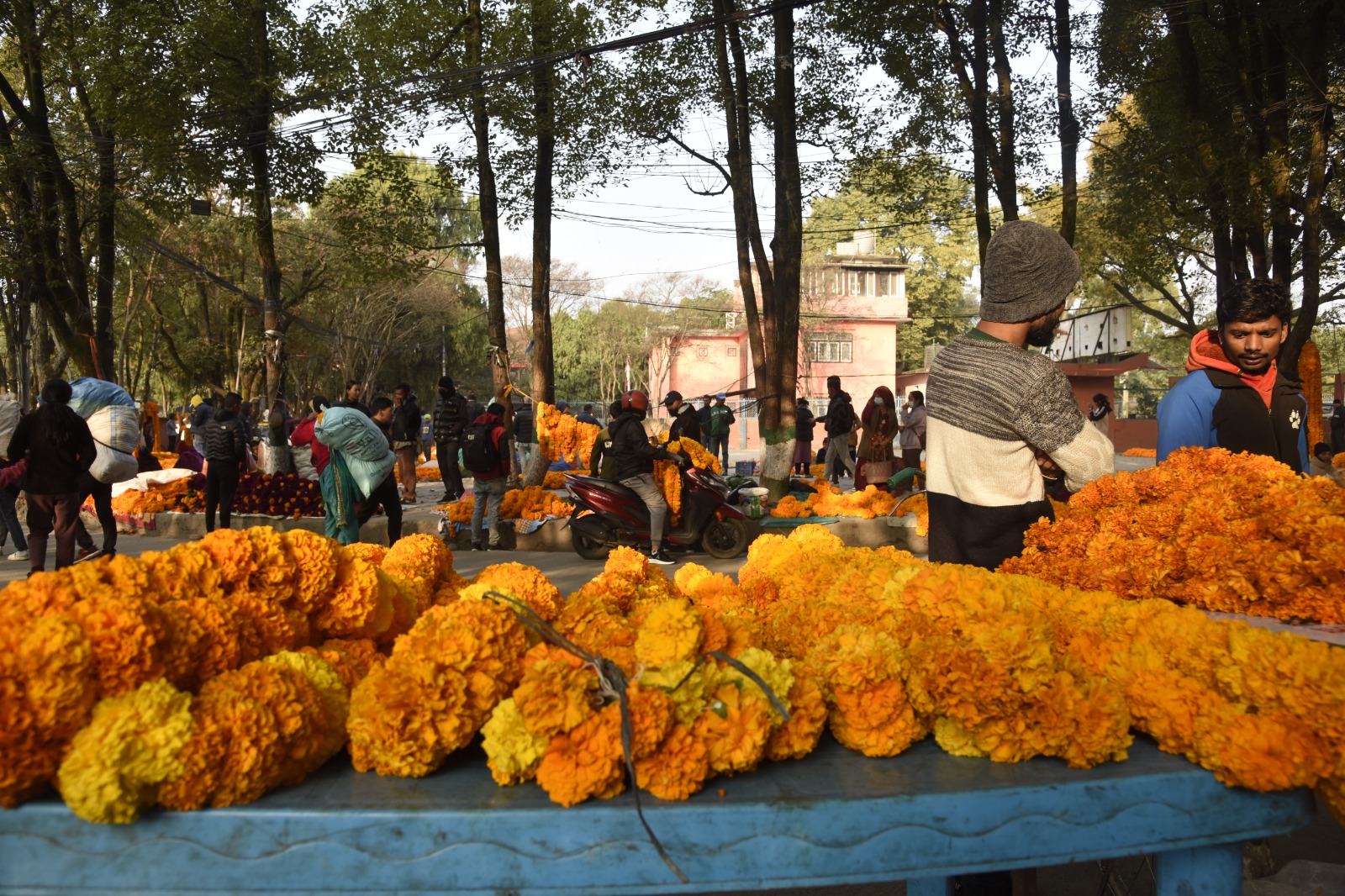
Kathmandu. Kathmandu Metropolitan City (KMC) has designated 33 places within its geographical area for the sale of indigenous flowers.
Similarly, the sale of plastic-based flowers and decorative items has been prohibited. The Department of Environment Management and the Metropolitan Police Force have published separate notices regarding this provision on the occasion of Diwali.
Information about the sales center has been given in the information of the police force. The notice made public in this way also includes the mobile number of the person who can call the farmer directly to help in the management of the sale point. According to this, Aakriti Shrestha (9801362312) can be contacted for NB Center, New Baneshwor, Bipin Rawal (9848643297) for Big Mart, Shankhamul and Shishir Kumar Pokhrel (9861781753) for iPlex Mall, New Baneshwor.
Similarly, Sapana Sijapati (9801971308) for Sales Berry, Middle Baneshwor, Suraj Thapa (9763697140) for Phoenix Tower, Battisputali (9763697140) and A.C. Thapa (9763697140) for Salesberry, Central Baneshwor. Likewise, Govinda Raj Giri (9841517233) for Chabahil, Ajjab Shrestha (9841078808) for Vegetable Bazaar, Chetna Gurung (9805841978) for Chabahil, Chetna Gurung (9805841978) for Chabahil, Kamaladi, Chitra Bahadur Dhungana (9869539511) for Star Mall, Putali Sadak, Ajay Lama (9801241451) for Bhatbhateni, Anamnagar, Kathmandu Mall (01-5352555), Mohingka Bhurtel (9851400791) for Bajra Complex Good Mart, New Plaza.
Similarly, Lagantole, Jaisidewal, Bhrikutimandap, Tebahal Temple premises, Swayambhu Dharma Chakra Park, Kalimati Banquet in Kalimati, Diaukhel of Kalimati, Bhatbhateni of Kalanki, Valley Cold Store of Naya Bazaar, Buddha Mall of Machhapokhari, deep part of the Quality and Metrology Department of Fish Pokhari, Dabali in front of the office of Hadigaun (Narade), Ganesh Mandir of Hadigaun and Ward No. Koirala Smart of Ward 26, Salesberry of Maharajgunj, Big Mart of Gongabu, Big Mart of Slipper Factory and Big Mart of Baluwatar have also been provided for the sale of flowers.
Along with this, farmers will also be able to sell flowers in Tinkune ground and Sifal ground. The Metropolitan Police Force will facilitate the places provided in this way but do not have contact numbers. To contact the Metropolitan Police Force, help can be obtained by contacting them at 01-5901763, 01-5901764 and mobile number 9851356509, said Bishnu Prasad Joshi, chief of the police force.
“The Government of Nepal, in exercise of the powers given by sub-section (6) of Section 15 of the Environment Protection Act, 2076, has completely banned the production, import, sale, distribution or storage of plastic garlands and bouquets throughout Nepal,” the Department of Environment Management said in a statement. The Kathmandu Metropolitan City (KMC) has also completely banned the import, sale, distribution or storage of plastic garlands and bouquets since the past years. ’
The notice reads, “We request all the people of the city to give priority to the sale, distribution and use of indigenous flowers and garlands to reduce the damage caused to the environment by the use of plastic bouquets and garlands imported in view of the upcoming Tihar.” The notice concludes with a warning to those who do not follow the law, saying, “If the import, sale, distribution, storage or decoration of the plastic bouquets that are completely banned by disobeying the notice are found to be used for the import, sale, distribution and storage or decoration, the materials will be confiscated and action will be taken as per the Kathmandu Metropolitan City, Environment and Natural Resources Conservation Act, 2077 and the prevailing Finance Act.” ’
With the increase in the use of flowers to decorate houses, temples and public places during Tihar, the business of domestic and foreign flowers is also increasing in the Nepali market. The metropolis is working to provide direct market access to the farmers to meet the growing demand for flowers through domestic production and to ensure market for the flowers produced by Nepali farmers.
Since 2080 B.S., the metropolis has been providing a specific place for the sale of indigenous flowers on the occasion of Tihar. This arrangement has been made to distinguish Nepali products from foreign flowers and to ensure priority in their sale.
In the first year, the metropolis had made arrangements to sell flowers in the premises of Bhrikutimandap, Tinkune Chaur, Hadigaun and Valley Code Store in Balaju. Initially, the traders did not have enough information about the plan of the metropolis, so they started selling flowers in different places of the city. After that, the Metropolitan Police Force helped the traders to load and unload flowers and garlands by taking them to the designated sales points by vehicle.
The size of the import of flowers and flower products is still large in Nepal. Nepal imports flowers and flower products from countries like India, the Netherlands, China, Japan, Germany, Kenya, Thailand, Vietnam, the United States, Egypt, Uganda, Belgium, Italy, UAE, Taiwan and Israel. The imported goods include various species of plants, seeds, fresh cut flowers, bulbs, tubers and tuber roots.
It is a positive effort for the metropolis to provide a definite place for the sale of indigenous flowers. Along with the metropolis, it is necessary for the concerned bodies to manage the chain from production to market for the long-term development of the flower business.
The competitive capacity of domestic production can be enhanced if farmers are provided with quality seeds, technical assistance, irrigation, production materials and subsidized loans, and support in storage, transportation and market management of flowers.












प्रतिक्रिया दिनुहोस्