

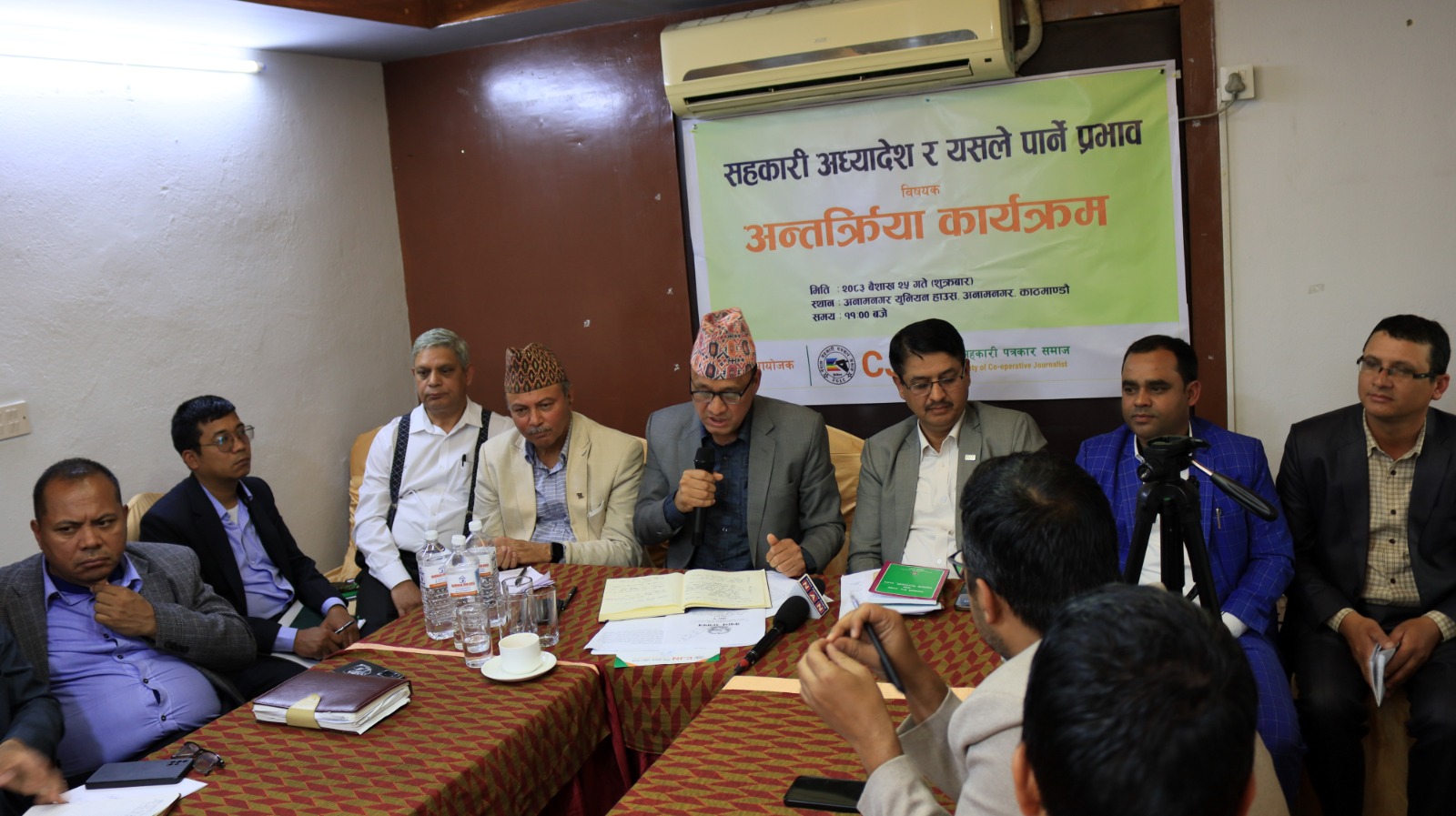
Kathmandu. Secretary at the Ministry of Land Management, Cooperatives and Poverty Alleviation, Madan Bhujel, admitted that the government failed to adequately consult with the campaign while promulgating the cooperative ordinance.
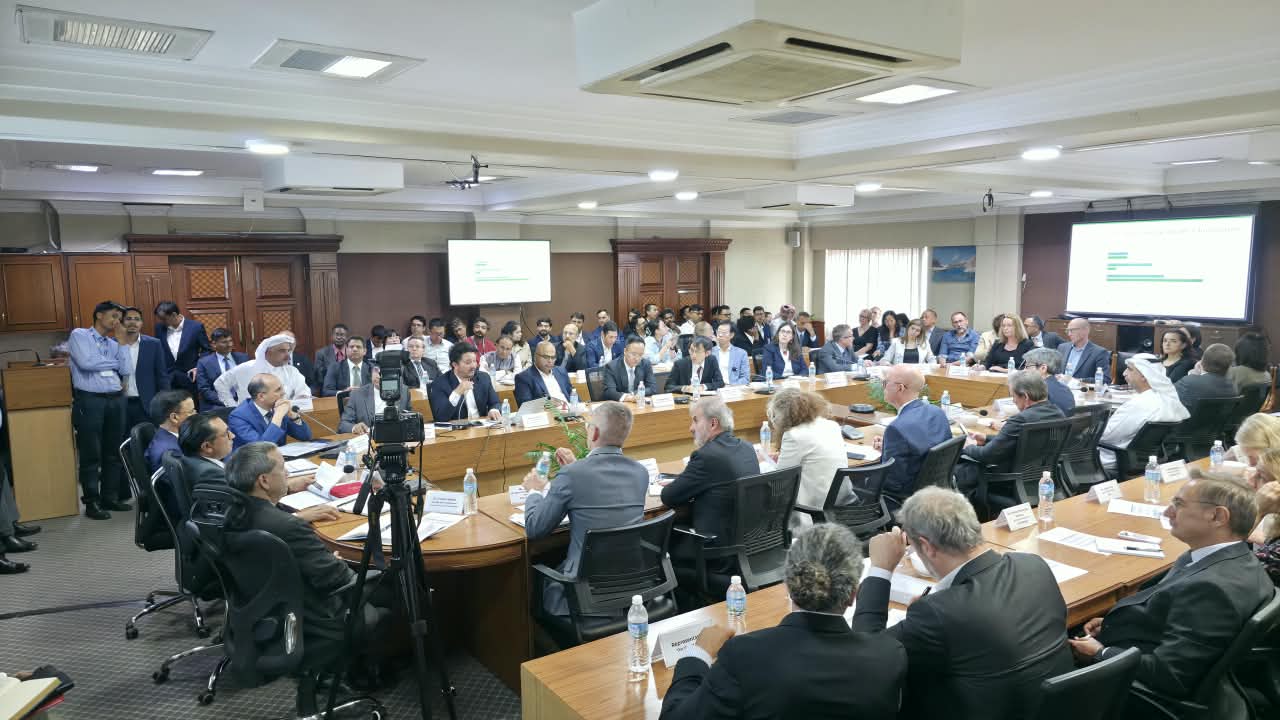
Speaking at an interaction programme on ‘Cooperative Ordinance and its Impact’ organized by the Society of Cooperative Journalists (CJN) here today, he said that the ordinance was brought as it would take a long time to amend the Act through regular parliamentary process.
He said that some problems in the cooperative sector should not be addressed immediately and there are legal hurdles for this. Stating that the Ministry was preparing a draft for amending the Act, he expressed commitment to make it scientific on the basis of consultation and suggestions with stakeholders. “Earlier, there was confusion about the jurisdiction of the Department of Cooperatives and the National Cooperative Regulatory Authority. The ordinance has made it clear how to move forward the work by giving clear roles to these two bodies. ’
Secretary Bhujel clarified that the ordinance has been brought with the objective of improving the overall campaign and not only focusing on the issue of problematic cooperatives. Stating that the same problematic cooperatives management committee has not been effective in managing more than 20 problematic cooperatives, he said the government has planned to form separate management committees of each organization in the future.
Similarly, the Financial Action Task Force (FATF) has placed Nepal in the ‘grey list’ on the issue of anti-money laundering and the ordinance has been brought keeping in mind how the cooperative sector should work to come out of it.
Elaborating on the reason for issuing the ordinance, he said, “The ordinance was brought as the Supreme Court had issued a mandamus order in the name of the government to make necessary arrangements for the return of savings to the cooperatives victims.” ’
He said that the weakness of the directors of the cooperatives as well as the cooperative campaign and the regulatory bodies was the reason for the problem of the cooperatives. According to him, the government could not interfere as the cooperatives are self-regulated autonomously, but due to the mischief of some institutions, strict laws had to be brought.
Secretary Bhujel said that various study reports received by the government in the past had also suggested that the associations should be banned from carrying out financial transactions of savings and loan.
He added, “According to the current law, the associations are doing financial transactions. But past reports have suggested stopping the union’s business. In the past, the ordinance has given three years to settle the transaction within one year. In the meantime, the option of opening another cooperative bank can also be discussed. But the main job of the associations is promotion. ’
He said that many of the primary institutions have become problematic as the cooperatives are focused on financial transactions. He added that the NRA would be made more powerful and autonomous for effective regulation of cooperatives dealing in savings and loan. He said that it is necessary to issue a separate act for this.
Secretary Bhujel said that he had held direct and indirect consultations with the stakeholders before issuing the ordinance and expressed commitment to take suggestions from all sides on the draft of the bill that the Ministry is preparing to present in the parliament.
Similarly, Executive Director of the National Cooperative Regulatory Authority Dr. Pushpa Raj Shahi said that the NRA was effortful to correct the anomalies created in the cooperatives due to the laws and working style of the last 35-40 years.
He said that a provision has been made to renew the license at the NRA annually for the purpose of updating the details of the transactions of the cooperatives. Stating that confusion was created between the federal cooperative department and the NRA in the past, he said the ordinance has brought clarity in the works. He said, “It will be easier to share the responsibility related to cooperative administration after making the registrar of the department a board member of the NRA.” ’
He, however, clarified that NEA could not carry out all its functions like the Company Registrar’s Office as there are less than 50 employees in the office.
Executive Director Shahi said that the ordinance has made provision to allow the NRA to fix the registration time as the main transaction of savings and loan will continue to increase in the future.
Similarly, Raghu Mahat, under-secretary at the Cooperative Division under the Ministry of Land Management, Cooperatives and Poverty Alleviation, said that the department is necessary to regulate cooperatives other than these cooperatives.
He said that the government had initially provided Rs 250 million seed capital to repay the money of small savers who could not get back their savings from the troubled cooperatives.
Similarly, he clarified that the ordinance has tried to make the borrowers as well as the loan disbursing directors responsible as there was a practice of blaming only the borrower members for the misappropriation of cooperatives in the past.
He said that although the transaction of savings and loans currently being carried out by the cooperatives is not illegal, the ordinance has given a period of three years to make it systematic.
He said, “There is a need for an alternative model to manage the financial transactions of cooperatives. When the Act is promulgated, the issue of long-term solutions will be addressed. Therefore, the associations do not need to immediately give back the savings to the members. ’
On the occasion, Acting President of National Cooperatives Federation Ramesh Prasad Pokharel said that although many issues were good in the ordinance, the government did not consult with the campaign before issuing the ordinance.
He expressed dissatisfaction over the provision made by the ordinance that the cooperatives deposit 0.5 percent of the total profit would be mobilized through the Federal Cooperative Department. “The money of the cooperative promotion fund belongs to the cooperatives, not the state,” he said, “Therefore, the government should make arrangements to mobilize the fund through the federation.” ’
He was of the view that the cooperatives should not be restricted as they have been carrying out savings and loan business by internalizing the spirit of ‘all for one, one for all’. He said, “Cooperatives are doing business among their members. It is also necessary to do such transactions to promote members. Therefore, instead of banning it, the state should manage it by making a separate standard. ’
Nepal Savings and Credit Central Cooperative Union Ltd. Chandra Prasad Dhakal, president of NEFSCUN, said that it was wrong to prohibit the associations from carrying out savings and loan transactions through the ordinance.
“Shutting down the savings loan business of the associations may create problems,” he said, “Therefore, it should be managed instead of closing the business.” ’
He cautioned that if the state prohibits the umbrella associations from carrying out savings and loan transactions, the task of protecting the savings in the initial cooperative institutions could also be at risk. Expressing the view that the associations should be allowed to carry out business by making necessary arrangements through the NRA, he said, “If the associations are stopped from carrying out savings and loan transactions, the money we have will go to the banks.” Therefore, it seems that this arrangement has been made with the intention of bringing the money of the co-operative to the commercial banks. ’
Lauding the government’s efforts to recover bad loans invested by cooperatives, he pointed out the need of taking back savings and loan recovery simultaneously.
Bagmati Province Savings and Credit Cooperatives Association (Bagmati Proscun) President Uddhav Sapkota also spoke about the ordinance.
On the occasion, former chairman of Bagmati Province Troubled Cooperative Management Committee and senior advocate Prabhat Adhikari made a presentation on the cooperative ordinance.
The program was presided over by CJN President Arjun Khatiwada and hosted by Secretary Madhav Khadka. Vice President Namita Dulal concluded the program with a vote of thanks.












प्रतिक्रिया दिनुहोस्