

. Nepal Telecommunication Service Provider Ncell has urged the government to review the government’s decision of the Council of Ministers, the conditions imposed during the license renewal and the tenth amendment to the Telecommunications Regulations, terming the government’s refusal to give formal recognition to the share transaction related to the change of ownership.
Handing over a letter to the Office of the Prime Minister and Council of Ministers on Wednesday, the company has demanded to repeal or amend Rule 7A of the Telecommunications Regulations on the basis of the Cabinet decision of 6th Falgun 2080, the conditions imposed by the Nepal Telecommunication Authority during the license renewal.TAG_OPEN_p_60 The letter has also been sent to the Ministry of Communications and Information Technology, the Ministry of Industry, the Department of Industry, Nepal Telecommunication Authority and other bodies.
Earlier, on 23rd Poush 2082, the company had written to various government agencies including the Prime Minister’s Office on the same issue.TAG_OPEN_p_59 However, Ncell has drawn the attention of the government again after no decision or directive has been received so far.
In the letter, the government has not accepted the company’s share transaction in the record even though it has been almost three years since the transaction was completed. According to the company, it is not logical to reject the share transaction only when the necessary tax has already been paid after the transaction, the new management is operating the company and the license has also been renewed by the Nepal Telecommunication Authority.
Demand to review the decision of the Cabinet{
}
According to Ncell, the then cabinet had decided not to accept the share trading as it was without prior approval and due to lack of technical, financial and managerial capacity of the buyer.
But the company claims that those grounds are no longer maintained. According to the company, the new management has been operating the company for about two years, has submitted all the necessary documents to the Department of Industry and Telecommunications Authority and the regulatory body has accepted the capacity of the company through license renewal.
Ncell has argued that the license has already been renewed for an additional five years with effect from 16th Bhadra 2081 and the share trading should not be rejected on the grounds of lack of capacity.
Why was the decision stopped even after the Supreme Court’s order?
Ncell has also reminded the Supreme Court’s order in its letter.
In a writ petition filed demanding the cancellation of the share transaction, the Supreme Court had directed the government and the concerned body to resolve the ownership dispute through administrative process as per the law.TAG_OPEN_p_53 The company said that it would not be appropriate for the government to keep the matter uncertain as the court has already rejected the demand for annulment of the share transaction.
The company has now demanded that the decision should be taken by the concerned body in accordance with the law, ending the political or administrative confusion.
Tax paid, but not recognized yet
According to Ncell, after the change of control, the tax of about Rs 1.TAG_OPEN_p_51 69 billion was paid on 14th March 2080 by submitting separate financial statements as per Section 57 of the Income Tax Act.
The company has also said that it is ready to pay additional tax in accordance with the law if the competent authority determines it in the future.
The company’s question is: What is the basis for accepting tax, renewing the license but refusing only share trading?
Ncell has also expressed its dissatisfaction with Rule 7A added through the tenth amendment of the Telecommunications Rules.
According to the company, the main Telecommunications Act provides for the status of the expiry of the license and the management of the assets. However, the imposition of additional restrictions on share structure through the amendment of the regulations is against the spirit of the Act and the principles of delegated legislation.
} Similarly, the condition of not changing the existing share structure while renewing the license is against the right to property guaranteed by the constitution and the freedom to operate an industry or business.
The company has stated that the issue of not obtaining prior approval can be resolved through the regulatory process.
If it is found that prior approval has not been taken, then a fine can be imposed as per the Telecommunication Act or instructions can be given to do business only after obtaining approval in the future, but it is not appropriate to suspend all share trading indefinitely on the basis of procedural issues.
Nepalese ownership and ready for IPO
}
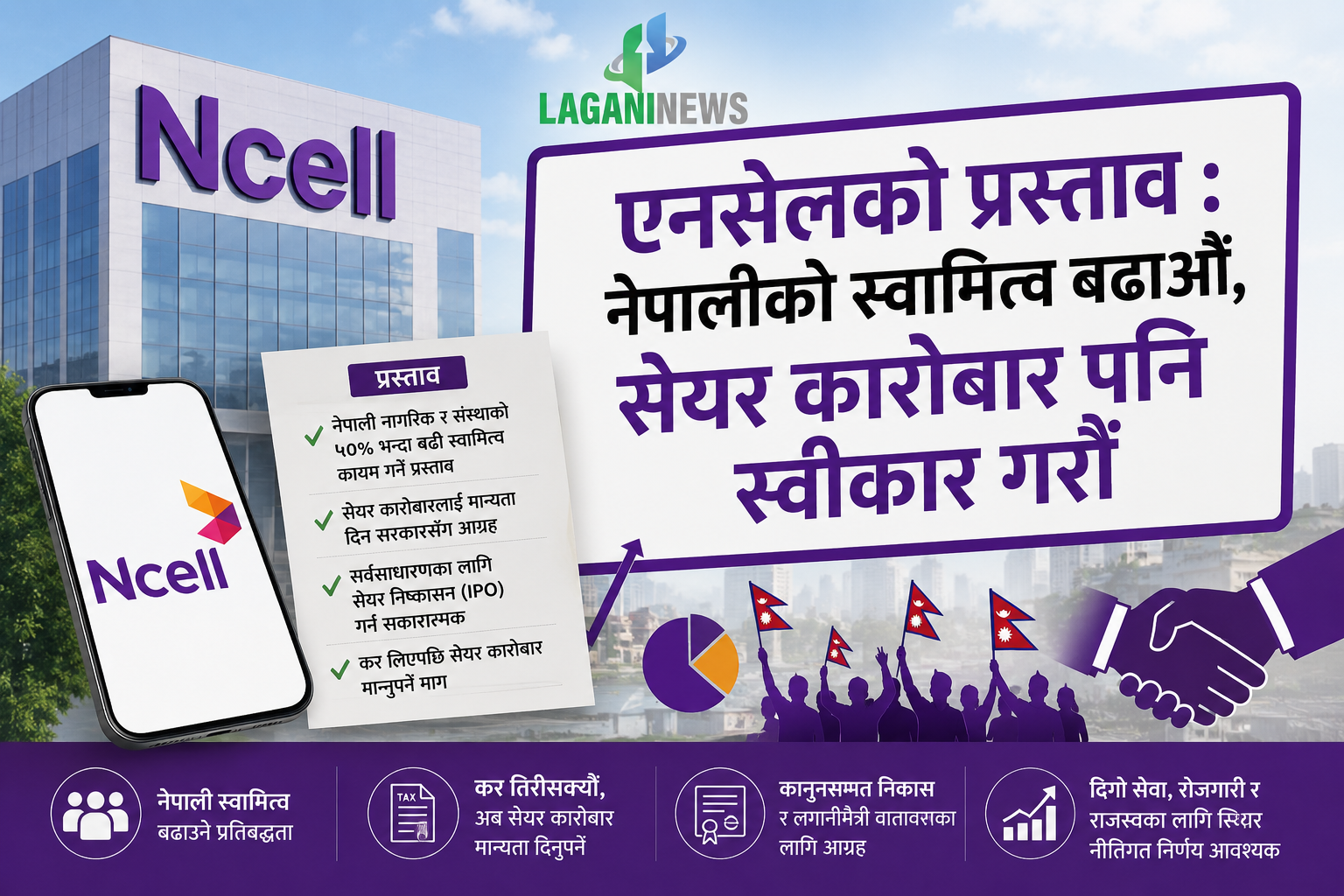
Ncell has said that it is ready to make the company a majority Nepali company by increasing the ownership of Nepali citizens and organizations to more than 50 percent.
The company has also said that it is positive to issue shares (IPO) to the general public in accordance with the securities laws.TAG_OPEN_p_42
According to the company, it is expected that this will increase the ownership of Nepali citizens, expand participation in the Board of Directors, attract investment in new technology and ensure the long-term stability of the telecommunications sector.TAG_OPEN_p_41
Ncell currently serves more than 14 million customers, contributes directly and indirectly to more than 100,000 jobs and has paid nearly Rs 375 billion in revenue to the state since its inception.TAG_OPEN_p_40
} The company warned that the prolongation of uncertainty over share trading and licensing could have a negative impact on service expansion, employment, government revenues, the digital economy and the foreign investment environment.
Ncell has requested the government to review the previous decision of the Council of Ministers, give formal recognition to the share trading, complete the documentation process from the Department of Industry, remove restrictions on share structure and scrap Rule 7A.













प्रतिक्रिया दिनुहोस्