

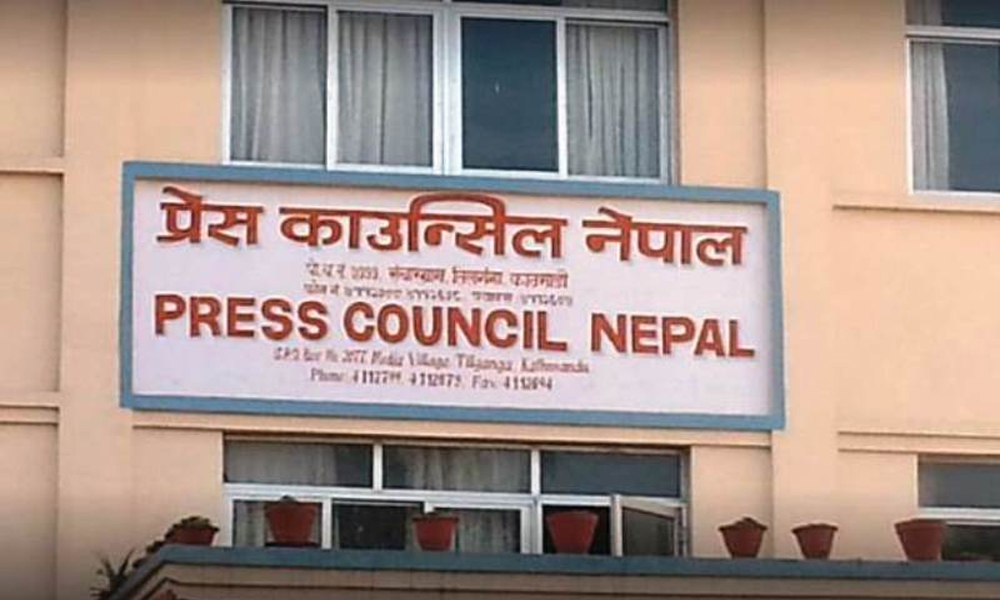
Kathmandu. The bill designed to amend and integrate the laws related to the Press Council, 2083 to protect the press and freedom of expression, maintain the professional dignity of journalism and make the media sector more credible, dignified and accountable through self-regulation has been sent to the Ministry of Law, Justice and Parliamentary Affairs for opinion.
The draft bill proposed by the Ministry of Information and Communications provides for restructuring the existing Press Council to develop it as an autonomous and empowered regulatory body. The bill proposes the formation of a directive committee for the policy-making and institutional work of the council.
The chairperson of the Directive Committee will be the chairperson of the Council and at least two members of the House of Representatives, including a woman, designated by the Government of Nepal in consultation with the Speaker of the House of Representatives, the President of the Federation of Nepali Journalists, at least one member representing working journalists working in print, broadcast and online media, one teacher of journalism from a recognized university, one expert in the field of mass communication law, human rights, artificial intelligence or information technology and at least one member from the readers, viewers and listeners of the media. The Director General of the Department of Information and Broadcasting will be a member and the Chief Administrative Officer will be the member-secretary.
The Directive Committee will make recommendations to the Government of Nepal in the formulation of policies related to mass communication, review the work done in accordance with the policy, annual plan and program of the Council and provide policy guidance and necessary directives to the Council. The Directive Committee will also be the mechanism to give necessary direction and guidance to the Press Council and the Council will be more focused on the executive role.
The council will consist of a chairman appointed by the Government of Nepal, a member appointed on the recommendation of the recommendation committee and a director general of the department. The chief administrative officer will act as the secretary of the council. The chairman and members will not be allowed to be involved in any media while in their post.
There will be a recommendation committee under the coordination of the Speaker for the appointment of chairperson and members. The draft bill has proposed that the committee will have the Minister of Communications as a member and a member nominated by the Ministry from among a person with at least 15 years of experience in the media sector.
The proposed provision shows that the main objective of the bill is to make the council more independent of its regulatory role without being directly influenced by the government and the Ministry of Communications. The role of the Speaker of the House of Representatives in the Directive Committee and the attempt to give more executive powers to the Council also confirms this.
from press freedom protection to AI-generated misleading content regulation
The proposed council will be empowered to protect, promote and promote the rights to press and freedom of expression and communication. The council will also be given the responsibility of developing and preserving free, fair, dignified and accountable journalism, freedom of publication and broadcasting, and taking necessary actions to prevent the violation of the professional dignity of journalism. Similarly, the council will issue a code of conduct related to journalism, monitor its implementation and monitor and regulate the material published or broadcast against the code of conduct. The council will also have the right to receive and hear complaints related to violation of the code of conduct.
As an important aspect of the bill, provisions have been proposed to regulate and control misleading content created by misinformation, disinformation, disinformation distortion and artificial intelligence i.e. AI. The council has also been given the responsibility to reconcile disputes between the general public, journalists, media organizations and media, develop a self-regulation and self-evaluation system of the media, and collaborate with the federal, provincial and local levels. Similarly, the council will be given the authority to encourage the media that practice good ethics, to conduct media literacy and citizen awareness programs, to protect the rights, interests and rights of media consumers, and to conduct studies, research and training on mass communication and journalism.
Agile administrative structure
The bill provides for the Chief Administrative Officer to be the Chief Administrative Officer for the day-to-day administration of the Council. The Chief Administrative Officer will be appointed by the Council and the term of office will be four years. The Chief Administrative Officer will be responsible for formulating the annual policy, plan, program and budget and submitting it to the Chairperson, preparing an action plan for the implementation of the annual program and supervising, coordinating, controlling, monitoring and evaluating the staff.
Classify the Code of Conduct into three levels
The bill also seeks to systematize the adherence to the code of conduct, monitoring and action in a new way. It is proposed to classify the violation of the code of conduct mainly as minor journalistic errors, professional negligence and serious code of conduct violations.
Common journalistic errors include errors in name, title, date, place, number or factual details, errors in printing, translation or editing, errors in mixing news and opinions, and general factual errors that do not distort the original intent of the news. Professional negligence includes publishing or broadcasting material without minimum fact-checking, not giving an opportunity to the concerned party to respond to news related to serious allegations, presenting material from unreliable or unverified sources as fact, and presenting headlines, images, videos or presentations in a way that distorts the true intent of the news.
Similarly, refusing to correct false information despite having factual evidence, taking information on the basis of inappropriate relationship with a news source, presenting news in the form of advertisement, reiterating material that later proved to be false and repeating factual errors are also included in the commercial negligence.
Serious code of conduct violations include disclosing the identity of children and victims of sexual violence or sexual offences protected by law, publishing or disseminating objectively false information, publishing or broadcasting material inciting hatred, discrimination or communal violence on ethnic, religious, gender or other grounds, and forging facts, images, audio or visual material.
Likewise, defamation of a person’s character or reputation through baseless or incorrect material, serious violation of the privacy protected by the law, willful violation of court order, violation of copyright, unauthorized use of photo, video or other evidence, publication or transmission of information or dissemination of information or material that may harm or harm national security, sovereignty or foreign relations are also considered serious violations.
Media should create their own code of conduct and style manual
The bill proposes that it will be the duty of every media house, media and journalist to follow the code of conduct issued by the Council. In addition, the media should prepare their own code of conduct, editorial standards and procedures related to the publication and broadcasting of news materials without contradicting the Council’s code of conduct.
Similarly, every media house should establish a self-regulation mechanism and listen to the complaints of readers, listeners and viewers. It has also been proposed that a style booklet should be prepared and made public in order to bring uniformity in journalism profession and writing and inform the council about it.
Media investment and interest should be made public
The bill also provides for transparency in the investment of media organizations. The chairperson and director of a media organization will have to inform the council about the business they have invested in, the area of investment and the source of investment. Similarly, a provision has been proposed that a media organization should disclose the information related to the investment in such a way that the public can see, read or listen to the news, article or article related to the area where it or its director invests.
New provisions for action
If the journalist code of conduct is violated, the concerned person or organization can file a complaint with the council either in writing or electronically. The bill proposes that while determining the action, the nature and seriousness of the violation, whether the violation was intentional or negligent, whether the violation was intentional or negligent, the public impact caused or likely to be caused by it, the efforts of the concerned party to correct the mistake or minimize the damage, the cooperation made in the investigation and the situation of the repetition of the violation.
Depending on the nature of the violation of the code of conduct, different action has been taken. In case of minor journalistic errors, instructions can be given to correct them, an apology can be made or a rebuttal can be published or broadcast in the number, time, place or page specified by the Council.
There is a provision that the name of the council can be made public by placing it in the records of the council if the order is issued to correct or clarify the professional negligence, or if the apology is not made public.
According to the provisions of the bill, a recommendation can be made to the concerned body to partially or completely stop the services, facilities, concessions, public welfare advertisements or other facilities provided by the Government of Nepal for the specified period in case of serious violations. Similarly, a recommendation can be made to the department to suspend the press pass for a maximum of one year.
The Council can impose a fine ranging from a minimum of five thousand to a maximum of one hundred thousand rupees and compensation if it is found that the dignity or prestige of the concerned person is seriously affected or there is a loss or damage to the property or business if these actions are not adequate.
If the dignity or reputation of a person is found to have been compromised due to any material, the council can mediate between the complainant and the concerned media organization, media or journalist. If the concerned party is not satisfied with the action or order of the council, the concerned party can file an appeal in the High Court within 35 days from the date of the order. The bill also provides that there will be no obstruction in taking separate legal action if the offence is committed under other prevailing laws because of the violation of the code of conduct.
Separate fund of the council
It has been proposed to have a separate fund for the Press Council to make it financially autonomous and empowered. The fund will include funds received from the Government of Nepal, grants and assistance from domestic individuals or organizations, foreign aid from foreign governments or agencies and other sources received by the Council.
Classification of media
The bill has also given the council the responsibility of classifying the media. The bill states that high professional practices, adherence to the code of conduct, production of investigative and innovative content, balanced and inclusive manpower, access area of communication, multidimensionality in content and innovation-oriented approach will be made the basis of classification of media.












प्रतिक्रिया दिनुहोस्