

Birgunj. President Chure-Tarai Madhes Conservation Development Committee Chair Dr Kiran Poudel has said that if deep boring is installed at a depth of 250 meters underground in the Tarai-Madhes, sufficient water will be available.
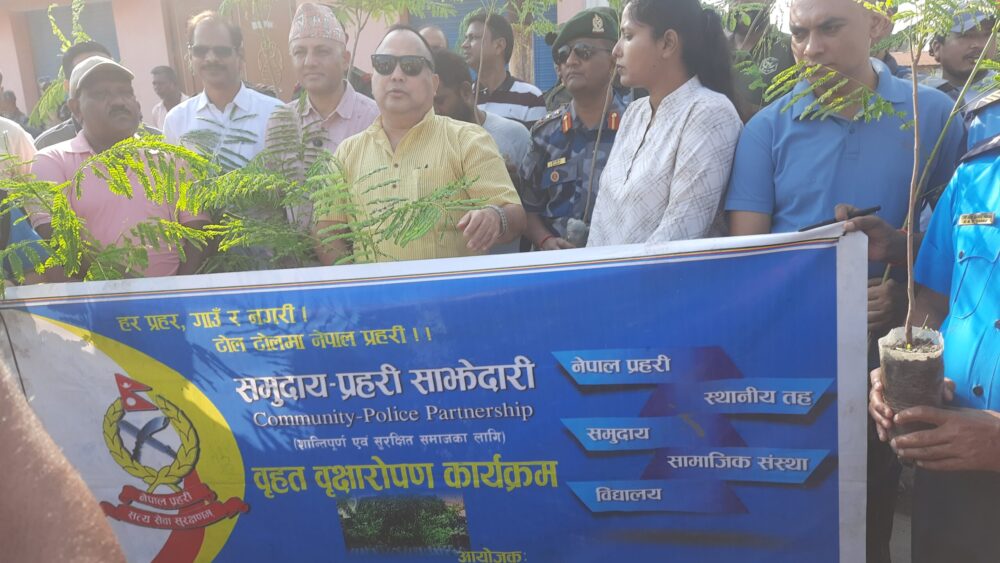
Speaking at a massive tree plantation programme organised by Green City Community Service Centre, Birgunj here today, he said adequate amount of underground water could be extracted if the deepwater exfer of at least 250 metres depth was carried out even though there was not enough source of water in the Tarai Madhes districts at a depth of 100 to 150 metres.
“It is especially seen that 100 to 150 meters of underground water is being drawn here. However, there is not enough storage of water at a depth of 150 meters below the ground,” he said, adding that the amount of groundwater at a depth of 250 meters has remained the same for the last 50 years. However, our neighboring country India uses water at a depth of 250 meters, but Nepal is not able to use that surface water. Now we have to draw water from the surface at a depth of at least 250 meters for drinking water and irrigation. ’
According to the committee, groundwater level up to 200 meters is called ‘shallow water exfer’ while groundwater level up to 250 meters is called ‘deep water exfer’.
Chairman Poudel claimed that although the cost of deep boring at a depth of 250 meters is relatively high, such borewells are more effective. “The groundwater level is similar to that of neighbouring Countries India and Nepal.
Water with a depth of more than 250 metres is being used by India,” he said. However, we are digging water at a depth of a few meters and saying that there is no groundwater here. ’
Chairman Poudel said that it was necessary for the metropolitan city and other bodies to encourage the digging of borewells from at least 250 meters below while digging large types of deep borewells.
“It has become necessary for all to join hands and pay attention to chure conservation to prevent the crisis of drinking water and irrigation seen in the Tarai-Madhes,” he said.
Chairman Poudel said that water problems have been created in the Tarai-Madhes region for the last few years due to less water and increased use of water this year. “Whatever we had to do to recharge the water. We are not able to do it enough,” he said, adding, “There are problems both from our human side and from nature.” ’
President Chure-Tarai Madhes Conservation Development Committee, drinking water ÷ irrigation-related organizations have called for the construction of different types of ponds and ponds to protect the water falling in the Chure area underground. “At present, there are very few water conservation ponds in the Chure area.
Small patches had to be made. It has become imperative to stop the water of various types of rivers and make arrangements for recharge under the ground,” he said.
Committee chair Poudel said it was also necessary to build necessary infrastructure to recharge the water around their homes in urban areas. “It is also necessary for the local levels to adopt long-term policies to make necessary infrastructure for the recharge of akashe water while passing the map,” he said, adding that such positive works would also contribute significantly to the conservation of water in the future. ’
Chairman Poudel said that water could not be recharged naturally in Birgunj due to dense settlement and blacktopping of roads everywhere in the recent past.
At present, even sky water is flowing into the river through sewage. Therefore, the work of sucking water around the house is also being stopped. The amount of water we absorb around us is also decreasing. We have also been unhelpful in the work of recharging groundwater in recent times,” he said, adding, “We should also improve our water conservation habits.” It has become necessary to create an environment that absorbs water around the house even when the metropolitan city passes the map from inside the house. ’
Birgunj Metropolitan City Mayor Rajesh Man Singh also claimed that they have been carrying out necessary works regarding immediate and long-term plans to solve the water crisis in Birgunj Metropolitan City. “The METROPOLIS has been distributing water through tankers for short-term solutions to water,” he said, adding, “We have been doing necessary work for long-term solutions.” ’
Chairman of Green City Community Service Centre, Jai Prakash Khetan, said that tree plantation has been a priority in the vicinity of Birgunj for a long time. “We have been regularly planting trees in the vacant areas here,” he said. ’












प्रतिक्रिया दिनुहोस्