

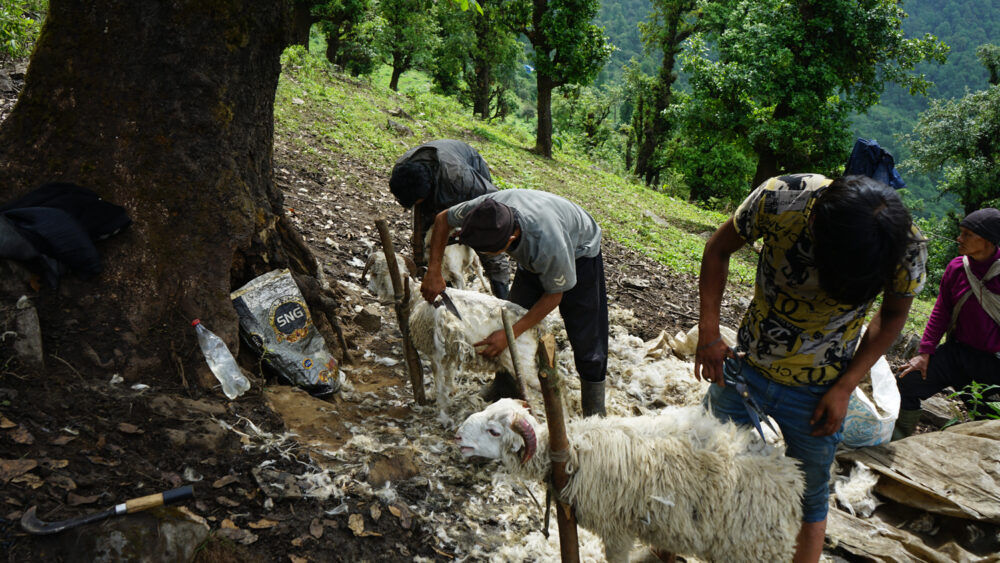
Myagdi. Until two decades ago, Purnakala Patel, 65, of Malika rural municipality-3, Khaten, was forced to weave kamlo and hardublo from sheep’s wool.
“We used to wear a jacket for warmth. It was customary to lay a blanket in the house instead of carpets and wear it instead of vinegar,” he said, adding, “Our original materials started disappearing as we could easily find vinegar, dasna and carpets.” The use of traditional radi, pakhi, kamlo and hardublo has started declining and the farmers throw sheep’s wool in the forest due to lack of sale in the market.
In June and October, wool is cut to ensure that the sheep are heated and do not get infected with external parasites. Kamal Paija, a sheep farmer of Paudwar of Annapurna Rural Municipality-5, said that the wool is thrown in the forest except for domestic consumption due to non-sale.
“In the absence of modern tools to extract wool, it is cut with the help of scissors,” he said, adding, “Consumption has also decreased due to the loss of the trend of making clothes from wool due to lack of skilled manpower.” The original fabrics woven from wool are eco-friendly. The original dress of the Minority Chhantyal community living in Gurja, Malkwang and Kuinemangale of Myagdi is made of wool.
According to the Veterinary Hospital and Animal Service Expert Centre, myagdi has seen a decline from 18,567 sheep in the fiscal year 2079/80 to 17,565 in 2080/81. According to Centre’s Information Officer Subhash Regmi, 61,424 goats were goats in Myagdi last year, which has come down to 60,423 in 2080-81.
He said there was a problem with the marketing of wool. Taranath Subedi, chief of the Social Development Office, Myagdi, said that an inter-generational knowledge skill transfer programme has been launched at the community level to prevent the disappearance of original skills, including making goods from sheep and goat wool.
Tekjit Chhantyal, a ward member of Raghuganga rural municipality-6, said that the residents of Thadakhani of Raghuganga rural municipality-6 wear wool clothes to protect their originality.














प्रतिक्रिया दिनुहोस्