

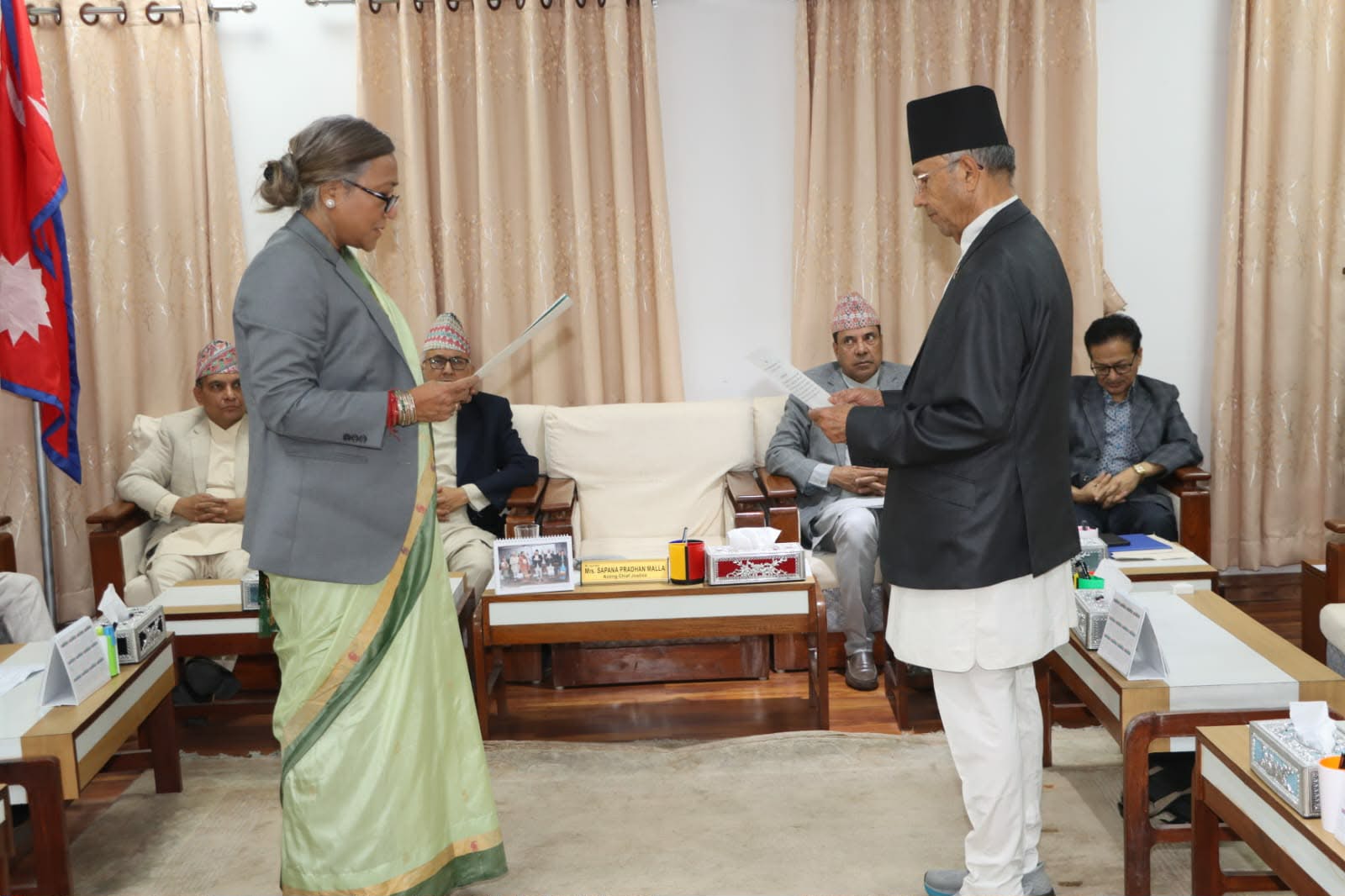
Kathmandu. KATHMANDU: The Property Investigation Commission (CIAA) formed by the government with the objective of ending corruption and impunity prevalent in the country has formally started functioning from today.
The meeting of the Council of Ministers on April 15, 2083 had formed a five-member commission under the chairmanship of former Supreme Court Justice Rajendra Kumar Bhandari. The office of the commission has been set up at Keshar Mahal.
Acting Chief Justice Sapana Pradhan Malla administered the oath of office and secrecy to the newly appointed chairperson Bhandari today.
Former Chief Judge of the Appellate Court, Purushottam Parajuli, former judge of High Court, Chandiraj Dhakal, former Deputy Inspector General of Police Ganesh KC and chartered accountant Prakash Lamsal were also sworn in as members of the committee.
The terms of performance (TOR) of the commission, which has been entrusted with the responsibility of performing its functions as per the Inquiry Act 2026, have also been approved. The commission, which has a one-year term, will conduct a thorough scrutiny by collecting details of assets in the name of public officeholders, retired or removed from office and their families.
As per the provision, the commission has to submit the report to the Office of the Prime Minister and Council of Ministers as soon as the investigation of any person is completed. The government will have to implement it within 45 days.
The Commission should fulfill its responsibilities without succumbing to anyone’s pressure and influence expressing commitment to work in a completely independent, impartial and professional manner. The CIAA will collect complaints through written, oral, electronic media, social media or any other means.
Although there is a provision that the Commission can consult experts from various fields as per the need in course of carrying out its work, strict conditions have been set that experts who have conflict of interest cannot be invited.
The commission has been formed as per the anti-corruption commitment mentioned in point number 43 of the ‘100 Agendas for Governance Reforms’ approved by the cabinet meeting on March 29, 2002. Currently, the Office of the Prime Minister and Council of Ministers is screening 32 employees required for the commission.
In order to make the work of the commission transparent, the employees deputed there have to make their property details public within a week of assuming the office.

















प्रतिक्रिया दिनुहोस्