

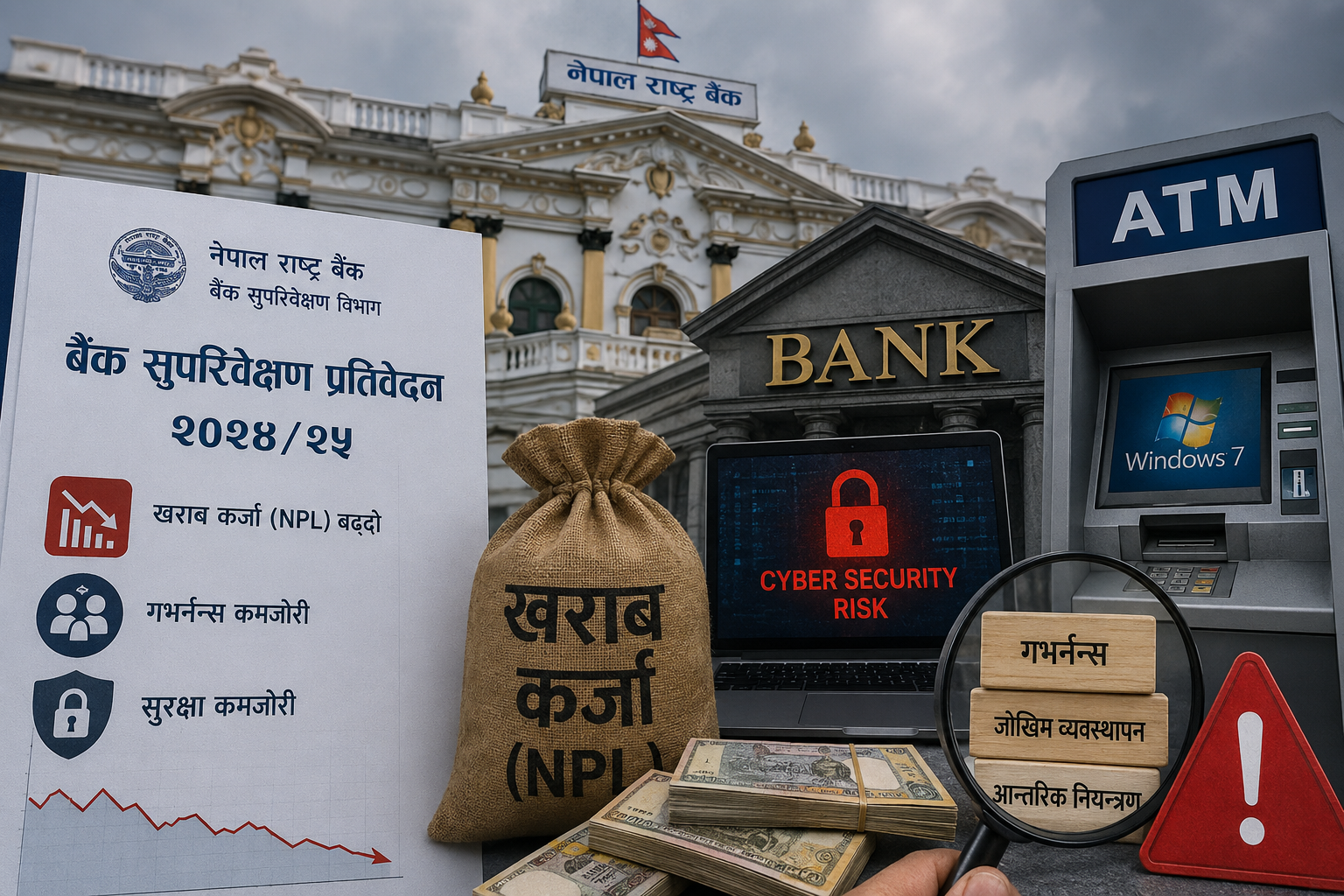
. The Bank Supervision Department of Nepal Rastra Bank (NRB) has released Bank Supervision{ Report 2024/25 Weak institutional governance, inadequate internal controls, and serious technical security challenges have been pointed out. The report warns that weaknesses could be detrimental to financial stability in the long run.
According to the report, non-performing loans (NPLs) in banks and financial institutions continue to rise.TAG_OPEN_p_33 The NRB has concluded that the borrowers’ ability to repay loans has weakened due to external financial pressures, aggressive credit expansion in the past years and weaknesses in institutional governance. This has forced banks to make further credit loss provisioning, which has a direct impact on profitability and capital adequacy.
During the inspection, it was found that some banks have adopted the practice of ‘loan rollover’ by giving new loans to the old loan accounts.TAG_OPEN_p_32 Such practices increase the risk of hiding genuine bad loans and artificially improving asset quality, the report said.
According to the Nepal Rastra Bank, there is more problem due to the lack of effective monitoring of the use of the loan after the disbursement of the loan.TAG_OPEN_p_31 Although the law requires monitoring of the end use of loans, many banks have not been able to implement it effectively. The report also mentions that in some cases, the loan amount was transferred to the accounts of the directors or related parties within a short time of disbursement.
TAG_OPEN_p_30 There is also a weakness in liquidity management. The NRB has concluded that there is an imbalance between short-term liabilities and resources of many banks and the contingency liquidity management plan is limited to paper. The report states that some banks have not taken corrective steps on time despite excessive concentration of deposits and pressure on loan-deposit ratio.
The report has also raised serious questions on the institutional governance of banks. According to the NRB, the practice of the Chief Executive Officer (CEO) himself evaluating the performance of the chief of risk management and the chief of internal audit has weakened the independent control mechanism.
} Due to the tendency of more than a hundred agendas to be presented at the same time in board meetings, there has not been enough discussion on issues related to risk analysis, stress tests, and financial stability, the report said.
Manpower shortage is another major problem in the internal audit system. Many banks are relying on trainee staff instead of permanent skilled manpower. As a result, thousands of audit comments went unresolved for long periods of time, and information technology security and policy audits were not completed regularly, the report said.
Serious flaws have also been found in the
regulatory reporting system. Some banks have been found to keep different details of the same borrower, use duplicate customer ID numbers and do not even mention the taxpayer ID number in big loans. This will make it difficult to assess the risk of a single borrower limit and the group concerned, according to the NRB.
There is also a weakness in human resource management. According to the report, some employees have been working in the same branch or post for more than a decade and many organizations have not even completed the expenses required for mandatory employee training.
The state of technical and physical security is also worrisome.TAG_OPEN_p_24 During the inspection, weaknesses were found such as unauthorized access to the vault, lack of necessary authentication in the cash records and the key of the vault was under the control of a single person.
TAG_OPEN_p_23 On the cyber security side, many bank ATM booths are still using outdated operating systems that have expired. The report also pointed out that the provision of keeping CCTV footage of sensitive areas for at least 90 days has not been fully followed.
According to the NRB, controlling the practice of artificially increasing the capital adequacy ratio by showing the high-risk loans as less risky, addressing the shortage of skilled manpower in the field of risk management and auditing, and developing an integrated supervision system based on artificial intelligence and modern technology are the major challenges.TAG_OPEN_p_22
The report has concluded that there is an urgent need to improve credit quality, strengthen good governance, improve internal controls, and improve cyber security to maintain the stability of the banking sector.TAG_OPEN_p_21


















प्रतिक्रिया दिनुहोस्