



. In Nepal, the telecom sector has always been at the forefront of paying the highest taxes, fees and royalties to the state. But here’s the irony — the sector — once filling state coffers — is now plagued by policy uncertainty, high tariffs, and investment insecurity.
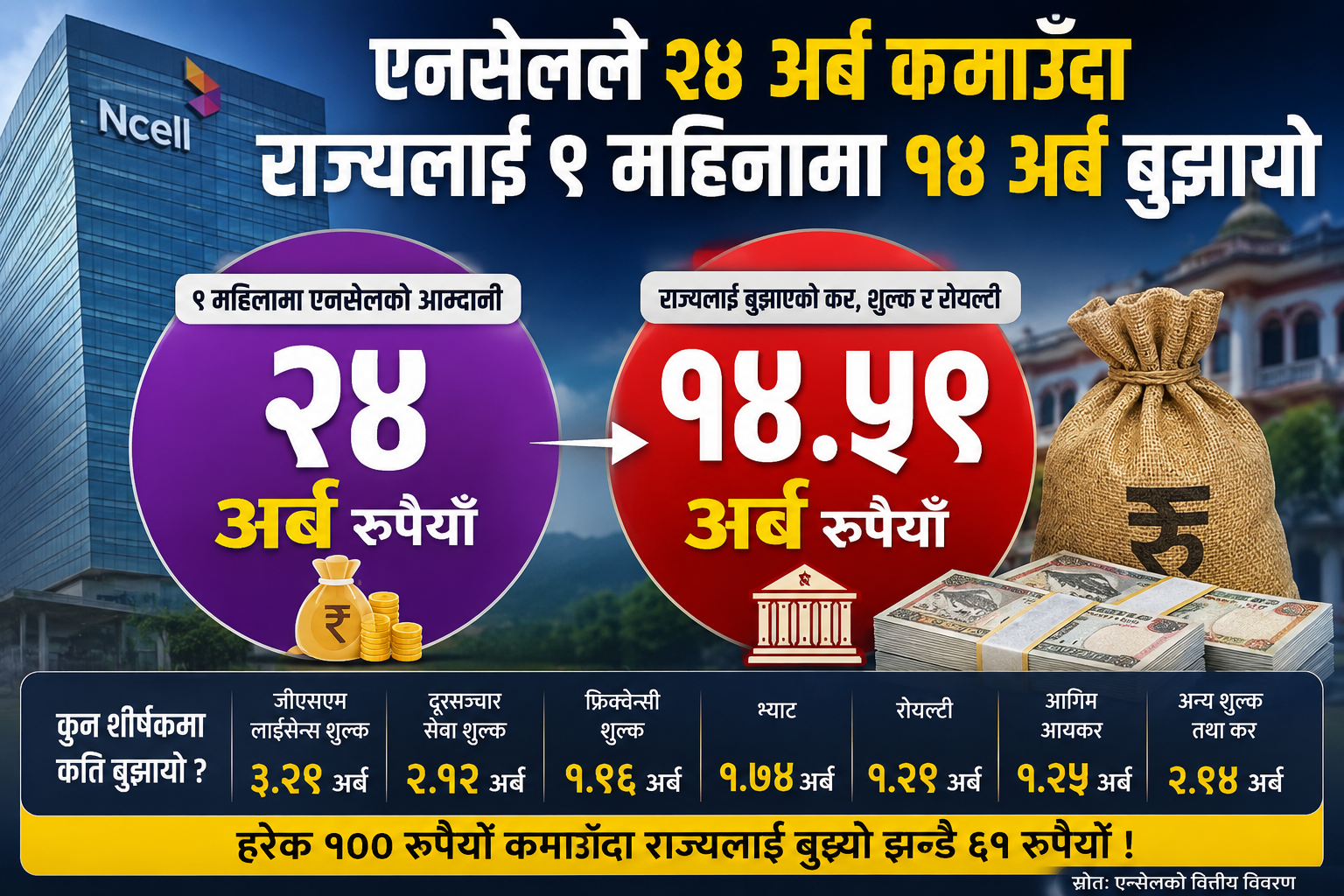
Private telecom service provider Ncell has earned Rs 24 billion in the first nine months of the current fiscal year.TAG_OPEN_p_44 In the same period, the company paid Rs 14.59 billion to the government under various headings including tax, royalty, frequency charges, telecommunication service charges, VAT, customs and others. That is, out of every Rs 100 earned by the company, about Rs 61 has been taken by the state.
If we look at the details of the fee, the telecommunication service charge alone is Rs 2.12 billion.TAG_OPEN_p_43 Likewise, frequency fee has been increased to Rs 1.96 billion, VAT to Rs 1.74 billion, royalty to Rs 1.29 billion, advance income tax to Rs 1.25 billion and GSM license fee to Rs 3.29 billion. Experts in the telecommunications sector say that the state’s attitude towards the sector that contributes so much has not gone beyond the source of revenue collection.
100 for Rs. 61 in the State’s share
}
Ncell’s revenue has decreased compared to the previous year.TAG_OPEN_p_42 In the first nine months of the fiscal year 2081/82, the income was Rs 24.25 billion which decreased to Rs 24 billion this year. But the burden of taxes and fees remains the same.
TAG_OPEN_p_41 In recent years, the traditional earnings of telecommunications companies have been declining. International calls have plummeted, voice revenue has plummeted, and Internet-based services are replacing old business models. In such a situation, there is a compulsion to invest billions of rupees in new technology and infrastructure.
The complaint of the TAG_OPEN_p_40 companies is that the state asks for investment, it asks for service expansion, it asks for quality improvement, but it is not able to provide the policy environment accordingly.
Text of Smart Telecom
TAG_OPEN_p_39 The Smart Telecom incident has intensified this debate. The company, which once had 24 lakh subscribers, was embroiled in a license renewal dispute, and eventually shut down. Millions of customers were affected, competition in the market decreased. But even today, when the company is in crisis, there are allegations that instead of finding a solution, there is an increase in disputes and legal complications.
The question arises here — if the state’s objective was to maintain service continuity and competition, why did Smart Telecom end like this? Many see this simply as a failure of one company, but for investors, it is a direct example of policy risk.
Telia, went to Axiata; Smart Telecom Shut Down — What Lessons Have We Learned?
Sweden’s Telia came to see the huge potential in Nepal’s telecommunications sector. Then came Malaysia’s Axiata. But both eventually decided to pull out.
Foreign investors don’t just look at profits, they also look at policy stability, regulatory clarity, and future assurance.TAG_OPEN_p_36 In Nepal, issues ranging from license renewal to ownership transfer and regulatory disputes drag on for years. This is the reason why the environment for new big telecom investors to come to Nepal is weak.
Michael Foley, CEO of Ncell, has repeatedly said that Nepal is five to eight years behind its neighbors in telecommunications technology.TAG_OPEN_p_35 He has publicly said that an additional Rs 20 to 25 billion can be invested if the environment is favourable. But the question remains: Has the state been able to convince companies that want to invest?
Investors are naturally cautious when a situation arises when a sector is taken only by the state, but does not make the necessary reforms for its sustainable development.
Still not waking up?
Nepal is talking about digital economy, artificial intelligence, fifth-generation mobile services and Digital Nepal. But the basic infrastructure of all of them is the telecommunications sector.
The state has been collecting Rs 14 TAG_OPEN_p_32.59 billion from this sector in nine months. In the past two decades, Ncell has paid more than Rs 357 billion in taxes, fees and royalties.
But if this sector is not seen only as a continuous revenue cow, policy reforms are not made, an investment-friendly environment is not created and competition is not encouraged, then the basis of tax collection by the state may shrink tomorrow.
Looking at the current state of the telecom sector, one question becomes more relevant — does the state consider the telecom company as a partner or just a tax-paying machine?TAG_OPEN_p_30
















प्रतिक्रिया दिनुहोस्