

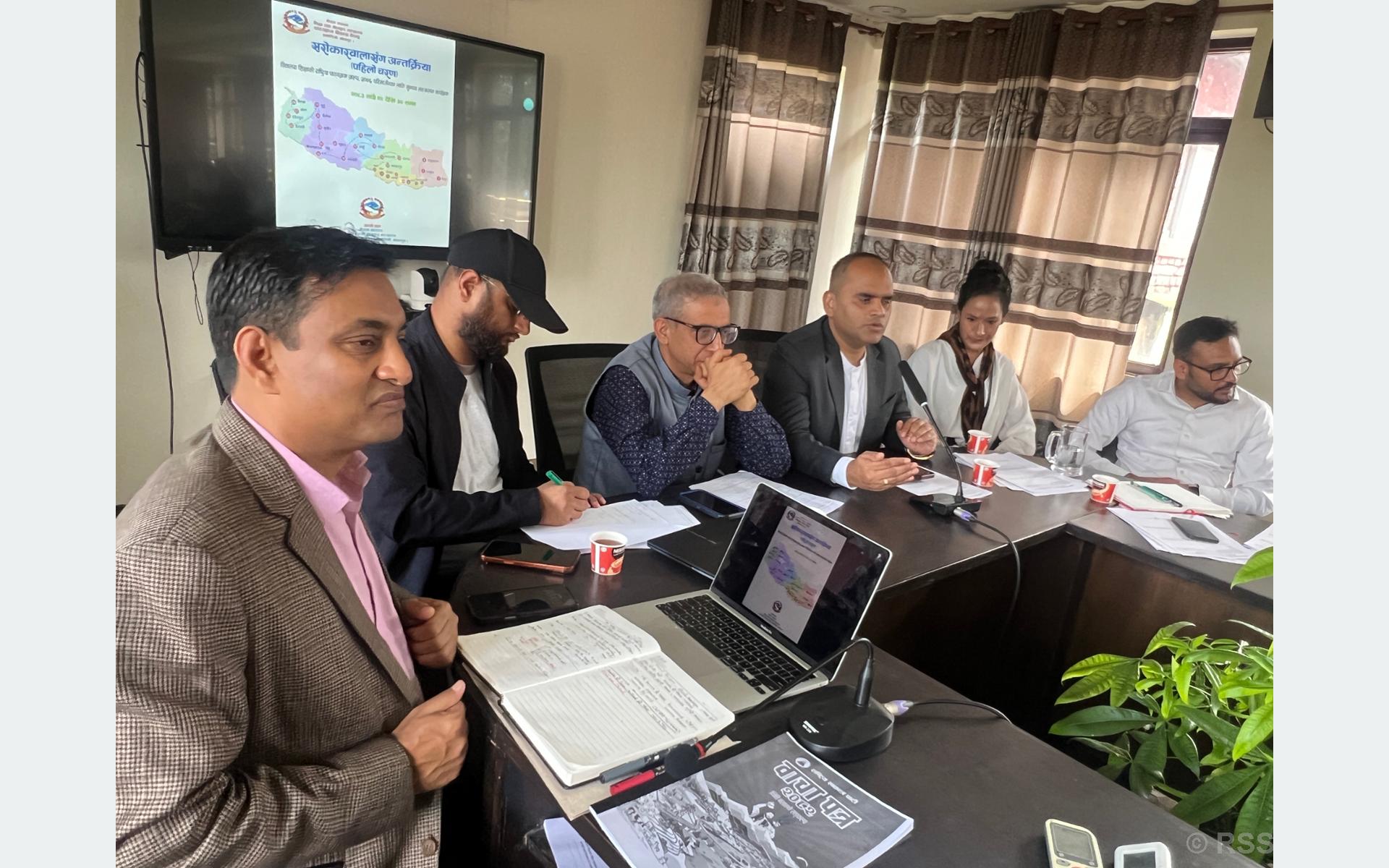
Kathmandu. Suggestions and feedback will be collected in all seven provinces to make the national curriculum of school education timely, practical, useful and effective.
The taskforce on revision of the National Curriculum Framework for School Education has reached 28 districts of all seven provinces from September 10 to interact with teachers, students, principals, guardians, experts, policymakers and other stakeholders.
Seven teams will be deployed at the provincial level. In the first phase, interactions will be held with stakeholders in 28 districts. In the second phase, suggestions will be taken from all 77 Education Development and Coordination Units. Suggestions will be taken through the Centre’s website.
An orientation program was organized at the Curriculum Development Center in Sanothimi, Bhaktapur on Friday to make the province-level discussions systematic and effective. Representatives of Private and Boarding Schools Organization Nepal (PABSON), National Private and Boarding Schools Association (NPABSAN), Higher Schools and Secondary Schools Association (HISSAN), Association of Preschool Education Nepal (APN), Guardians Association, teachers and other stakeholders participated in the program.
According to the decision of the 98th meeting of the National Curriculum and Evaluation Council, a task force was formed under the coordination of Prof. Dr. Bal Chandra Luitel in April last year. The task force has been holding discussions with the stakeholders at various stages to revise the curriculum framework. The 12 thematic groups under the task force will collect suggestions at the state and district levels.
On the occasion, Chief Advisor to the Education Minister Shailendra Jha said that the curriculum should be enriched by understanding the real situation of the field by staying away from intellectual biases. He said that suggestions are being collected from across the country to revise the curriculum keeping the future of the next generation at the center.
Stressing the need of developing curriculum making positive impact on students’ learning achievement and academic outcomes, he suggested that universities and related educational institutions should also take ownership of new curriculum.
Coordinator of the task force, Prof Dr. Bal Chandra Luitel, said that it is necessary to understand the strong and weak aspects of the school community to identify the issues to be included in the curriculum for the improvement of school education. He said that suggestions are being taken from all over the country to modify the education as per the wishes and needs of the students. “No work can be successful without partnering with the community,” he said, “Therefore, all aspects should be included as much as possible while developing the curriculum.” ”
Executive Director of the Curriculum Development Center, Mahendra Parajuli, said that the curriculum draft will be finalized soon after consultation and coordination with all stakeholders. He said that the new curriculum should also include what education should be like and what kind of education children want.
Pramod Bhatta, a member of the task force, said that suggestions would be collected on the issues of teacher education, early childhood development, natural disaster management, indigenous and local knowledge after holding discussion with the stakeholders of 28 different districts.
During the discussions, suggestions will be collected on the main goals of school education, education that can be implemented in practice at the school level, present structure from early childhood to secondary level, age and developmental needs of students and continuity of learning.
Similarly, opinions will be sought from stakeholders on curriculum, teachers’ perspective, technical and vocational education and training, inclusion of indigenous and local knowledge, digital technology and artificial intelligence (AI), development of appropriate behavior among students, human values, moral education and civic education, among others.
Under the program, discussions will be held in Morang, Dhankuta and Sankhuwasabha districts of Koshi Province and eight districts of Madhes Province. Suggestions will also be collected in Makwanpur, Dolakha and Kathmandu of Bagmati Province, Kaski, Tanahun and Gorkha of Gandaki Province and Rupandehi, Dang, Banke and Pyuthan of Lumbini Province.
Similarly, interaction will be held with stakeholders in Surkhet, Dailekh and Mugu of Karnali Province and Kailali, Dadeldhura, Baitadi and Doti of Sudurpaschim Province. Seven groups have been mobilized in each province with representation from the Ministry of Social Development, local level, institutional schools and Education Development and Coordination Unit.
According to the taskforce, suggestions and feedback based on the knowledge, skills and experience of the stakeholders would be important in revising the school education curriculum framework which is the basis for preparing the future generation.









प्रतिक्रिया दिनुहोस्