


KATHMANDU: The Non-Resident Nepalese Association (NRNA) National Coordination Council (NRNA) USA has submitted a 17-point suggestion to Minister for Foreign Affairs Shishir Khanal.
Minister Khanal, who is in New York to attend the 81st General Assembly of the United Nations, was met by a team led by NCC President Satendra Sah and submitted his suggestions regarding the problems of Non-Resident Nepalis (NRNs) and their participation in Nepal’s development.
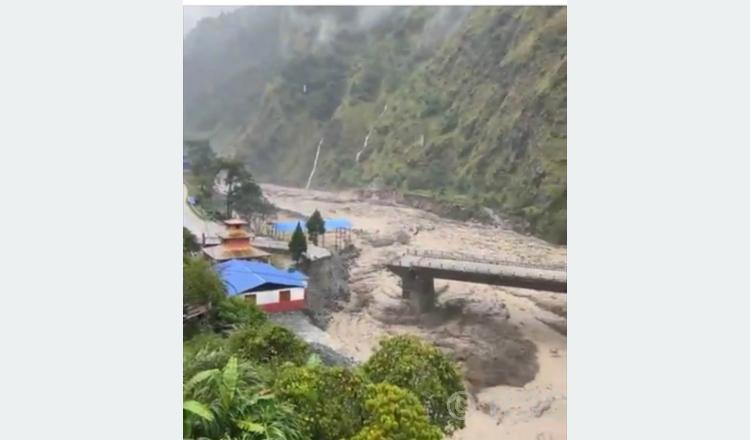
Reminding about the cooperation with the government in the post-flood relief and reconstruction of the Bhotekoshi and Rasuwa floods, the memorandum has also stressed on amendment of the draft of the Non-Resident Nepali Act, 2083, practical implementation of NRN citizenship, investment security and voting rights from abroad.
The 17-point recommendation paper has demanded the formation of a joint technical task force of the Ministry of Foreign Affairs and NRNA to give final shape to the Non-Resident Nepali Act and to immediately amend the laws related to Land Revenue, Immigration, Foreign Currency and Securities for practical use of NRNA citizenship.
The committee also urged the government to make arrangements for the collection of applications for non-resident Nepali citizenship from Nepali diplomatic missions abroad and distribution of online identity cards, regularization of properties purchased prior to the enactment of the Act, exemption of family remittance up to Rs 25 million (Rs 25 million) annually, easy return of capital and dividend and 10-year free multiple entry visa.
Likewise, Nepal Rastra Bank (NRB) and Securities Board of Nepal (SEBON) have issued directives for NRNAs to access the secondary share market for NRNs in the secondary share market, directives have been issued to operate ‘Diaspora Bond’ and ‘Motherland Fund’.
It has also demanded the establishment of a joint single service and grievance redressal desk comprising representatives from the Ministry of Foreign Affairs, Investment Board and the Department of Industry for facilitating the investors and to operate a ‘Diaspora Experts Network’ and a ‘knowledge bank’ through executive decision before the Act is enacted.
In relation to consular service and the security of Nepalis living abroad, it has been suggested to add adequate staff or transfer the positions in the high-demand diplomatic missions such as Tokyo, Canberra, Dubai, Doha, Kuala Lumpur and Lisbon.
As the consulates like San Francisco are closed, it calls for continuity through honorary consulates and mobile camps, to fully digitize consular services, to establish permanent emergency rescue teams and 24-7 hotlines for Gulf and conflict-hit regions, and to establish a legal aid fund in missions for workers and students in trouble in Europe and the Gulf.
The memorandum calls setting up a ‘Diaspora Coordination Centre’ under the Ministry of Foreign Affairs with a separate staff, preparing a registry based on national studies and consensus, and expanding access of Nepali language classes and open university to connect Nepali children of second and third generation to their motherland.
NRNA America has urged the government to establish a Diaspora Coordination Center, form a joint task force for NRNA Act and start regular review meetings immediately. The team formed under the leadership of Sunil Shah, Chief Patron of NRNA NCC America, had prepared the draft of the suggestion paper.
After receiving the suggestion letter, Foreign Minister Khanal briefed about the government’s policy and priorities to utilize the diaspora as an important partner for Nepal’s economic transformation. He presented the government’s view on utilizing the knowledge, skills, capital, technology and connectivity of the Nepali diaspora for the economic development and transformation of Nepal.
Minister Khanal said that the government’s priority is to further strengthen the relations between Nepal and Nepali Diaspora and to mobilize their contribution in Nepal’s economic transformation in an effective manner.












प्रतिक्रिया दिनुहोस्