




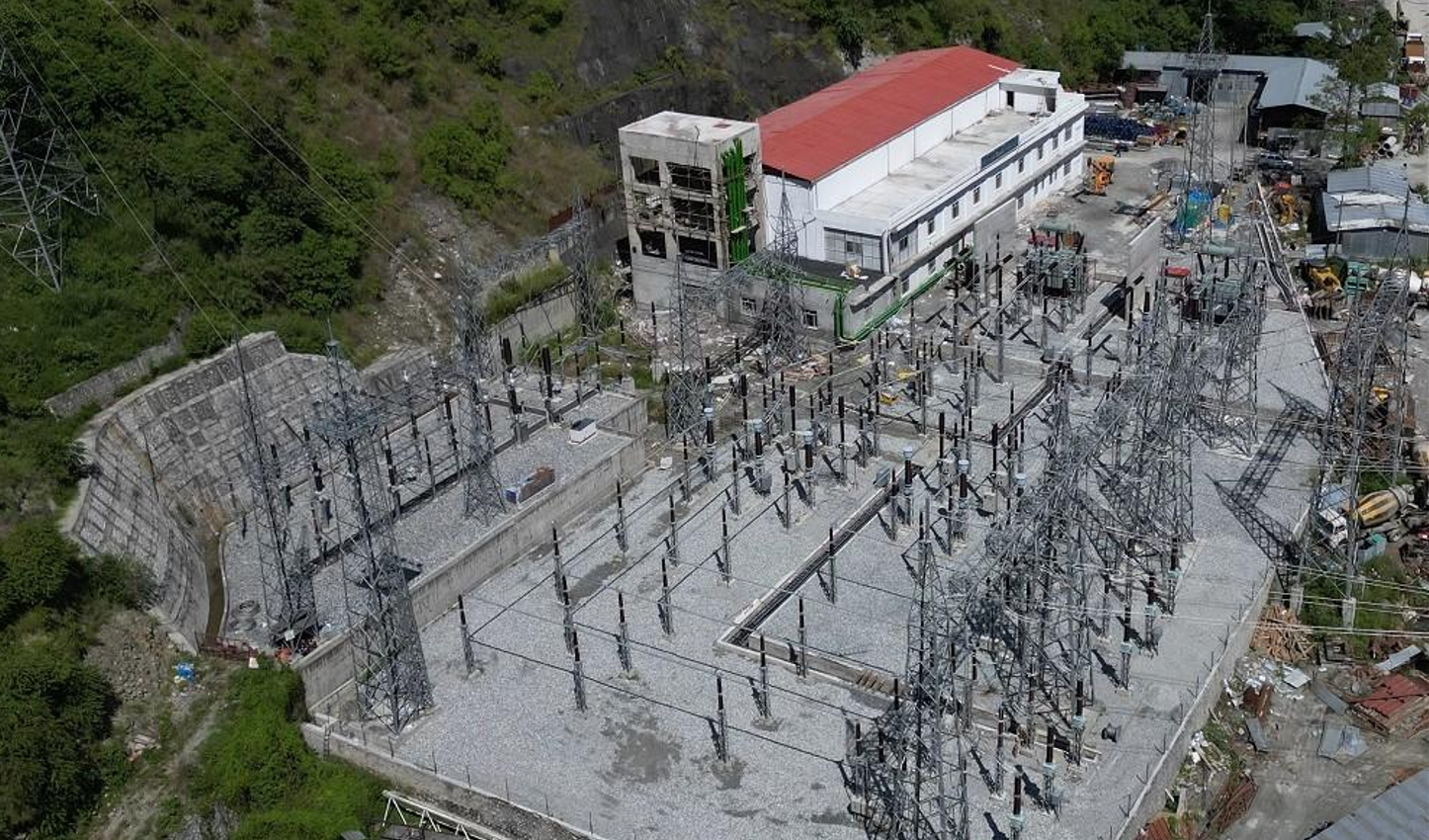
Myagdi. Raghuganga Hydropower, a subsidiary of the government-owned Nepal Electricity Authority, has entered the phase of commercial production a decade and a half after the construction of the 40-megawatt Rahughat Hydropower Project in Myagdi.
For the first time, construction of a 32-megawatt capacity project is set to be completed after one and a half decades due to contractor issues, contract cancellations, restructuring, selection of new contractors, the coronavirus pandemic, floods, landslides, and shortages of river-based construction materials.
The project built in Raghuganga Rural Municipality, Myagdi, has completed its trial period and commercial production has begun, said Ganesh KC, managing director of Raghuganga Hydropower.
“The project was delayed due to the construction period of the project that began on Asom 6 after the Kaligandaki flood caused erosion and damage to the power house complex located in Tilkenichaur, Raghuganga Rural Municipality-3, Myagdi, on Asoj 11,” he said, adding, “Due to natural disasters, COVID-19, customs issues, the impact of international wars, and the ban imposed on riverine extraction of riverine materials in the Kali Gandaki River, the project construction was delayed. ”
At the base of Raghuganga Rural Municipality–4 Dagnam and Ward No. 5, there is a dam, a main tunnel six kilometers 270 meters long, and two water storage ponds. There is a power plant at Tilkenichour, Raghuganga Rural Municipality–3, next to the Beni–Jomsom–road in the Kali Gandaki Corridor. A six-kilometer-270-meter-long tunnel has been constructed for the project.
An 11-kilometer access road has been constructed from Tilkenichaur to the dam site, passing through Chumanu Tal, Piple, Mauvafant, and Bugl, and a bail bridge has been constructed at Rahughat, according to project chief Raj Bahadur Bisht. Four towers and transmission lines have been constructed to connect the 220 kV (double circuit) Dana–Kushma transmission line through Lilo medium at the switchyard and Kaligandaki corridor within the power plant complex.
This project signed a power purchase and sale agreement (PPA) in Chaitra 2075 with a target of producing 240,593,034 units of electricity annually. Vakfos of India is a consulting company based in Rahughat.
For the construction of the Rahughat Hydroelectric Project, the Nepal Electricity Authority signed a civil contract agreement with Indian construction company IVRCL on Kartik 18, 2067, for two billion 50 million rupees. Had IVRCL worked according to the agreement, Rahughat would have started electricity production as early as 2070 BS.
Due to weak financial conditions, the electricity authority canceled the contract with IVRCL in 2072 B.S. When the contract was broken, the project’s physical progress was limited to 12 percent over a five-year period.
The authority decided to restructure the project, increase the capacity from 32 megawatts to 40 megawatts, and proceed with construction on a company model. After IVRCL’s contract was canceled, the authority established a subsidiary company, Raghuganga Hydropower Limited, in 2073 B.S. and proceeded with the project.
The process to construct Rahughat has been advanced with a concessional loan of 67 million US dollars from Exim Bank of India and investment from the Nepal Electricity Authority and the Government of Nepal in the Engineering, Procurement, and Contract (EPC) format.
A contract agreement worth approximately six billion rupees was signed on Mangsir 6, 2074 BS, with a target of completing the contract in 45 months with the Indian civil contractor Jayprakash Associates (JP), selected through a new process. Construction of the access road began from Asar 2075 BS and from Asar 8, 2076, from the third audit at Piple, the tunnel construction began. On 15th Saun 2081 BS, the main tunnel of Rahughat was connected.
The deadline was extended for the first time in February 2022, the second in February 2022, and the third until November 2025. The event was completed within the fourth extended timeframe. In Kartik 2076, an electromechanical contract agreement was signed with Bharat Heavy Electricals Limited (BHEL) for 10,293,222.35 US dollars. BHEL is a company owned by the Government of India.
According to Subin Shrestha, president of the Magdi Industry and Commerce Association, Rahughat, which was the first in the district and operated with government investment, was considered the ‘gateway’ (entry point) for hydroelectric development.
“After Rahughat started, 10 projects entered into Magdi have been completed,” he said, “Although delayed, after a decade and a half of waiting, we are excited that the Rahughat Hydroelectric Project has started commercial production. ”













प्रतिक्रिया दिनुहोस्