

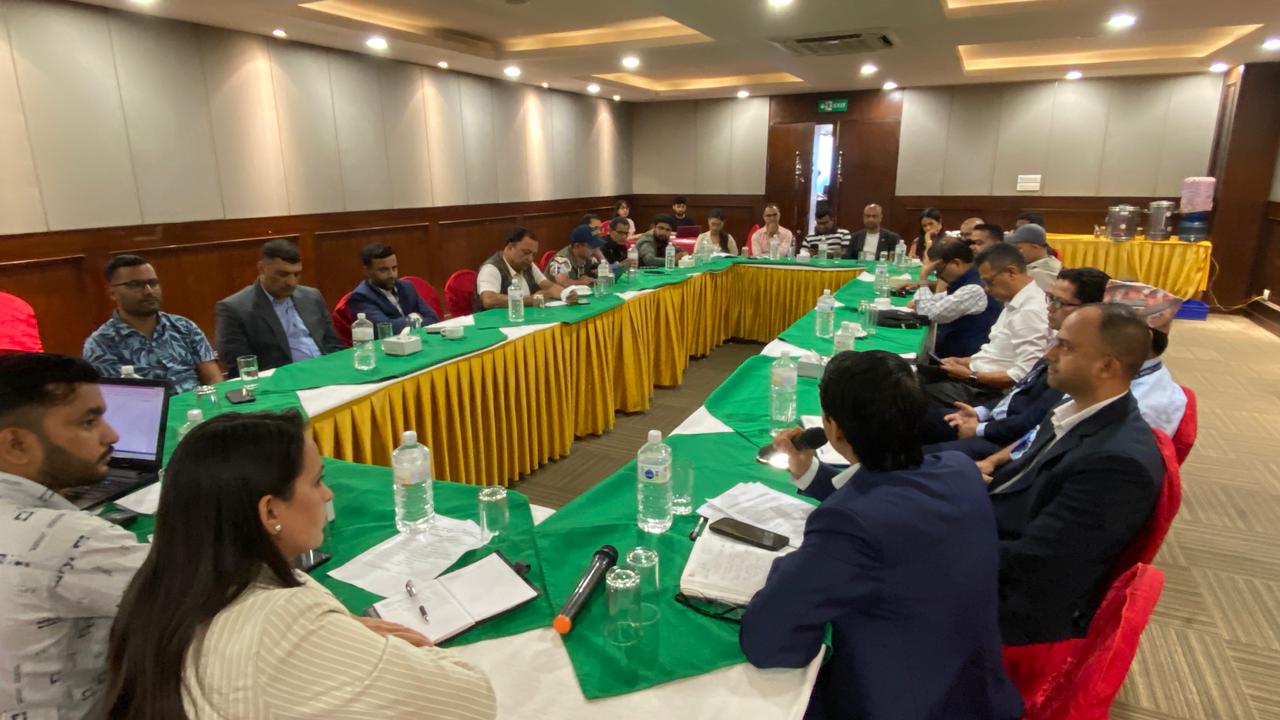
Kathmandu. The government and telecom regulators are interested in bringing the fifth generation of mobile technology, 5G technology. In an interaction and roundtable discussion on ‘Current Telecommunications Situation of Nepal’ organized by Technology Journalists’ Forum (TJF) on Thursday, regulators, government representatives and service providers said that they are ready to use 5G.
The program was attended by government bodies, regulators, service providers, IT entrepreneurs, consumer rights activists and experts.
The participants were of the view that existing towers and services should be upgraded and developed as a 5G ecosystem so that there is no confusion like the billing system.
Nepal Telecommunication Authority (NTA) spokesperson Min Prasad Aryal said that the required frequencies for the service have already been determined. According to him, the NEA is now ready to proceed with the auction process. “We are ready to go for auction after determining the spectrum to bring in 5G technology,” he said, “The authority will not have any problem in distributing spectrum if the service providers are ready.” ’
According to Nepal Telecom’s Deputy Manager Rajendra Dulal and Senior Business Officer Prakash Chandra Sigdel, the company has internally decided to launch the service in major cities. Nepal Telecom has already tested it in various cities three years ago and now they are waiting for the frequency. “When we tested, the number of mobile handsets running 5G was only about 5 percent in the country,” he said, “but now it has reached more than 20 percent.” This shows that the market is ready. ’
It was informed in the program that Nepal Telecom is preparing to launch 5G services in urban areas or metropolitan cities. Private sector Ncell has also sought permission from the government for the third time to test 5G technology. Ncell had applied to the Nepal Telecommunication Authority (NTA) in April demanding 15 MHz frequency in 700 MHz band and 10 MHz frequency in 2600 MHz band.
On the occasion, Engineer Krishna Kumar Jha of the Ministry of Information and Communications said that the government was always positive to welcome the new technology. According to him, 5G is necessary for smart city and modern communication. “More than personal use, 5G is important for smart cities, machine-to-machine communication and digital governance,” he said. However, Nepal Telecommunication Authority’s smart meters, GPS for tracking public buses, and 5G are required for high-quality live streaming in tournaments such as the Nepal Premier League. ’
Telecommunications expert Ananda Raj Khanal pointed out that there is a possibility of increasing complaints about quality issues while switching to 5G at a time when the 4G service is not in full swing. Telecom sector is complex to ensure high quality as it is multi-dimensional and constantly refining. “There has not been any real improvement in the telecommunications sector due to the existing political and administrative situation,” he said, adding, “The regulatory body should be autonomous but has become like a branch of the ministry.” Since the NRA is headed by the Prime Minister or the Minister, it does not have the capacity to convince the government on concrete issues. ’
On the occasion, discussions were held on the possibilities and challenges of third telecommunication service providers apart from Nepal Telecom and Ncell, quality of telecommunication and internet, consumer complaints, policy and legal reforms, telecommunication tax, among others. The participants pointed out the need for timely reforms in the Telecommunications Policy and Act.
Binay Bohora, managing director of Vianet Communication, who is also the former president of Internet Service Providers Association of Nepal, said that the quality of the internet has improved a lot and now most of the problems are caused due to the wiring inside the house or the capacity of Wi-Fi router. “There is so much competition in the internet business that customers are not satisfied that customers can change service providers,” he said, “Every year, about 15-20 percent of the customers shut down the service and change the company.” ’
Bohara said he would welcome new technology like Starlink. “We cannot reach many remote areas, technology like Starlink can reach there,” he said, adding, “We are not in favor of stopping new technology, but rules and tax should be the same for all.” Chairman of NAS-IT Gaurav Pandey said that although the quality of telecommunications and internet is not satisfactory, there is no situation to be upset with the service providers. “They have to pay 30-40 per cent tax of their income,” he said, adding, “This is not an industry-friendly policy.” It is very difficult to get a credit card or make an outward payment. ’
Chiranjibi Adhikari, executive president of the Federation of Computer Association Nepal (CAN Federation), accused the government of facilitating the export of IT services. He was of the view that a policy should be introduced to encourage not only the exporters of services but also the companies developing software in Nepal. He also said that a separate guideline should be made for IT procurement.
Secretary of the Forum for Protection of Consumer Rights, Jaya Prasad Poudel, said that they have received the most complaints about the telecom service. “There is a huge gap between the fees charged by the service providers and the quality of the service provided, many consumers feel cheated,” he said, “The service providers should clearly inform the consumers where the money they pay goes and what quality of service they will get.” ’














प्रतिक्रिया दिनुहोस्