

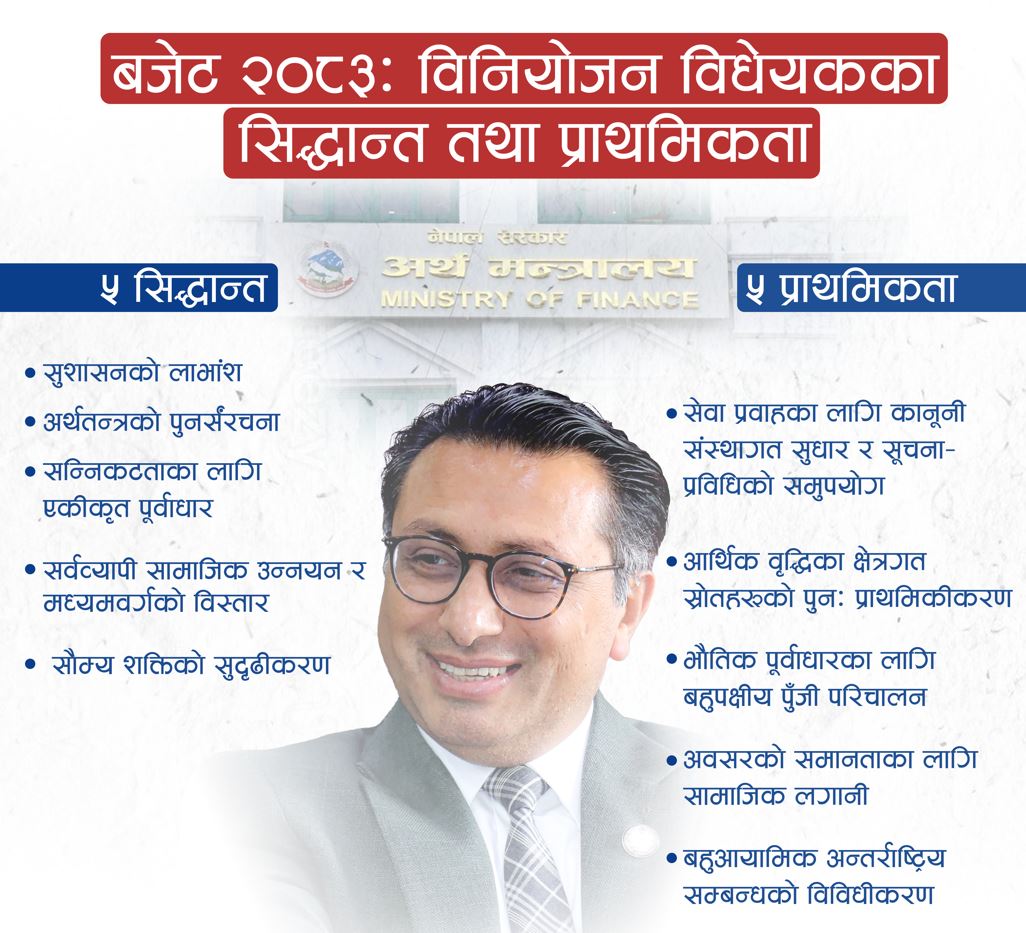
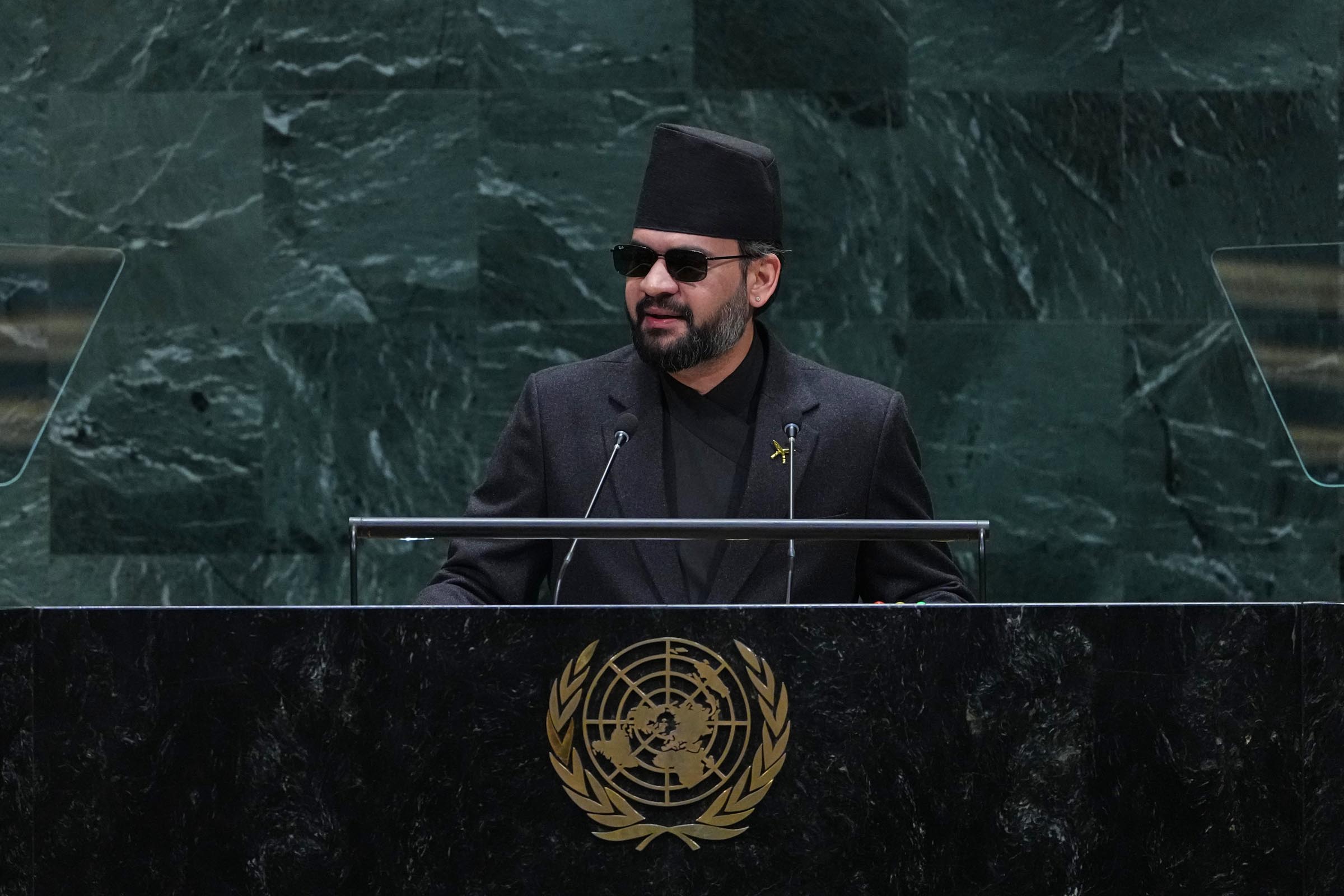
Kathmandu. Finance Minister Dr. KATHMANDU: Swarnim Wagle presented the principles and priorities of the Appropriation Bill for the coming fiscal year in separate meetings of both houses of the Federal Parliament.
He said the present government was moving ahead towards policy stability, institutional strengthening and result-oriented governance system with the determination to maintain the status quo in the country’s constitution, democratic norms, values and the main ideals of good governance.
According to him, the budget is being formulated focusing on good governance and justice, employment-oriented economic growth, quality public services and equal opportunities.
The Finance Minister said that there are 5 guiding principles in the Appropriation Bill. These include the dividends of good governance, restructuring of the economy, integrated infrastructure for contiguity, universal social upliftment, expansion of the middle class, and strengthening soft power.
Dividend for Good Governance
The Finance Minister said that the budget for the coming fiscal year would establish the moral legitimacy, service efficiency and economic capacity of the state that the citizens directly feel good governance. Prudent rule of law, institutional efficiency and supremacy of public integrity would be the starting point for good governance, he said, adding that a series of governance reforms would be implemented to make the state accountable and technology-friendly so that the direct benefits of good governance would be felt in the daily life of the citizens.
According to him, the upcoming budget would be focused on ensuring speedy and reliable public services thereby saving time, labor and cost to the citizens. The delays, hassles and undesirable intermediaries in service delivery will be eliminated through administrative reforms based on integrated digital governance.
The Finance Minister said that the government will comprehensively review the policies, laws and regulatory arrangements of the state by freeing public institutions from illegal capture and exploitation tendencies. The investigation and prosecution system will be made result-oriented against corruption, money laundering, revenue leakage, misuse of public resources and organized crime.
Restructuring the economy
Achieving high, broad and rapid economic growth and creating adequate employment opportunities would be the major goal of the economic restructuring, he said. Similarly, the upcoming budget will transform the consumption-based economy into an investment and production-based economy. He apprised the House that the new phase of economic reform would be pursued on the basis of expansion of economic opportunities, promotion of entrepreneurship, guarantee of competitive environment and productive mobilization of financial instruments.
According to him, the investment-friendly economic climate would be strengthened through balanced public financial management, the confidence of the private sector would be restored and obstacles to the enterprises and business would be removed.
“We will strengthen an equitable social market economy by ending unhealthy competition, syndicates, cartels and monopolies. We will encourage production and innovation by making the tax system simple and equitable. Digital economy, service export, clean energy and high value-added agriculture sector will be promoted as drivers of economic transformation,” he said.
Minister for Finance Wagle clarified that it would be the responsibility of the State to make drastic improvements in international standard aviation service, telecommunications and logistics infrastructures to lessen the structural economic burden inherent in the land-locking adversity of Nepal.
Integrated infrastructure for contiguity
}
Proximity strengthens socio-economic relations by bridging the gap not only between geography and settlement but also between production, market, services and opportunities. Minister Wagle informed the House that it would contribute to economic mobility and social integration by expanding proximity through the construction of extensive infrastructure.
According to him, the priority of the budget will be to develop road, air, energy, urban and digital infrastructures with an integrated approach and strengthen institutional coordination to keep the infrastructure under the discipline of time, cost and quality.
The government aims to mobilize capital, technology and managerial capacity for balanced development that would benefit all regions and communities, expand digital public infrastructure to take economic activities, service delivery and national proximity to a new level. Similarly, the concept of resilient infrastructure development would be adopted taking into account climate change, environmental balance and disaster risk and the relation between conservation, utilization of natural resources and future-secured economy would be maintained.
ubiquitous social upliftment and expansion of the middle class
}
Developing competent human capital, ensuring equal access to quality education, health, nutrition and skills and building a reliable base of social security to those who need state protection will be the priorities of the budget for the coming fiscal year.
Likewise, the government has prioritized expanding the middle class by ensuring economic mobility and social security, promoting agriculture and micro, small and medium enterprises and developing skilled human resources by providing practical and employment-oriented education. Similarly, appropriate financial instruments will be mobilized to link innovation, entrepreneurship and startup culture with production and employment.
We will link the education system with production, entrepreneurship, innovation and labour market. Employment-oriented education will be emphasized by increasing the state’s investment in technical and vocational education, citizens’ access to health services and financial security will be strengthened through the restructuring of health insurance and social security system.
Likewise, Finance Minister Dr Wagle said that steps would be taken for real social mobility to improve the living standard of all Nepalis and inclusion would not be limited only to representation, but would also be linked to economic opportunity and respectful participation.
Reinforcement of soft power
The government will strengthen the balanced foreign relations based on mutual benefit, national self-respect and sovereign interest and mobilize soft power for economic prosperity.
He said that economic diplomacy, cultural identity, integrated use of technology and tourism would expand Nepal’s international presence, credibility and influence and increase economic benefits by developing mature relations with neighbors, friendly countries and international institutions.
Likewise, mobilizing the network, skills and capital of the Nepali community abroad along with domestic capital, technology and entrepreneurship as an integral part of the national development, facilitating the expertise of the Non-Resident Nepalis to be linked to the national economy and legal reforms to link economic diplomacy with investment, technology transfer, export expansion and international capital mobilization.













प्रतिक्रिया दिनुहोस्