

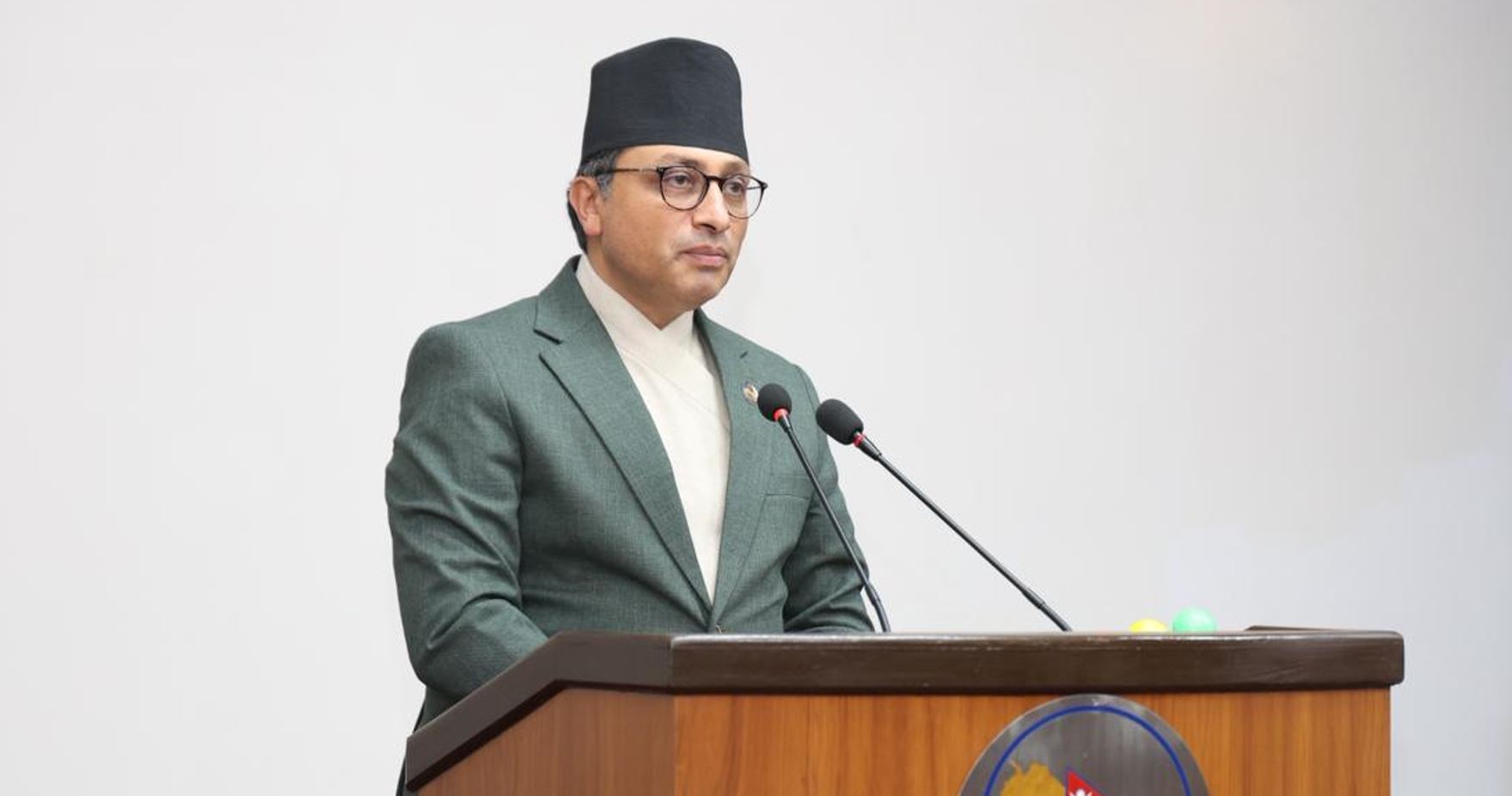
. Finance Minister Dr. KATHMANDU: Swarnim Wagle has said that the budget for the fiscal year 2083/84 is a serious effort to change the direction of economic development of Nepal. In his concluding speech delivered before the passage of the Appropriation Bill in the House of Representatives, he stressed the need for Nepal to be transformed from production, investment, innovation and export-oriented economy to the economic model based on remittance, import and consumption.
“Although revenue, expenditure, debt, tax, agriculture, education, health, social security, industry, energy and economic growth are important issues raised during the discussion on the budget, the government has brought the budget with the objective of seeking answers to some fundamental national questions,” he said.TAG_OPEN_p_41
“Are we going to continue to run our economy on remittances, imports and consumption for the next decade or build an economy based on production and export?” he asked.TAG_OPEN_p_40 Should we be limited to managing the sending of workers abroad, or should we create a safe and dignified labor market?”
Finance Minister Wagle stressed that farmers should be established as competitive producers and entrepreneurs and not only beneficiaries of subsidies, forest resources should be made the basis for green industrialization and employment instead of passive natural resources, and an environment of trust and competition should be created instead of entanglement the private sector in procedural hassles.TAG_OPEN_p_39
According to him, the main objective of the budget is to create a new development paradigm by attacking the structural weaknesses of the economy.TAG_OPEN_p_38 “We are here not to manage the status quo, but to set the direction of change,” he said.
Concerns about the limitations of the remittances and import-dependent models
Wagle said that in the last three decades, Nepal’s economy has been driven mainly by remittances, import-based consumption and asset appreciation.TAG_OPEN_p_37 This, he argued, has contributed to increasing foreign exchange reserves and improving the living standards of millions of families, but it is not enough for long-term prosperity.
} “No country can achieve sustainable prosperity by constantly sending its most energetic young people abroad,” he said. According to him, the practice of focusing consumption over production and making asset price increase the economic base instead of productivity was not suitable for long-term development.
He said that Nepal’TAG_OPEN_p_35 s challenge is not only to increase the economic growth rate but also to change its source.
Roadmap to a Production-Oriented Economy
According to him, the budget has presented the roadmap for the transition from consumption-based economy to production-based economy, import-dependent structure to competitive economy and remittance-dependent model to enterprise, investment, innovation and export-based economy.TAG_OPEN_p_34
He claimed that the budget has tried to start a journey from a distributive-oriented state to an opportunity-creating state, from conservation-based structure to a competitive structure and from dependent mentality to a confident economy.TAG_OPEN_p_33
Base income increase of poverty alleviation
}
Wagle said that the most sustainable policy against poverty is the increase in income, and efforts are being made to expand the base of prosperity creation while maintaining social security.TAG_OPEN_p_32
According to him, productive employment, commercial agriculture, competitive industries, quality education, skill development, innovation and investment are the main bases for preventing future poverty.TAG_OPEN_p_31 He said that the budget has also been prepared with this belief.
}’The Difficult Road to Prosperity, Not Populism’
Finance Minister Wagle said that the biggest feature of the budget is its direction.TAG_OPEN_p_30 Nepal’s economic transformation in the coming decade is possible on the basis of a capable state, dynamic private sector, productive workforce and equal access to opportunities.
}”We have chosen not the easy road to popularity, but the difficult road to prosperity,” he said. Stating that the budget is not only a list of expenditures but also a blueprint for economic transformation of the coming decade, he described it as the first firm step towards the journey towards a production-oriented, competitive, innovative, employment-oriented and self-confident Nepal.
At the end of his concluding remarks, he repeated an important question: “Do we have confidence that our own generation can change the economic destiny of Nepal?”TAG_OPEN_p_28












प्रतिक्रिया दिनुहोस्