

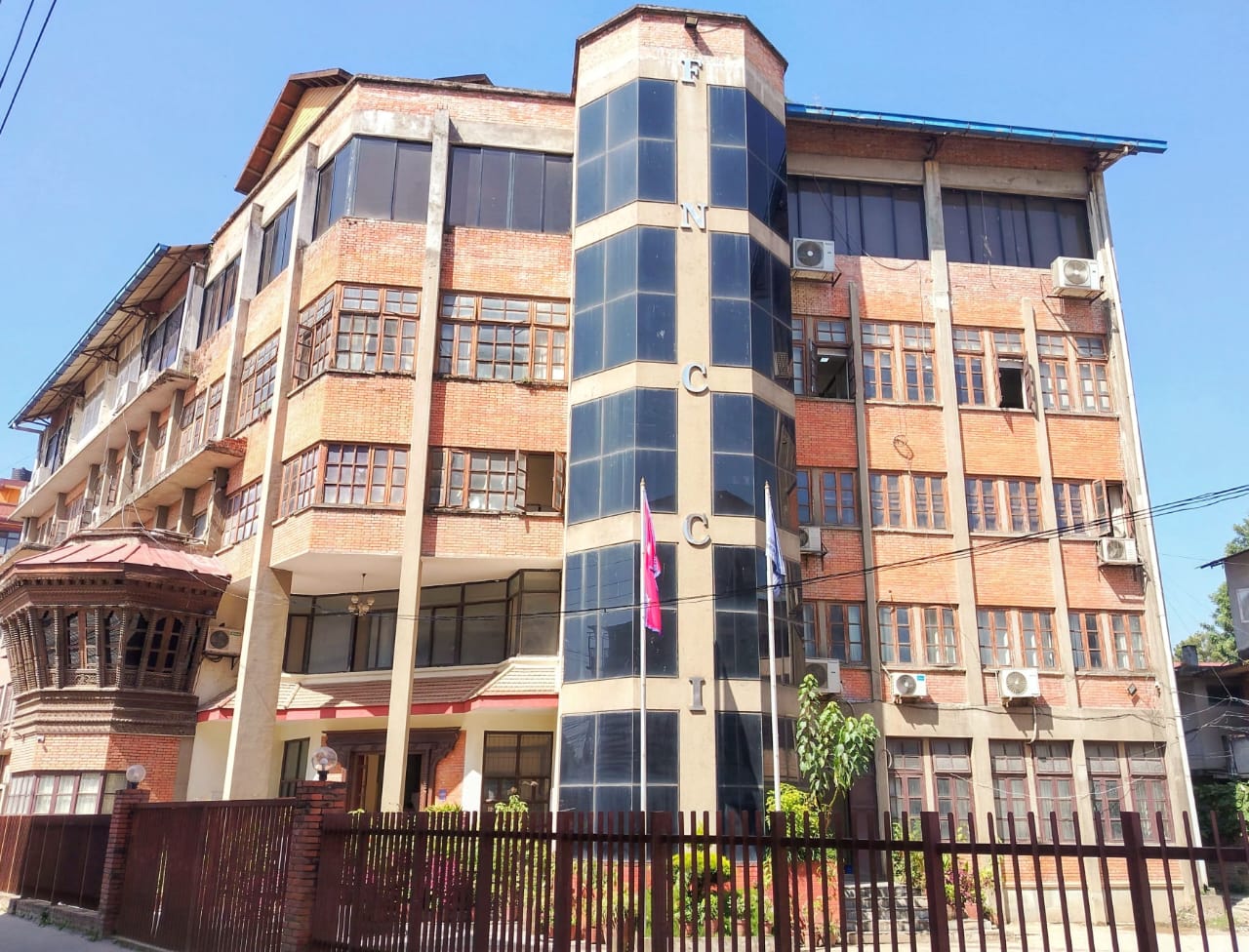
Kathmandu. KATHMANDU: The Federation of Nepalese Chambers of Commerce and Industry (FNCCI) has furnished recommendations to the Nepal Rastra Bank (NRB) for the monetary policy for the coming fiscal year 2083/84. The federation has given suggestions under various headings.
The recommendation states that the credit flow to the private sector has shrunk from 7.3 percent to 5.7 percent even though the average interest rate has come down to 6.9 percent.
Due to lack of demand in the market, Rs 14 trillion worth of investment has piled up in the banking system and more than Rs 37 trillion of liquidity has to be absorbed in 10 months.
According to the FNCCI, the recent Genji agitation, confusion in the global economy and the crisis in West Asia have made the Nepali economy more challenging.
The main challenge at present is not the interest rate, but the demand for investment and capital mobilization, the expectation of the private sector: investment facilitation announced in the budget, alternative finance mobilization, etc. are promising. The monetary policy is expected to help achieve the target of the budget and boost the confidence of the private sector by ending the policy-level uncertainties.
Nepal Rastra Bank (NRB) has already reduced the policy rate, SDF and SLF rates, and the interest rate on deposits has also reached a historic low.
But despite this, credit expansion has not picked up as expected, and a large amount of liquidity in the banking system has stagnated in a passive manner.
Therefore, the main demand of the private sector should not be to reduce interest rates further, but to strengthen the mechanism to reach the real economy and restore the credit flow capacity of the banks.
Now the banks are not reluctant to lend money, the capital capacity required to expand the loan is limited.
The core capital ratio of many banks and financial institutions has reached close to regulatory minimums. In such a situation, there is a risk of breaching the regulatory limit by issuing additional loans even if there is a demand for credit.
If the NRB wants to speed up credit expansion, it needs to focus on capital adequacy more than interest rates, realistic flexibility in provisioning and capital relief measures.
It is now necessary to take a concrete decision for the management of the non-performing assets of the banks.
Billions of dollars worth of seized and idle assets owned by banks are stuck outside the productive economy.
Banks’ credit capacity can be significantly increased if such assets can be re-invested through sales, rentals, leases, or asset management companies. This topic has been under discussion for many years; Now it is necessary to take it to the implementation phase.
The current capital loan provision states that the working capital loan should be flexible according to the nature of the business and the decision authority should be given to the concerned bank and borrowers.
The overdraft facility that has been discontinued due to the working capital loan guidance should be reintroduced on a limited basis to 20 percent of the total approved loan.
The provision related to restructuring and rescheduling should be made easier and more flexible before categorizing the loans of industries that are in trouble due to the economic recession into bad loans.
Likewise, the provision of classification of non-performing loans on the basis of arrears for 3 months should be amended and the classification of loans should be improved immediately after the payment of arrears.
In the entire banking sector, the fee should be reduced by maintaining uniformity in the property valuator’s fees, service charges, and loan flow documents and terms.
The existing law states that necessary policy provisions should be made as there is a lack of clear law to distinguish between bankers and businessmen and business and businessmen. The legal and banking process related to cheque bounce should be made fast, effective and business-friendly.















प्रतिक्रिया दिनुहोस्