Skip to content

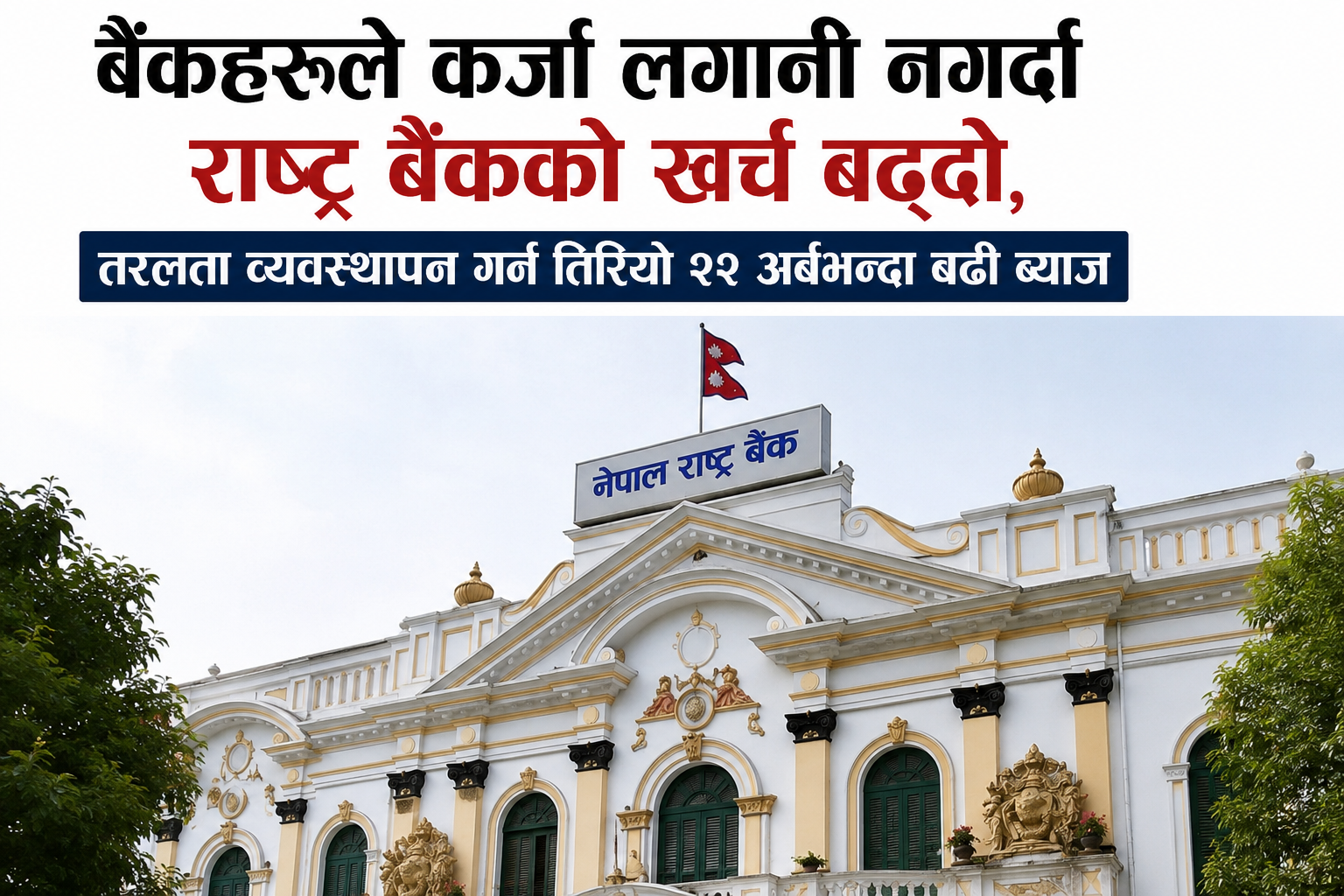
Nepal Rastra Bank (NRB) spends more than Rs 22 billion in interest to manage liquidity 

. Banks and financial institutions have not been able to disburse loans as expected, which has led to excess liquidity in the banking system. A large amount of money is lying idle in banks due to weak demand for credit in the market. In order to manage this additional liquidity, Nepal Rastra Bank has to spend more than Rs 22 billion in interest through various monetary instruments in the current fiscal year.

The Nepal Rastra Bank (NRB) has been using various monetary instruments throughout the fiscal year to control the surplus amount accumulated in the system due to the failure of banks and financial institutions to disburse loans.TAG_OPEN_div_46 According to Sudha Shrestha, joint spokesperson of the NRB, the central bank has paid Rs 22.12 billion in interest on the deposits and debentures of the central bank.

The Nepal Rastra Bank (NRB) has been using these tools to balance the money supply by pulling in excess of the required amount in the market.TAG_OPEN_div_44 Sources in the central bank said that the central bank has been intervening regularly because of the risk of inflation and financial imbalances in the future if excess liquidity remains in the market for a long time.

The Rastra Bank does not provide free liquidity management.TAG_OPEN_div_42 Interest has to be paid on the basis of inter-bank interest rate for the amount withdrawn from banks and financial institutions. Due to this provision, the central bank has paid the interest in the last fiscal year.

According to the Nepal Rastra Bank, in the fiscal year 2082÷83, the bank and financial institutions have spent Rs 13.30 billion in interest on deposits kept by banks and financial institutions through deposit collection bidding tools.TAG_OPEN_div_40

Similarly, Rs 5 TAG_OPEN_div_38.79 billion has been paid interest on deposits kept through the Fixed Deposit Facility Instrument. Similarly, the interest paid by the banks through the debenture instrument of Nepal Rastra Bank is Rs 3.02 billion.

According to NRB sources, in the last fiscal year 2082÷83, 157 deposit collection bids were conducted.TAG_OPEN_div_36 Similarly, the bank has used the permanent deposit facility 101 times. Similarly, Nepal Rastra Bank (NRB) has issued 17 debentures in the last fiscal year.

As of July 14 of TAG_OPEN_div_34 the last fiscal year, banks and financial institutions have collected deposits of Rs 82.88 trillion. Of this, the share of commercial banks is Rs 7.486 trillion, while the development banks and finance companies have collected deposits of Rs 802 billion.

As of July 14, the total loan investment of banks and financial institutions has reached Rs 5.TAG_OPEN_div_32 944 trillion. Out of this, commercial banks have disbursed Rs 5.286 trillion while development banks and finance companies have disbursed Rs 658 billion.

Nepal Rastra Bank (NRB) has allowed banks and financial institutions (BFIs) to maintain their loan-deposit ratio (CD) ratio up to 90 percent.TAG_OPEN_div_30 That is, banks can disburse a large part of their deposits in the form of loans. However, at the end of the fiscal year, the average CD ratio of banks and financial institutions stood at 71.08 percent. Although the banks still have the capacity to extend a large amount of loans, the money has remained idle due to lack of demand in the market, according to a source in the NRB.

The inter-TAG_OPEN_div_28 bank interest rate is another indication of the easing of liquidity in the banking system. As of July 14, the weighted average interest rate of inter-bank transactions between banks and financial institutions in local currency stood at 2.75 percent. An official of the Rastra Bank said that the low inter-bank interest rate is an indication that banks have enough liquidity.

Lately, the demand for loans has been low when there is enough money in the banks. Banks have been saying that there is a lack of demand for quality loans. In the last few years, the private sector has been cautious about new investments. The demand for loans has weakened due to lack of expected expansion in industry, trade, construction, tourism and housing sectors. The economic activities of the private sector have not been fully revived as the government’s capital expenditure has not been able to pick up the expected pace. The impact of this has been seen on the credit expansion of banks.

} On the other hand, banks are also prioritizing safe investments rather than extending loans to risky areas. Banks have been cautious in sanctioning loans to prevent the increase in non-performing loans. As a result, even though banks have adequate resources, a large part of it remains with the central bank.

Prabhu
sikhar insurance

प्रतिक्रिया दिनुहोस्

dish home
national life
http://sanimareliancelife.com/
MAK 4T
Arghakhachi
Gili