



The unimaginable flood in the Bhotekoshi River last Wednesday caused huge damage to the settlements, roads, bridges and physical structures on the banks of the river within a few minutes. The flood that started from Rasuwa has spread to the coastal areas including Nuwakot, Dhading, Gorkha via Trishuli, displacing many families and causing a huge loss of life and property.
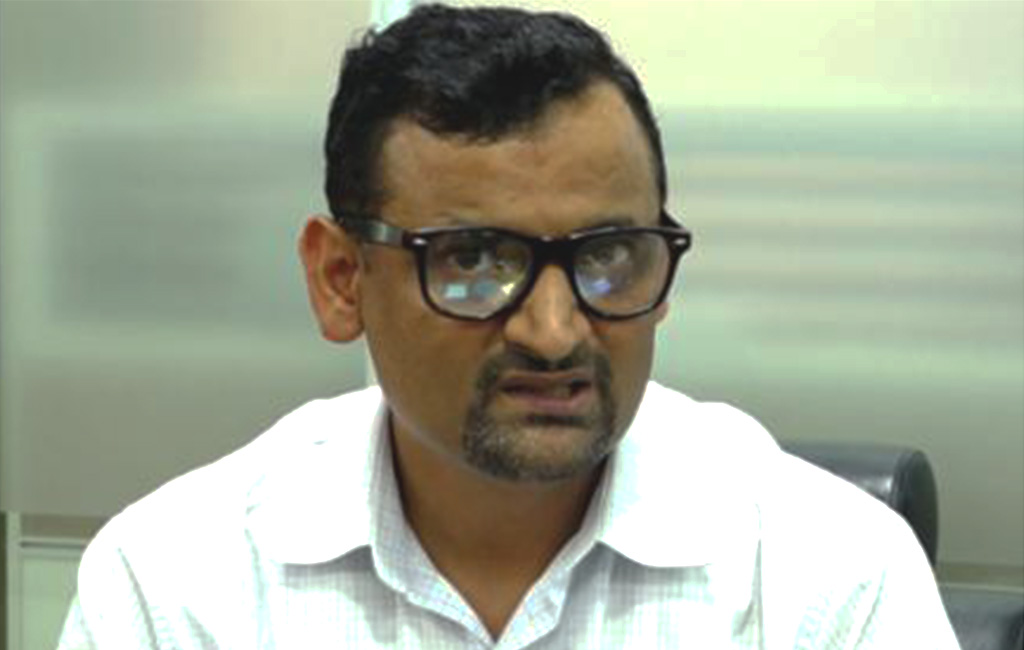
This sudden flood has also raised a serious question – why was there no warning of such a big disaster? What is the risk around the Bhotekoshi and Trishuli rivers in the coming days? Are the lakes formed due to the floods still on the verge of bursting? And how can the citizens be protected from such disasters in the future? Here is an edited excerpt from a conversation with Binod Parajuli, a flood expert at the Flood Forecasting Division under the Center for Hydrology and Water Resources Research:
– Last Wednesday, there was a devastating flood that we did not think of. Some people have interpreted it as an avalanche tsunami. Didn’t you get any early signs before the floods?
Now we did not get a pre-indication of it. Mainly, to get the pre-signal, the equipment installed there has to inform us. We had set up an automatic hydrometer station about a kilometer down near the border of Rasuwa. Similar sensors were installed in Betrawati. The flood came to a much higher place than the place where those sensors were placed. Normally, we install sensors up to 10 meters. We call it the flood of the return period of 100 years. These devices are kept for floods that can come back in 100 years, but this time all those devices were washed away at the same time and we could not get any information.
To get information about the lake bursting, we have to have either a CC camera at that place or some ‘real-time monitoring’. Either we have to take a decision on the basis of the information that the vibration of any earthquake is measured. Now we do not have ‘real-time access’ to earthquake information. Again, the tremor measurement of the earthquake does not mean that all avalanches go away. It is a bit difficult to make a decision.
It is possible to work in this direction in the future. In the case of floods, all the mechanisms that we had failed. On the one hand, it has been proved that our water measurement station was not for such a big flood. I do not know whether there was any sensor on the Chinese side to measure the floods in the border river. Information could not be obtained from them. Or even if it was, it may have been washed away in the beginning because there has been a huge human loss on the Chinese side as well.
– Last year too, a glacial lake burst causing floods in the Bhotekoshi. Wasn’t it agreed to exchange early information about the climate-related disaster that occurred on the Nepal-China border at that time?
That agreement has not even been formally agreed. We just sat at the negotiating table and discussed. Now it was agreed that we should go in this direction. Now we have to go to data sharing. Before that, we have to work on data collection. There should be joint research. We cannot reach data exchange without studying and researching in that area where the risk is, where the sensors should be placed.
As far as we know, there was no data collection or data survey system in this region of Tibet as well as in Nepal, in the border border area.
I think if the Chinese government had the data, we could have got it. Now if they had that data, China could also have saved the population of its territory. Therefore, there is no room to blame China. But in the future, there is a need for Nepal and China to jointly take diplomatic initiatives on how to jointly expand such a survey mechanism, expand the connection including CC cameras, and give real time access to it to Nepal, so that we can detect in time when such disasters occur in the future, and we can protect our citizens.
– Could the damage have been reduced if we had given advance notice some time earlier? Or did the damage increase because some people did not take it seriously even after getting the information on time? How do you see this incident?
Both things are true in this. First, there was damage in Betrawati or below the place where we had given prior notice. Even after getting the information, the citizens could not guess why the damage was done, it was such a big flood.
On the one hand, we did not put such a big flood in the notice. In our notice, we only said ‘there is a very big flood, let’s go to a safe place, go to a higher place’, but the citizens did not think that this flood is so big and it will destroy the village. It seems that you only thought that the flood is a little bigger than the flood that happens every year.
On the other hand, the citizens who assessed the possibility of a big flood and went to a higher place to protect themselves have been saved. Therefore, there is some negligence on the part of the citizens. If we had the ability to give information a little earlier, then some more citizens could have been saved. But looking at the situation of not being able to assess this, it seems that even if so many citizens were informed beforehand, it could not be saved because especially in Betrawati and Vidur and other areas, there were many places where citizens did not leave their homes even after knowing about it.
We were informed before the flood reached Betrawati and there was a human loss. After the damage, the citizens of the lower areas realized that it was no longer enough to be vigilant, they had to climb the hills to save themselves. After that, many citizens left their homes and climbed up the hills and they were able to save their lives. If they had been informed a little earlier, some more citizens could have been saved, of course. But it was not possible to save them completely, because the citizens could not assess the real risk of floods.
– What is the main lesson we have learned from this flood?
Now, what we have learned from this is that we should not ignore the warning of any disaster. Whether it is a small flood or a big flood, we should take ourselves to a safe place because even in a small flood, we do not suffer any damage, but if there is a big flood, then we can avoid the damage. Therefore, we should not ignore any information that we issue in the future or any information sent by the citizens from the upper areas. That information may or may not be said to be a very big flood.
As soon as the information about the flood is coming, it is enough for the citizens to go to the nearby high altitude area in the hilly areas. This is due to the Bhotekoshi flood. There are equally risk areas in the same river and other rivers. Therefore, in the future, all the rivers that flow through the mountainous areas of the country, the residents living near all those rivers should prepare in advance to take them to the nearest high safe place.
– The risk still remains. The glacial lake is blocked and there is a risk that it can burst at any time. Similarly, how much risk do you see now that small landslides have blocked the river?
In the information so far, it is reported that two lakes have been formed. It has been reported that the lower of these two lakes partially opened on Saturday night. As a result, we measured the flood of about three meters on Sunday morning in Galchi, Dhading. We have set up a new center there. The bridge which was not washed away has a water measurement center on that bridge. Therefore, that three-meter flood is a major flood. However, it was smaller than last Wednesday’s flood and there was no flood that would cause damage as it was outside the affected area.
There is still one lake left there and it is said that the lake is in danger of bursting. Therefore, we will keep the people of the low-lying areas alert. Until there is a situation that the lake is not in danger, there is a need to carry out rescue and relief programs downstream.
– Isn’t there any immediate action that can be taken to reduce the risk of the lake?
Now there is a risk of doing some work on the ground immediately. More landslides may fall and those who go there for work will be at risk themselves. It is a matter of thinking about how we can open the lake and drain the water and reduce the risk until the lake bursts in the future, but for the time being, if the lake bursts, the only option left is to give early warning and save people.
– In some places, the citizens are still living outside. When will they be able to return home with confidence that their settlement is safe?
The settlements that were submerged and swept away by this flood will never be safe again. That is clear. Even if the settlements are in place now, they can be updated on the warning, it is not possible. However, we recommend not to stay there because there is a possibility of a bigger flood than last Wednesday. The flood that we have seen as the biggest flood so far, a bigger flood is also possible, because the big glaciers are still in the upper areas. We can also assess the possibility of a bigger avalanche.
Now, there is a need for the citizens to stay in the same area for the time being without further arrangement, and in the long run, they have to change their place of residence and shift to a safe place. This is not only for them, but all the settlements that are located near the rivers and rivers all over the country have to think about it. How to relocate those settlements, where to relocate them, and especially how the state will help the poor people who live near the rivers, how will the state help them to settle in new places? The state should also think.
We will expand and develop the early warning system a little bit because we may be able to evacuate the settlements, but the hydropower project, the irrigation project, the roads, the bridges, all are around the river. So, we need early warning to protect the passengers, the workers working in the project, the security personnel, everybody. The citizens are also near the river for agricultural work and various other works.
If settlements can be relocated in the future, it will help reduce both physical and human losses. This is also a very important lesson behind the flood incident. We have been learning this lesson from the past as well, but it has been learned that we need to go to safer places as it becomes a bigger disaster.
– How challenging is it to collect early information now after the water measurement stations have been washed away?
It is very challenging. In the midst of that challenge, we are trying to work for the time being by putting CCTV cameras in the border area. On Sunday, a team has already gone there to study the feasibility of installing CC cameras. Right now, the plan is that we can have at least two. If that happens, we will be able to sit here day and night in the control room and study the pictures obtained through the CC cameras and give information. Immediately, we are not in a position to have an automatic device to measure the flow of water in the river. All the bridges there have been washed away. Everything is swampy, muddy and there is no situation to go there and put another station again.
– What would you like to say to the flood-affected citizens?
We request the people affected by the Bhotekoshi floods to remain in high morale and stay updated with any information related to any flood, landslide or disaster. We do not issue some information, but incidents may happen. Therefore, as soon as the local people get the news, we request the people living in the lower areas to share it. If we all try to deal with this disaster together, the loss of life and property can be minimized.












प्रतिक्रिया दिनुहोस्