

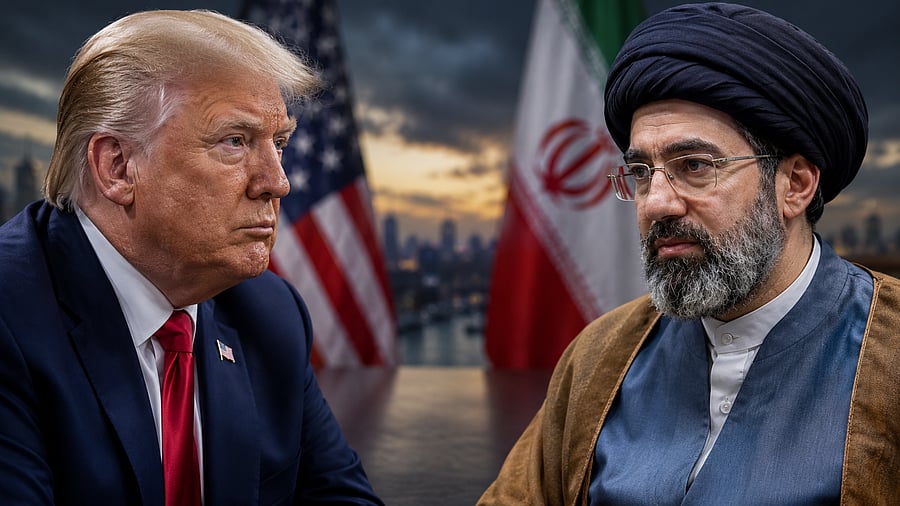
The United States and Iran have reached a comprehensive peace deal after four months of military tensions and conflicts.TAG_OPEN_p_28 U.S. President Donald Trump and Iranian President Massoud Pezeshkian signed a memorandum of understanding (MoU) on Monday.
The U.S. administration has called this agreement (performance-based). This means that sanctions will be lifted and economic benefits will come into effect only after Iran fulfills all its commitments.
Under the agreement, the United States, Iran and their allies commit to an immediate and permanent end to military action on all fronts.TAG_OPEN_p_26 The ongoing military activities in Lebanon are also covered under this provision. The two sides have agreed not to resort to military aggression or threat against each other and respect each other’s sovereignty and territorial integrity.
The agreement states that the United States and Iran will not interfere in each other’s internal affairs.TAG_OPEN_p_25 It is seen as a basis for rebuilding trust between the two countries.
With the signing of the MoU, negotiations for the final peace accord are expected to be completed within 60 days.TAG_OPEN_p_24 If necessary, the period can be extended with the consent of both the parties.
Under the agreement, the United States has agreed to lift the military sanctions imposed on Iran.TAG_OPEN_p_23 The blockades at Iran’s ports will be removed within 30 days, and the US military presence around Iran will be gradually reduced after the final agreement is reached.
The resumption of the Strait of Hormuz, the main route for global energy supply, is also an important part of the agreement.TAG_OPEN_p_22 Iran has pledged to ensure the safe passage of commercial ships and not to charge any additional fees. The reopening of the war-closed route is expected to stabilise international oil markets.
The deal provides for at least $TAG_OPEN_p_21 300 billion in funds to fund Iran’s reconstruction and economic development. This amount will be raised through the US, partner countries in the Gulf region and international investment. However, the US has clarified that it is not obliged to make a direct financial contribution to the fund.
At the same time, it was agreed that the US and United Nations economic sanctions on Iran will be gradually lifted.TAG_OPEN_p_20 But the lifting of sanctions will only move forward after Iran fulfills its commitments on its nuclear program.
In the deal, Iran has made a clear commitment not to build, destroy or acquire nuclear weapons.TAG_OPEN_p_19 It was also agreed to reduce existing enriched uranium to low-enriched levels under the supervision of the International Atomic Energy Agency (IAEA). However, its technical implementation will be decided through further negotiations.
Both sides have agreed to maintain their current nuclear status until a final solution is reached.TAG_OPEN_p_18 During this period, the United States will not impose new sanctions and will provide concessions on oil, petroleum products and related banking and transportation transactions.
The agreement also states that Iran’s frozen and confiscated assets abroad will be opened in a phased manner.TAG_OPEN_p_17 U.S. officials have said that if Iran abides by the terms of the deal, the process of providing the sanctions will be forwarded.
Joint mechanism will be formed to monitor the implementation of the MoU. The final agreement is also expected to be ratified by the UN Security Council through a binding resolution.
However, some important aspects of the agreement are still unclear. In particular, there is still no clarity on the timeline for lifting sanctions, the final modality for uranium disposal, and Israel’s role in Lebanon. Therefore, analysts say the next 60 days of negotiations will be a decisive step in determining the future of US-Iran relations.














प्रतिक्रिया दिनुहोस्