



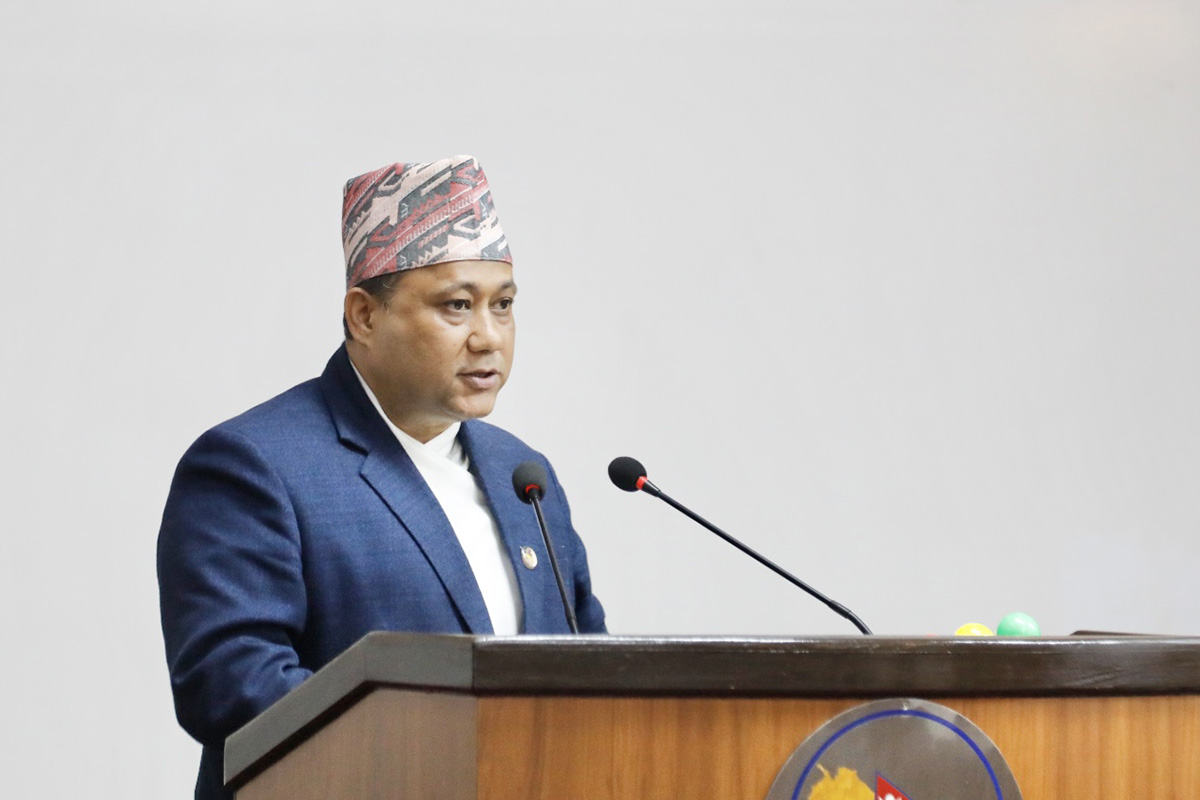
Kathmandu. The incumbent government, commanding a two-thirds majority in the general elections, has prioritized economic diplomacy and multilateral cooperation.
On the basis of this, works are underway to further elevate Nepal’s relations with its neighbours and friendly countries since many years on the basis of balanced and mutual benefit, expand the areas of cooperation and strengthen the environment of trust.
The foreign visits and diplomatic interactions held during the period of hundred days of the formation of the government are sure to further broaden Nepal’s foreign relations and help increase external cooperation and goodwill in the country’s economic prosperity.
Meanwhile, Minister for Foreign Affairs Shishir Khanal has paid official visits to India and China. Intensive meetings with the representatives of foreign missions in Nepal are also continuing. In this context, RSS’s Krishna Adhikari talked to Foreign Minister Khanal:
How much TAG_OPEN_strong_72 does the foreign policy of the present government match the policies adopted by the previous governments?
The incumbent government has adopted the foreign policy on the basis of the constitution, international commitments, election manifesto and the priorities clearly mentioned in the hundred-point commitment letter issued immediately after the formation of the government. Although the centenary agenda is mainly focused on governance reforms, some priorities related to foreign policy have been included.
Our priorities are centered on protecting and promoting national interests. To enhance the effectiveness of the services of Nepali embassies and missions abroad, to improve the security and consular services of Nepalis in foreign employment, to form a special mechanism to attract foreign investment of overseas Nepalis, to attract foreign investment through economic diplomacy, to institutionalize high-level dialogue with development partners and neighboring countries, to map, utilize and manage the skills, knowledge, network and investment capacity of overseas Nepalis and to promote the prestige and image of the country through effective mobilization of soft power. and other topics.
Our efforts will be to maintain balanced relations with all the neighboring neighbors, India and China, emphasize on economic diplomacy and maintain easy relations with all to take forward a new style of diplomatic dialogue centered on national interest.
The present government wants to maintain cordial relations with all friendly countries including neighbours and development partners keeping the national interest at the centre. Our endeavor will be to maintain balanced relations with all including our two neighbouring countries, India and China, emphasizing on economic diplomacy and maintaining easy relations with all sides and to move forward a new style of diplomatic dialogue centered on the national interest.
What are the major diplomatic achievements made after the formation of the present government?
Diplomatic steps have been taken as per the government’s priorities by conducting the foreign policy in accordance with the principles stipulated by the Constitution of Nepal. The foreign policy of the new government has sent a clear message to the neighbours and the international community.
The Ministry of Foreign Affairs has been working as the “first line of defence” in the protection of national interests. To promote high-level meetings and cooperation, to make the meetings of bilateral mechanisms active, to make economic and public diplomacy effective and to facilitate service delivery, to operate an online app named ‘MOFA Mitra’ for consular service facilitation, to make foreign employment more systematic, safe and dignified including security, rights and welfare of Nepali citizens living abroad, and to provide assistance to Nepalis in trouble. We are working on the issue of rescue and retrieval of dead bodies in case of death.
For this, making the Ministry of Foreign Affairs and our diplomacy more powerful and effective is also a priority.
I am confident that the recent visits to China and India have contributed significantly to further consolidating the friendly and multifaceted bilateral relations. During the visit, fruitful discussions were held on expanding cooperation in various areas including infrastructure, connectivity, border management, energy, trade, investment, agriculture, technology transfer, information technology and digitalization, tourism, chemical fertilizers, petroleum and natural gas exploration and people-to-people relations.
We are working on the issues of making foreign employment more systematic, safe and dignified and providing assistance to Nepalis in trouble, rescue and retrieval of dead bodies {TAG_CLOSE_em_75}}
}
Important tasks have been done in terms of strengthening the Nepali missions abroad, preparing a country-specific strategy keeping economic diplomacy at the center, and formulating our dialogue-centered strategy and priorities through inter-ministerial coordination meetings. We have introduced new programs including International Health Day, Nepal’s soft power promotion program, establishment and operation of Nepal Diaspora Global Network, Lumbini Fellowship, among others.
Similarly, coordination has been made to resolve the problem by holding virtual talks with the ministers of the countries concerned on the issue of Gurkha and the release of Nepalis from prison in Ukraine. We have also laid special emphasis on adherence to the diplomatic code of conduct. The issue of joint courtesy calls held at the level of the Right Honorable Prime Minister has also been seen as a new style in the diplomatic practice.
What is the priority of the present government in economic diplomacy and soft power?
As I have said before, after the formation of the present government, works are being carried out with priority to the foreign policy and international relations centered on promoting national interest and image of the nation.
The government has prioritized the issues of making economic diplomacy particularly effective, enhancing the country’s international image and prestige through the effective mobilization of public diplomacy by highlighting Nepal’s soft power and digitization and software upgradation for strengthening consular services. The government has paid special attention to the culture, heritage, promotion of political values and foreign policy of the soft power.
The government is working with priority towards achieving good governance and economic prosperity while remaining committed to the Constitution, foreign policy and the established norms of international relations. We have also promoted regional and international cooperation.
Both sides expressed commitment to take forward the traditional friendly relations between the two countries with ‘new energy’.TAG_OPEN_strong_67 Currently, bilateral mechanisms between the two countries are active and operational. Economic cooperation is at the centre. Therefore, this tour can be considered special {
}
Since the issue of conducting foreign relations is sensitive, everyone has equal responsibility, contribution and role on this issue. The Constitution has established the UN Charter, non-alignment, Panchasheel principles, international law and world peace as the basic principles of Nepal’s foreign policy.
TAG_OPEN_strong_66 A few days ago, there was talk that relations with India have expanded from a new angle after his visit to India. On what basis can the importance of this visit be considered special compared to the previous visits?
After the formation of the present government, I had visited India at the invitation of the Indian External Affairs Minister. As this was the first high-level foreign visit after the formation of the new government, there was a lot of interest inside and outside the country. The relationship between Nepal and India is not only based on the two governments, but is based on open borders, cultural proximity and people-to-people ties. Trade, energy, investment, connectivity and border management were centred and result-oriented discussions were held during the visit.
In the past few years, both sides have reaffirmed their commitment to managing the ups and downs in relations seen due to border disputes and political misunderstandings through dialogue. Both sides expressed commitment to take forward the traditional friendly relations between the two countries with ‘new energy’. Currently, bilateral mechanisms between the two countries are active and operational. Economic cooperation is at the centre. Therefore, this visit can be considered special.
Has there been any agreement on the issues of border and bilateral trade after the Prime Minister’s visit to India in the near future?
Nepal wants to further strengthen bilateral relations with India keeping economic development at the center. We are committed to resolving border issues between Nepal and India through diplomatic dialogue on the basis of the historic treaty, agreements and maps in line with the letter and spirit of the close ties between Nepal and India.
} Immediately after returning from his visit to India, he also completed his visit to another neighboring country, China. Is it just a coincidence or is it diplomatic ingenuity?
Neighbourly relations are very important when it comes to a country’s international relations and foreign policy. We have very close relations with our friendly country China. In this context, it is appropriate to consider this visit as concluded in the direction of further consolidating our relations with China rather than mistaking it as a mere coincidence or diplomatic tact.
The need of the hour is a sensible, effective and development-oriented foreign policy to protect and promote national interests, considering the changing world context{{TAG_OPEN_strong_64 TAG_CLOSE_strong_64}}
During these visits, important discussions and understandings were held on further strengthening bilateral relations, expanding economic cooperation and further consolidating mutual trust, understanding and people-to-people relations.
Were there any agreements of cooperation during the visit to China?
During his meeting with Chinese Foreign Minister Wang Yi, matters relating to bilateral relations, investment and infrastructure development cooperation were discussed. Matters related to infrastructure development, investment, tourism, agriculture, technology and trade expansion were discussed during the visit. We want to advance our relations with China as an economic and development partnership. China also pledged to strengthen infrastructure development and economic cooperation with Nepal. China has pledged to advance high-quality Belt and Road Cooperation with Nepal and expand cooperation in the fields of electricity transmission lines, highways, border points and air connectivity. China has reiterated its support to transform Nepal from a ‘landlocked’ situation to a ‘land-linked’ country.
What should be Nepal’s foreign policy in the coming days?
World politics is entering a new phase of intense competition and power balances. There are also very interesting projections about the new world order. At the same time, the need for Nepal to adopt balanced diplomacy has increased. On the one hand, there is a need to expand foreign relations keeping one’s national interest at the center and on the other hand, there is a need to maintain bilateral and multilateral relations to find solutions to the challenges brought about by globalization and rapid development of information technology. The government is working keeping the national interest at the centre. Therefore, sensible, effective and development-oriented foreign policy is the need of the hour to protect and promote national interests in view of the changing global context.













प्रतिक्रिया दिनुहोस्