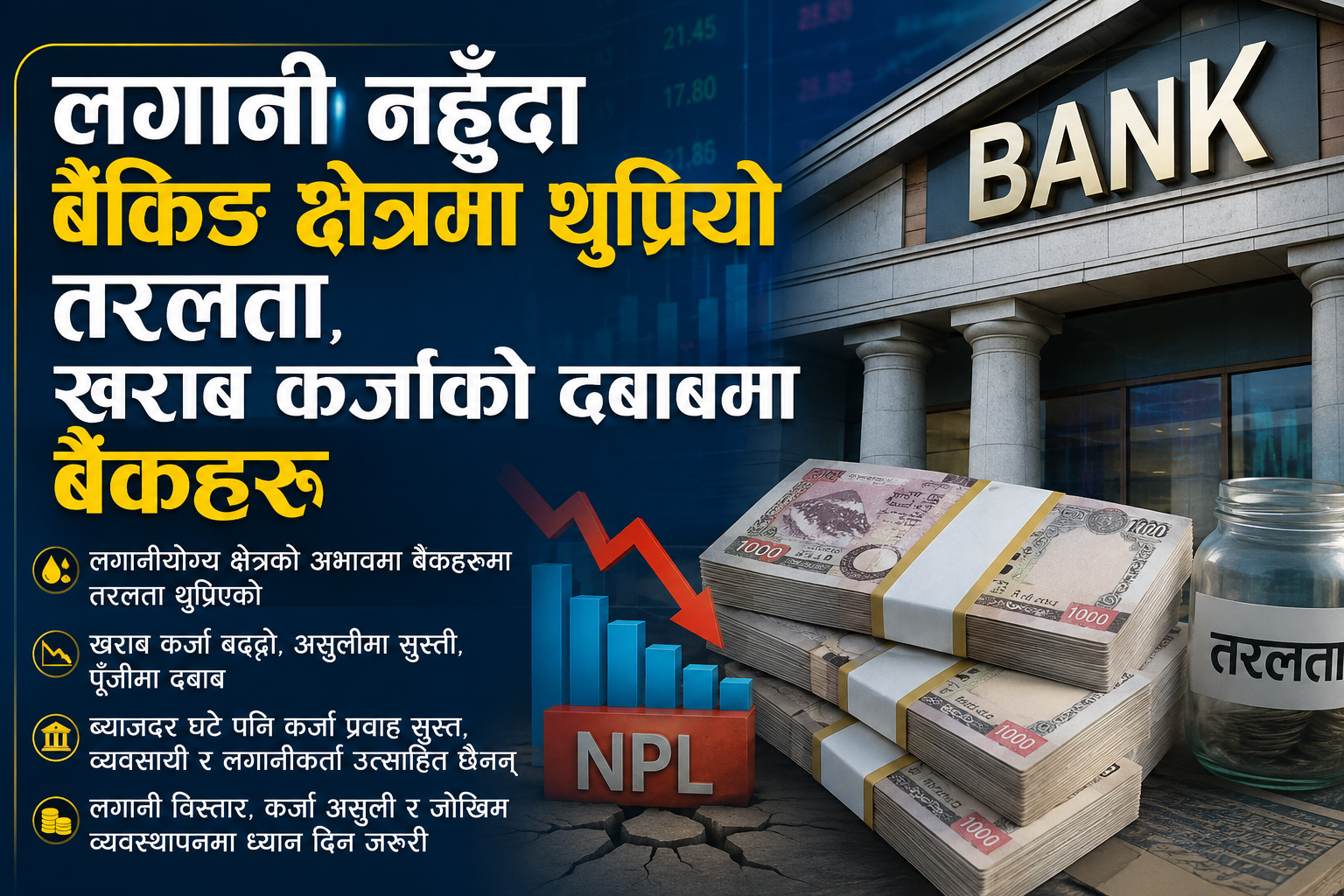
Banks under pressure of non-performing loans due to lack of investment in the banking sector
लगानी न्यूज
. According to a study published by ICRA Nepal, investment in the banking sector has been declining in the last few years. Although there is enough money to invest in the banking system, the demand for loans is weak, which has led to liquidity accumulation in banks and financial institutions.
There is enough investment in the banking sector in recent times as the remittance inflow has increased significantly. However, the expansion of new credit has not picked up pace due to the lack of expected improvement in economic activity. According to the report on the banking sector released by ICRA, it is a big challenge to not be able to invest in safe and productive sectors even though there are resources for investment at present.
According to the report, credit expansion declined significantly in fiscal years 2023 and 2024 due to the slowdown in economic activity, high interest rates and the implementation of working capital guidelines.TAG_OPEN_div_82 But in recent years, the expansion of credit has started gaining momentum. In the first nine months of fiscal year 2025 and 2026, credit expansion has increased to about 8 percent annually. But even as credit expansion has started improving, bad loans remain the biggest concern in the banking sector.
TAG_OPEN_strong_46Commercial banks’ non-performing loans cross 5 per cent
The gross non-performing loan (NPL) of commercial banks has increased from just 1.2 TAG_OPEN_div_79 0 per cent in mid-FY22 to 5.41 per cent at mid-April 2026. According to the report, the NPL of the overall banking sector has also increased by 5.60 percent. According to the report, the problems in the banking sector are not limited to NPL.
The share of delayed loans is still around 15 to 25 percent, according to ICRA.TAG_OPEN_div_77 This also raises the risk that some of the loans that are not currently in the NPL could turn into bad loans in the future.
Non TAG_OPEN_div_75-banking assets (NBAs) of banks have also increased due to the slowdown in mortgage sale and loan recovery. The bank’s ABA NBA stood at about 0.9 percent or Rs 54 billion. The adjustment of NBA is expected to increase the adjusted NPA to about 6.46 percent. This could lead to a weaker real asset quality than the published NPL rate.
Liquidity is the strength of the banking sector
}
On the one hand, the pressure of bad loans is increasing, on the other hand, the liquidity situation in the banking system is easy. The continued increase in remittance inflows and relatively weak demand for credit have left banks with enough money to invest. As a result, the loan-deposit ratio (CD ratio) of banks has come down to around 74 to 75 percent. Banks can invest up to 90 percent as per the regulatory limit.
{
Excess liquidity in the banking system has also had an impact on interest rates. Deposit and loan interest rates have fallen significantly. According to the report, the average cost of deposit of commercial banks has come down from a high of around 11 per cent at one point to 3.64 per cent by April 2026. After the reduction in interest rates, the environment for taking loans from banks has become comparatively easier. However, the report predicts that it will have a negative impact on the profitability of banks.
Moving from Fixed to Savings Deposits
As interest rates have fallen, the deposit structure of the banking system has also changed. At a time of high interest rates, customers were attracted to fixed deposits. But now, with the decline in the yield of fixed deposits, savers have started returning to ordinary savings and current accounts. This has helped to reduce the cost of funds of the banks, but the failure of the banks to extend credit in the same proportion has led to more liquidity in the system.
Increasing pressure on capital adequacy{
}
The report points to the pressure on core capital i.e. Tier-1 capital as another significant risk in the banking sector. When bad loans increase, banks have to make more provisions. This reduces profitability and weakens the bank’s ability to build up internal capital.
As a result, some banks’ Tier-1 capital regulatory thresholds have reached close to 8.5 per cent, the report said.TAG_OPEN_div_61 In order to manage the pressure on capital, banks are trying to increase capital through paid-up, non-convertible preference shares and right shares.
Trouble in recovery due to sluggishness of real estate{
}
At a time when mortgage-based loans account for a large share of Nepal’s banking system, the slowdown in the real estate market has had a direct impact on banks’ ability to recover loans.TAG_OPEN_div_58 The non-banking assets of the banks have been increasing as the process of recovering loans by auctioning the collateral has not progressed as expected. This puts pressure on banks’ reporting and makes it more challenging to manage the real risk of bad loans, the report said.
Impact of Co-operative Crisis to Banks
}
The crisis in the cooperative sector and the overall economic slowdown have also affected small and informal businesses.TAG_OPEN_div_55 Due to the liquidity problem in such businesses, they are not able to repay the loan taken from the bank on time. Due to this, on the one hand, the financial condition of the businessmen has weakened and on the other hand, the loan recovery of the banks has also been directly affected.
The report shows that the cooperative crisis, the slowdown in real estate and weak business activity are linking each other to put pressure on the credit quality of the banking sector.
Tendency to raise capital through IPOs rather than bank loans
Investors and projects have started looking for alternative capital sources as it is difficult to get additional loans from banks following the working capital guidelines.TAG_OPEN_div_50 According to the study, the trend of raising capital through primary share issuance (IPO) and equity has increased.
While this has created an opportunity to expand Nepal’s capital market, the fact that companies have started using the stock market as an alternative to bank loans has also brought about a new change in the relationship between the banking system and the capital market.TAG_OPEN_div_48




















प्रतिक्रिया दिनुहोस्